

HR Analytics Roadmap For Strategic Alignment




Try Before you Buy Download Free Sample Product
 Impress Your
 Audience
 100%
100% Editable
 Save Hours
 of Time


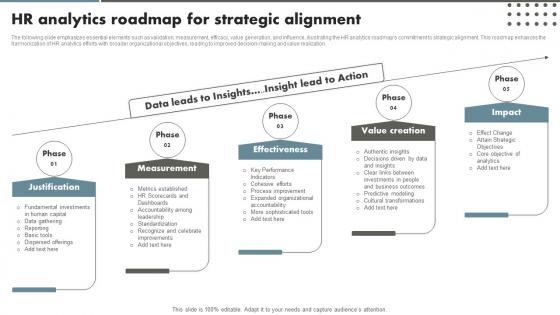
The following slide emphasizes essential elements such as validation, measurement, efficacy, value generation, and influence, illustrating the HR analytics roadmaps commitment to strategic alignment. This roadmap enhances the harmonization of HR analytics efforts with broader organizational objectives, leading to improved decision-making and value realization.
People who downloaded this PowerPoint presentation also viewed the following :
HR Analytics Roadmap For Strategic Alignment with all 9 slides:
Use our HR Analytics Roadmap For Strategic Alignment to effectively help you save your valuable time. They are readymade to fit into any presentation structure.








FAQs for HR Analytics Roadmap
HR analytics should focus on employee turnover rates, time-to-hire, employee engagement scores, performance metrics, and cost-per-hire to drive organizational success. These metrics enable organizations to streamline recruitment processes, enhance retention strategies, and optimize workforce productivity, with many companies finding that strategic HR data analysis ultimately delivers improved talent management and competitive advantage.
HR analytics improves employee retention by identifying turnover patterns, predicting at-risk employees, and analyzing engagement survey data to address root causes. Through predictive modeling and performance metrics, companies can proactively implement targeted interventions, enhance career development programs, and optimize compensation strategies, ultimately reducing turnover costs and maintaining valuable talent.
Predictive analytics enables HR teams to forecast hiring needs, identify ideal candidate profiles, and anticipate workforce gaps by analyzing historical data, market trends, and employee patterns. Through machine learning algorithms, organizations streamline recruitment processes, reduce time-to-hire, and enhance retention strategies, with many companies finding that data-driven talent decisions ultimately deliver stronger team performance and competitive advantage.
HR analytics integrates with existing HRIS systems through API connections, data warehousing solutions, cloud-based platforms, and automated data pipelines that centralize employee information. This strategic combination enables organizations to streamline reporting processes, enhance predictive modeling capabilities, and deliver real-time workforce insights, with many companies finding that integrated systems reduce manual data processing while improving strategic decision-making.
Organizations should prioritize data privacy, informed employee consent, algorithmic transparency, and bias mitigation when implementing HR analytics programs. These ethical frameworks help companies avoid discriminatory hiring practices, protect sensitive personal information, and maintain workforce trust, while ensuring analytics initiatives enhance rather than undermine employee experiences and organizational culture.
Small businesses can leverage HR analytics through affordable cloud-based platforms, basic spreadsheet analysis, and free online tools that track key metrics like turnover rates, performance indicators, and recruitment costs. By starting with simple data collection and focusing on high-impact areas like retention and productivity, these organizations streamline decision-making and enhance employee satisfaction, ultimately delivering competitive advantages without significant investment.
Organizations commonly face data quality issues, lack of analytical skills, resistance to change, inadequate technology infrastructure, and difficulty connecting metrics to business outcomes when implementing HR analytics. These challenges present both obstacles and opportunities, with many companies finding that strategic investment in training, technology upgrades, and change management ultimately delivers enhanced decision-making capabilities and competitive advantage.
HR analytics impacts employee engagement and morale by identifying satisfaction patterns, predicting turnover risks, and revealing factors affecting workplace happiness through data-driven insights. By analyzing survey responses, performance metrics, and behavioral indicators, organizations can proactively address concerns, personalize development opportunities, and create targeted retention strategies, ultimately delivering higher engagement scores and improved workplace culture.
HR analytics informs diversity and inclusion initiatives by analyzing recruitment patterns, compensation equity, promotion rates, retention data, and employee engagement scores across demographic groups. Through predictive modeling and statistical analysis, organizations can identify bias in hiring processes, address pay gaps, and track progress toward inclusion goals, while benchmarking performance against industry standards, ultimately creating more equitable workplace cultures and improving organizational outcomes.
Recommended HR analytics tools include Workday, BambooHR, Tableau, Power BI, and SAP SuccessFactors, offering comprehensive data visualization and workforce insights capabilities. These platforms streamline talent management, performance tracking, and predictive modeling, with many organizations finding that strategic integration of multiple tools delivers enhanced decision-making accuracy and operational efficiency.
HR professionals can effectively communicate analytics findings by using visual dashboards, storytelling with data, translating metrics into business outcomes, and focusing on actionable insights rather than technical processes. This approach involves creating clear charts and graphs, connecting data points to specific business challenges like retention or productivity, and presenting recommendations in terms of cost savings, efficiency gains, and strategic workforce planning, with many organizations finding that narrative-driven presentations resonate more effectively with executives and department heads.
HR analytics will increasingly integrate artificial intelligence, predictive modeling, real-time workforce monitoring, natural language processing, and advanced behavioral analytics to transform talent management. These technologies will enable organizations to predict employee turnover, optimize recruitment strategies, and personalize career development paths, while many companies find that data-driven insights ultimately deliver enhanced productivity and competitive advantage.
HR analytics supports leadership development by identifying high-potential employees through performance data, skill assessments, competency mapping, and behavioral analytics. These insights enable organizations to create targeted development programs, predict leadership readiness, and build robust succession pipelines, with many companies finding that data-driven approaches deliver stronger leadership outcomes and reduced talent gaps.
Companies like Google use HR analytics to optimize hiring through algorithmic assessments, IBM leverages predictive analytics to reduce employee turnover by 50%, and Walmart applies workforce analytics to improve scheduling efficiency and reduce labor costs. These implementations demonstrate how data-driven HR approaches streamline talent management, enhance employee retention, and deliver measurable operational improvements, with organizations increasingly finding competitive advantage through strategic people analytics.
Organizations measure HR analytics ROI by tracking key metrics like reduced turnover costs, faster hiring times, improved employee productivity, and enhanced retention rates against their analytics investment. Through dashboards and performance indicators, companies can quantify savings from better workforce decisions, streamlined recruitment processes, and strategic talent management, ultimately demonstrating measurable value and competitive advantage.
-
I want to thank SlideTeam for the work that they do, especially their customer service.
-
The way SlideTeam professionals work is exceptional. Thanks for being so helpful!