


HR Automation With Talent Acquisition





Try Before you Buy Download Free Sample Product
 Impress Your
 Audience
 100%
100% Editable
 Save Hours
 of Time


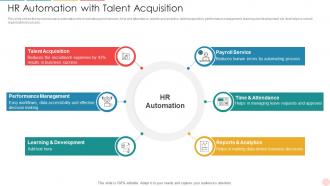
This slide shows the human resource automation which includes payroll services, time and attendance, reports and analytics, talent acquisition, performance management, learning and development, etc. that helps in overall organizational success.
People who downloaded this PowerPoint presentation also viewed the following :
HR Automation With Talent Acquisition with all 6 slides:
Use our HR Automation With Talent Acquisition to effectively help you save your valuable time. They are readymade to fit into any presentation structure.





FAQs for HR Automation
HR automation delivers enhanced efficiency, reduced administrative costs, improved compliance, faster recruitment processes, and better employee experiences through streamlined workflows. Organizations across industries find that automated systems minimize manual errors, accelerate onboarding and performance reviews, and enable HR teams to focus on strategic initiatives, ultimately delivering significant cost savings and competitive advantage.
HR automation improves employee engagement and satisfaction by streamlining routine processes, enabling faster response times, and providing self-service capabilities for common requests. Through automated onboarding, performance tracking, and feedback systems, employees experience more personalized interactions, reduced administrative delays, and greater transparency in HR processes, ultimately delivering enhanced workplace experiences and stronger organizational commitment.
Recruitment screening, payroll processing, employee onboarding, time tracking, and performance review scheduling are most effectively automated in HR operations. These automated systems streamline administrative workflows by reducing manual data entry, ensuring compliance consistency, and accelerating decision-making processes, with many organizations finding that automation delivers faster hiring cycles, improved accuracy, and enhanced employee experiences.
HR automation enhances recruitment and onboarding by streamlining candidate screening, automating interview scheduling, and accelerating background verification processes. Through AI-powered applicant tracking systems and digital onboarding platforms, companies significantly reduce time-to-hire, minimize administrative overhead, and deliver seamless new employee experiences, with many organizations finding faster integration and improved retention rates.
Artificial intelligence serves as the analytical engine of HR automation, enabling predictive analytics, natural language processing, candidate matching, performance insights, and decision support systems. Through AI-powered tools, organizations streamline recruitment processes, enhance employee engagement tracking, and automate routine administrative tasks, with many companies finding that intelligent automation delivers faster hiring cycles and improved talent retention.
Small businesses can leverage HR automation through cloud-based platforms, free or low-cost software solutions, and phased implementation strategies that prioritize high-impact areas like payroll and attendance tracking. By starting with basic automated systems for recruitment, onboarding, and performance management, small companies streamline operations while reducing administrative costs, ultimately enabling better resource allocation and competitive advantage.
Common challenges when transitioning to HR automation include employee resistance to change, data migration complexities, integration difficulties with existing systems, initial implementation costs, and ensuring compliance with regulations. While these obstacles require careful planning, organizations implementing strategic change management, comprehensive training programs, and phased rollouts find that automation ultimately delivers streamlined processes, reduced administrative burden, and enhanced employee experiences across departments.
HR automation significantly enhances compliance and risk management by standardizing processes, maintaining detailed audit trails, and ensuring consistent policy application across organizations. Through automated systems, companies minimize human errors in documentation, streamline regulatory reporting, and proactively identify compliance gaps, with many financial services and healthcare organizations finding that automated workflows ultimately deliver reduced legal risks and improved regulatory transparency.
Organizations should track metrics including time-to-hire reduction, cost-per-hire decrease, employee satisfaction scores, process completion rates, and error reduction percentages. These measurements enable HR teams to demonstrate ROI through streamlined recruitment, enhanced onboarding experiences, and improved compliance tracking, with many companies finding that automated processes deliver 40-60% efficiency gains while significantly reducing administrative overhead.
HR automation supports diversity and inclusion initiatives by removing unconscious bias from recruitment through blind resume screening, standardizing interview processes, and ensuring equitable performance evaluations. These technologies enable organizations to track diversity metrics, identify pay gaps, and create inclusive workflows across hiring, development, and retention, with many companies finding that automated systems deliver more consistent, fair outcomes while enhancing their competitive advantage in talent acquisition.
Security considerations when automating HR processes include data encryption, access controls, compliance with privacy regulations, secure authentication protocols, and regular security audits. These measures work together to protect sensitive employee information, ensuring organizations maintain trust while streamlining operations, with many companies finding that robust security frameworks ultimately enhance both efficiency and regulatory compliance.
Automated performance management systems streamline evaluation processes through real-time feedback collection, data-driven analytics, continuous goal tracking, and integrated communication tools, unlike traditional annual review cycles. These systems enable managers to identify performance trends instantly, provide timely coaching interventions, and make objective promotion decisions, ultimately delivering more consistent employee development and reducing administrative overhead.
Emerging HR automation technologies include artificial intelligence for recruitment screening, chatbots for employee inquiries, predictive analytics for workforce planning, robotic process automation for payroll processing, and machine learning for performance evaluation. These technologies streamline administrative tasks, enhance decision-making accuracy, and reduce processing times, with many organizations finding that strategic automation delivers significant cost savings while enabling HR teams to focus on strategic talent development initiatives.
HR automation benefits remote and hybrid work environments by streamlining employee onboarding, automating time tracking across different zones, and enabling seamless performance management regardless of location. These technologies enhance communication workflows, facilitate virtual collaboration, and provide real-time analytics on team productivity, with many distributed organizations finding that automated HR processes deliver consistent employee experiences and improved operational efficiency.
HR professionals need analytical thinking, data interpretation, strategic planning, change management, and emotional intelligence skills to thrive alongside automation. These competencies enable HR teams to leverage automated insights for decision-making, manage technology implementations, and focus on relationship-building and strategic initiatives, with many organizations finding that upskilled HR professionals deliver enhanced employee experiences and organizational outcomes.
-
The designs are very attractive and easy to edit. Looking forward to downloading more of your PowerPoint Presentations.
-
“Excellent information with easy access.”