

HR Team Meeting Agenda For Hiring Candidates




Try Before you Buy Download Free Sample Product
 Impress Your
 Audience
 100%
100% Editable
 Save Hours
 of Time


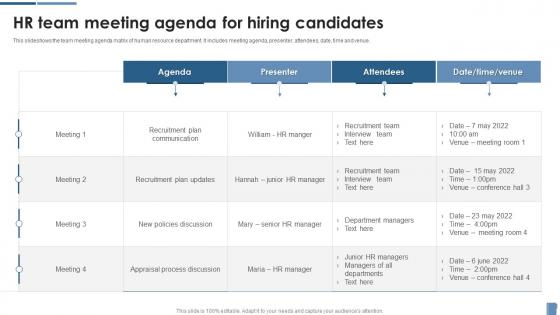
This slideshows the team meeting agenda matrix of human resource department. It includes meeting agenda, presenter, attendees, date, time and venue.
People who downloaded this PowerPoint presentation also viewed the following :
HR Team Meeting Agenda For Hiring Candidates with all 6 slides:
Use our HR Team Meeting Agenda For Hiring Candidates to effectively help you save your valuable time. They are readymade to fit into any presentation structure.






FAQs for HR Team Meeting Agenda
Key HR meeting agenda objectives include workforce planning and recruitment updates, employee performance and development discussions, compensation and benefits reviews, policy updates and compliance matters, and employee engagement initiatives. These objectives streamline organizational alignment by addressing talent acquisition needs, enhancing professional development opportunities, and ensuring regulatory compliance, with many HR departments finding that structured agendas ultimately deliver improved employee satisfaction and operational efficiency.
Ensuring inclusivity and engagement requires structured preparation, diverse communication methods, and active participation strategies like rotating speaking opportunities, anonymous feedback channels, and multilingual resources when needed. Organizations enhance meeting effectiveness by implementing pre-meeting surveys, designated discussion time for different perspectives, and follow-up mechanisms, ultimately creating more collaborative environments where all team members contribute meaningfully to HR initiatives.
Performance metrics serve as foundational data points that guide HR meeting discussions, influencing agenda items like talent retention strategies, training program effectiveness, employee engagement initiatives, and compensation reviews. These metrics enable HR teams to identify trends, address performance gaps, and allocate resources strategically, with many organizations finding that data-driven agendas ultimately deliver more targeted solutions and measurable workforce improvements.
HR meetings should typically be held weekly for core team coordination, bi-weekly for department updates, and monthly for strategic planning and policy reviews. Regular scheduling enables consistent communication, streamlined issue resolution, and proactive workforce management, with many organizations finding that structured frequency enhances team alignment while maintaining operational efficiency without overwhelming daily productivity.
**INPUT**: What are the best practices for structuring an agenda for an HR meeting? **OUTPUT**: Best practices for structuring HR meeting agendas include starting with strategic updates, addressing policy changes, reviewing performance metrics, discussing employee development initiatives, and allocating time for team feedback. This structured approach streamlines communication, enhances decision-making efficiency, and ensures comprehensive coverage of critical HR functions, with many organizations finding that well-organized agendas ultimately deliver better employee engagement and improved operational outcomes.
Technology integration in HR meetings enhances collaboration through video conferencing platforms, real-time document sharing, digital polling tools, collaborative whiteboards, and AI-powered meeting assistants. These solutions streamline communication by enabling remote participation, instant feedback collection, and automated note-taking, with many organizations finding that hybrid meeting formats ultimately deliver improved engagement and more efficient decision-making processes.
Regular HR meetings should cover routine operational topics like policy updates, compliance reviews, performance management cycles, recruitment progress, and employee engagement metrics. Special sessions should address strategic initiatives like organizational restructuring, crisis management, major policy overhauls, compensation reviews, and diversity programs, with many organizations finding that this division streamlines decision-making while ensuring critical issues receive focused attention.
Feedback from previous HR meetings informs future agendas by identifying recurring discussion themes, unresolved action items, and employee engagement patterns that require sustained attention. This strategic approach enables HR leaders to prioritize high-impact topics, allocate appropriate time blocks for complex issues, and streamline meeting efficiency, ultimately delivering more focused discussions and measurable organizational outcomes.
Strategies include setting clear time limits for each agenda item, appointing a dedicated facilitator, using structured discussion formats, implementing parking lot techniques for off-topic issues, and circulating pre-read materials beforehand. These approaches streamline meeting efficiency by minimizing digressions, maintaining productive dialogue, and ensuring comprehensive coverage of critical HR topics, with many organizations finding that structured facilitation ultimately delivers faster decision-making and improved meeting outcomes.
Prioritize HR agenda items by assessing immediate business impact, employee welfare concerns, compliance deadlines, and strategic organizational goals. Rank urgent matters like policy violations or regulatory updates first, followed by relevant topics affecting team productivity, with many organizations finding that this structured approach streamlines meetings while ensuring critical issues receive appropriate attention and resources.
Methods to facilitate open communication during HR meetings include anonymous feedback systems, structured brainstorming sessions, rotating discussion leadership, small breakout groups, and dedicated time for questions. These approaches streamline dialogue by encouraging participation from quieter team members, minimizing hierarchy barriers, and creating psychological safety, with many organizations finding that diverse communication channels ultimately deliver more honest feedback and enhanced employee engagement across departments.
Action items from previous meetings should be reviewed systematically by tracking completion status, identifying outstanding tasks, and scheduling follow-ups in a dedicated agenda section. This approach ensures accountability and continuity, with many HR teams finding that starting meetings with action item reviews enhances team productivity, streamlines decision-making processes, and ultimately delivers better project outcomes while maintaining strategic momentum across initiatives.
The ideal duration for HR meetings typically ranges from 30-60 minutes, depending on agenda complexity, with focused sessions around 45 minutes often delivering optimal engagement and decision-making outcomes. Strategic time allocation enables comprehensive discussion while maintaining participant attention, with many organizations finding that shorter, well-structured meetings enhance productivity and ensure actionable follow-through on critical initiatives.
Measuring HR meeting agenda effectiveness involves tracking participation rates, decision implementation timelines, action item completion, and participant feedback scores. Through post-meeting surveys and follow-up assessments, organizations can evaluate whether discussions achieved intended outcomes, with many HR departments finding that structured agendas ultimately deliver faster decision-making and improved employee engagement.
Common pitfalls include overloading agendas with too many topics, lacking clear time allocations, failing to prioritize urgent matters, and omitting employee feedback opportunities. These issues create unfocused discussions and rushed decision-making, while well-structured agendas with realistic timeframes, strategic priorities, and interactive elements enhance meeting productivity and employee engagement across organizations.
-
SlideTeam is very efficient when it comes to saving time. I am happy that I chose them for my presentation.
-
Helpful product design for delivering presentation.