

HRMS Software Implementation Plan Time And Attendance Management System




Try Before you Buy Download Free Sample Product
 Impress Your
 Audience
 100%
100% Editable
 Save Hours
 of Time


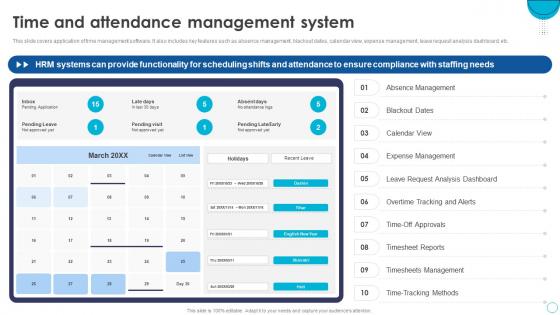
This slide covers application of time management software. It also includes key features such as absence management, blackout dates, calendar view, expense management, leave request analysis dashboard, etc.
People who downloaded this PowerPoint presentation also viewed the following :
HRMS Software Implementation Plan Time And Attendance Management System with all 9 slides:
Use our HRMS Software Implementation Plan Time And Attendance Management System to effectively help you save your valuable time. They are readymade to fit into any presentation structure.








FAQs for HRMS Software Implementation Plan Time And
HRMS implementation objectives include streamlining payroll processing, enhancing employee self-service capabilities, improving compliance tracking, centralizing talent management, and automating performance evaluations. These systems enable organizations to reduce administrative overhead, accelerate decision-making through real-time analytics, and deliver better employee experiences, with many companies finding that strategic HR automation ultimately drives operational efficiency and competitive advantage.
Current HR process architecture directly influences HRMS feature selection by determining integration requirements, workflow compatibility, data migration needs, and automation priorities. Organizations with complex approval hierarchies require robust workflow management tools, while companies with distributed teams need enhanced self-service portals and mobile accessibility, ultimately ensuring the selected features streamline existing processes rather than disrupting operational efficiency.
When choosing an HRMS vendor, consider system scalability, integration capabilities with existing infrastructure, security compliance standards, customization flexibility, and total cost of ownership including implementation expenses. Organizations should evaluate vendor support quality, user interface design, mobile accessibility, and data migration assistance, with many companies finding that comprehensive demos and reference checks from similar-sized businesses ultimately deliver the most informed selection decisions.
Effective stakeholder engagement during HRMS implementation involves regular communication, comprehensive training programs, clear role definitions, feedback collection mechanisms, and change management support. Through structured workshops and progress updates, organizations streamline adoption across departments like payroll, recruitment, and employee relations, while addressing concerns proactively, ultimately delivering smoother transitions and higher user acceptance rates.
Essential steps include analyzing current HR processes, identifying system gaps, surveying stakeholder requirements, evaluating integration capabilities, and defining success metrics. Through comprehensive workforce analysis and technology auditing, organizations streamline vendor selection, minimize implementation risks, and ensure alignment with business objectives, ultimately delivering improved employee experiences and operational efficiency.
Data integrity and security during HRMS migration are ensured through encrypted data transfer protocols, comprehensive backup systems, role-based access controls, audit trail monitoring, and phased migration testing. These measures work together by minimizing data exposure, maintaining complete transaction records, and enabling rollback capabilities, with many organizations finding that staged migrations significantly reduce risks while ensuring seamless transitions.
Training programs should include role-specific modules for HR administrators, managers, and employees, hands-on workshops covering core functions like payroll and performance management, and ongoing support sessions. These comprehensive programs enhance user adoption by providing practical experience, reducing implementation resistance, and ensuring seamless system integration, with many organizations finding that structured training significantly accelerates proficiency and operational efficiency.
HRMS success measurement includes tracking key performance indicators like reduced processing times, improved data accuracy, employee satisfaction scores, compliance audit results, and cost savings from automated workflows. These metrics enable organizations to evaluate operational efficiency gains, enhanced employee experiences, and strategic HR transformation outcomes, with many companies finding that comprehensive measurement frameworks ultimately deliver measurable ROI and competitive advantages.
Effective change management strategies include comprehensive employee training programs, clear communication channels, phased rollout approaches, dedicated support teams, and regular feedback collection mechanisms. These strategies streamline adoption by addressing resistance proactively, ensuring user competency, and maintaining operational continuity, with many organizations finding that early stakeholder engagement and transparent progress updates ultimately deliver higher acceptance rates and faster implementation success.
Automation will streamline HR operations by digitizing recruitment workflows, automating payroll processing, enabling self-service employee portals, and providing real-time analytics for decision-making. Through intelligent automation, organizations can reduce administrative overhead, minimize processing errors, and accelerate routine tasks, ultimately delivering faster employee services and enhanced operational efficiency across departments.
HRMS customization involves configuring workflows, approval hierarchies, performance metrics, communication templates, and policy frameworks to reflect your organizational values and cultural practices. Through flexible module settings, custom fields, and automated processes, organizations can embed their unique leadership styles, recognition programs, and collaboration approaches, ultimately delivering personalized employee experiences that reinforce company culture while streamlining HR operations.
HRMS implementation risks include data migration errors, employee resistance, system downtime, budget overruns, and inadequate training programs. Organizations mitigate these challenges through phased rollouts, comprehensive change management strategies, robust backup protocols, and extensive staff training, with many companies finding that early stakeholder engagement and thorough testing ultimately deliver smoother transitions and higher adoption rates.
HRMS ensures labor law compliance through automated policy enforcement, real-time regulatory updates, comprehensive audit trails, and built-in compliance monitoring across payroll, benefits, and employment practices. These systems streamline compliance management by tracking regulatory changes, generating required reports, and maintaining detailed documentation, with many organizations finding that automated compliance reduces legal risks while enhancing operational efficiency.
Ongoing HRMS support should include dedicated technical support teams, regular software updates, comprehensive user training programs, detailed documentation, and access to vendor expertise. Organizations typically benefit from establishing internal IT support, scheduling routine system maintenance, providing continuous employee education, and maintaining strong vendor relationships, ultimately ensuring optimal system performance, user adoption, and long-term operational efficiency.
User feedback can be integrated through regular surveys, focus groups, analytics monitoring, helpdesk ticket analysis, and structured feedback sessions with department representatives. These mechanisms enable organizations to identify pain points, prioritize feature requests, and streamline system functionality, with many companies finding that continuous user input ultimately delivers enhanced employee satisfaction and operational efficiency.
-
The best and engaging collection of PPTs I’ve seen so far. Great work!
-
The presentations are very helpful. I am always able to get appropriate templates for the different topics related to my profession.