

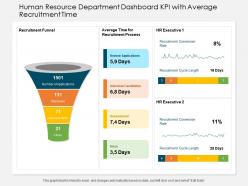
Human resource department dashboard kpi with average recruitment time





Try Before you Buy Download Free Sample Product
 Impress Your
Audience
 100%
Editable
 Save Hours
of Time


Our Human Resource Department Dashboard KPI With Average Recruitment Time are topically designed to provide an attractive backdrop to any subject. Use them to look like a presentation pro.
People who downloaded this PowerPoint presentation also viewed the following :
Human resource department dashboard kpi with average recruitment time with all 2 slides:
Use our Human Resource Department Dashboard KPI With Average Recruitment Time to effectively help you save your valuable time. They are readymade to fit into any presentation structure.

FAQs for Human resource department dashboard kpi with
Time-to-fill, cost-per-hire, and quality of hire are your big three - they'll show you exactly how your recruitment's performing. Offer acceptance rate matters too, plus tracking which sources actually bring good candidates (not just any candidates). Don't go overboard measuring every tiny thing though. I've seen teams get stuck in spreadsheet hell doing that. Start with these basics, track them consistently for maybe 3-4 months, and you'll spot the real problems fast. Where you're wasting time, where money's disappearing - it becomes pretty obvious once you have the data.
Look, slow hiring is literally costing you money every day - lost productivity, overtime for your exhausted team, missed revenue from empty seats. Candidates hate it too. Nobody's sitting around for weeks waiting to hear back from you (well, maybe they used to, but not anymore). Top people will assume you're disorganized and bail. Here's what actually works: track your average time-to-fill by department first. Then figure out where things get stuck - that's usually where the magic happens. Set realistic targets, but honestly, just fixing your biggest bottlenecks will make a huge difference.
So cost-per-hire is just tracking how much you spend to fill each job. Take all your recruiting costs - job postings, recruiter pay, interview stuff - then divide by however many people you actually hired. Pretty straightforward math. I was shocked when I first calculated ours, honestly way higher than expected! Lower numbers usually mean you're being efficient, but don't sacrifice good candidates just to save money. Monthly tracking helps, and comparing different departments shows you where money's disappearing. Time-to-fill matters too since dragging out hiring gets expensive fast.
Look, quality of hire metrics are huge for figuring out if your hiring actually works long-term. You're basically measuring whether new employees perform well, stick around, and fit your culture. Most companies mess this up by tracking useless stuff at first though. Focus on 90-day performance reviews, 12-month retention rates, and how happy managers are with their new hires. This shows you which sourcing channels and interview processes actually deliver results - not just the ones that sound good on paper. It's way better than just filling open positions and hoping for the best.
Honestly, forget just counting how many resumes each source brings in - that's pretty useless. Track the stuff that actually matters: acceptance rates, how fast you're hiring, and whether people stick around after 90 days. LinkedIn floods you with applications, but if your referral program keeps people for years? That's gold right there. Cost-per-hire is huge too. Some pricier channels end up being way more worth it long-term. Focus your energy on whatever's working best. Try new sources every few months though - you never know what might surprise you. Just make sure you're tracking everything properly so you can spot the patterns.
Honestly, start with your ATS - most can pull these reports automatically which saves you tons of time. Set targets for underrepresented groups at every hiring stage, not just final numbers. Track your diversity ratios in the pipeline, how conversion rates differ by demographic, and whether certain groups take longer to hire. First step is figuring out your current baseline percentages, then set realistic goals from there. I'd check monthly and tweak your sourcing if you're missing targets. The interview-to-offer rates are usually where you'll spot the biggest issues, in my experience. It's definitely data-heavy but worth it.
So basically, this ratio tells you how many interviews it takes before you actually make an offer to someone. Like, are you interviewing 10 people or just 3? Makes a huge difference. If your number's really high, you're probably not screening well enough upfront - or maybe your standards are just insane. Low ratios might mean you're being too picky during initial screening. I'd shoot for around 3-5 interviews per offer, though honestly that depends on how specialized the role is. Track it over a few months and you'll start seeing where things get stuck in your process.
Look, retention rates tell you if your hiring process actually works or if you're just filling chairs. When people bail after a few months, your job descriptions probably suck or you're screening for the wrong stuff. Track it at 90 days, 6 months, and a year - you'll start seeing patterns. Honestly, amazing hiring speed means nothing if half your team quits by month six. Use that data to fix how you're presenting roles and who you're targeting. It's way better than scrambling to backfill positions constantly.
Dude, candidate experience literally affects everything in recruiting. Bad experience? Your offer acceptance rates plummet and time-to-fill goes through the roof because people talk. Plus your employer brand takes a beating and cost-per-hire skyrockets since you're constantly hunting for new people. But nail the candidate experience and you'll see more referrals (which are honestly the best hires anyway), better Glassdoor reviews, and people who actually want to join your team. I always tell people to track candidate satisfaction scores - they're like a crystal ball for how your other metrics will look.
Honestly, recruitment funnel metrics are a game changer - they show you exactly where people are bailing. Like if you're getting flooded with applications but nobody's making it to phone screens? Your initial screening's way too picky. People dropping off after first interviews is even worse - that screams problems with your process or you're taking forever to follow up. Track conversion rates at every step: applications to screenings, screenings to interviews, all that stuff. Once you spot the pattern (and there's always a pattern), you can actually figure out what's broken and fix it instead of just wondering why nobody wants to work there.
Look, there's really no magic formula for this stuff. Your benchmarks totally depend on your industry and company size. That said, most places shoot for 30-45 days to fill positions, maybe $3-5K per hire (though that varies like crazy by role), and you want about 90% of new people hitting their targets after 6 months. Don't obsess over those "industry standard" articles you see everywhere - half of them are BS anyway. Track what you're doing now for a couple months first. Then set goals that actually make sense for your situation, not some consultant's spreadsheet.
Oh man, ATS systems are total game changers for this stuff. No more digging through random spreadsheets trying to figure out your time-to-hire - it just pulls everything automatically. You'll get these dashboards that actually show you which job boards are worth the money and where candidates are getting stuck. Real-time reporting is clutch too, saves you from doing those awful monthly manual reports. Though honestly, the setup can be a bit of a pain at first. I'd pick your top 3-4 metrics before you even start configuring anything, makes the whole process way smoother.
Ditch the spreadsheet dumps - nobody reads those anyway. Visual dashboards are where it's at. Show trends over time instead of just static numbers, and always add context like "vs last quarter" so people actually understand what they're looking at. Color coding saves your life here - red/yellow/green makes everything scannable in seconds. Different audiences need different views too. Your CEO wants the big picture, but your team needs all the nitty-gritty details. Oh, and automate data collection wherever you can. Trust me, you don't want to be manually updating reports every single week.
So I'd check your recruitment KPIs monthly but only change them quarterly - unless your hiring strategy does a complete 180 or something. Monthly reviews catch problems early, like when time-to-fill goes crazy or you're getting terrible candidates. We totally missed red flags for three months once and it was a disaster lol. Don't mess with the actual KPIs too much though. You need consistent data to spot real trends. Quarterly tweaks give changes enough time to actually work. Oh and set up those recurring calendar reminders now because you'll definitely forget otherwise!
Dude, stakeholder feedback is pure gold for fixing your recruitment KPIs. Hit up your hiring managers first - ask if your current metrics actually predict who'll be good at the job. Candidates can tell you if your satisfaction scores make sense based on their actual experience. Your HR team knows what data helps them make real decisions versus what just looks pretty in reports. Oh, and don't forget new hires after they've been around six months - they'll tell you what the whole process missed. Just make sure you're actually using their feedback to change things, not just collecting it because you're "supposed to."
-
Helpful product design for delivering presentation.
-
Use of icon with content is very relateable, informative and appealing.
-
Thanks for all your great templates they have saved me lots of time and accelerate my presentations. Great product, keep them up!
-
Content of slide is easy to understand and edit.