

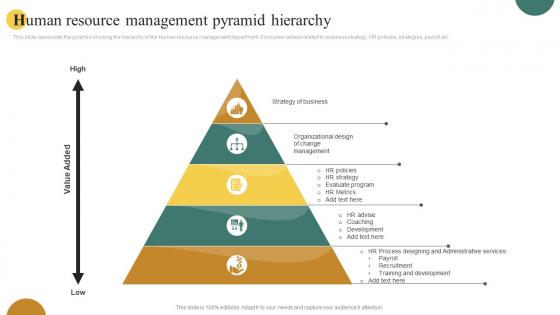
Human Resource Management Pyramid Hierarchy




Try Before you Buy Download Free Sample Product
 Impress Your
 Audience
 100%
100% Editable
 Save Hours
 of Time


This slide represents the pyramid showing the hierarchy of the human resource management department. It includes details related to business strategy, HR policies, strategies, payroll etc.
People who downloaded this PowerPoint presentation also viewed the following :
Human Resource Management Pyramid Hierarchy with all 6 slides:
Use our Human Resource Management Pyramid Hierarchy to effectively help you save your valuable time. They are readymade to fit into any presentation structure.





FAQs for Human Resource
Human Resource Managers handle talent acquisition, employee development, performance management, compensation planning, and organizational culture initiatives in modern corporations. Through strategic workforce planning and data-driven decision making, they enhance operational efficiency, reduce turnover costs, and improve employee satisfaction, with many organizations finding that effective HR leadership ultimately delivers competitive advantage and sustainable business growth.
HR analytics improves employee performance and satisfaction by identifying skill gaps, predicting turnover risks, personalizing development paths, and measuring engagement drivers through comprehensive data analysis. Through predictive modeling and performance dashboards, organizations streamline talent management, enhance retention strategies, and deliver targeted interventions, with many companies finding that data-driven HR approaches ultimately reduce costs while significantly boosting productivity and employee experiences.
Effective talent acquisition strategies include employer branding enhancement, competitive compensation packages, streamlined recruitment processes, employee referral programs, and strategic social media outreach. These approaches enable organizations to attract top candidates by showcasing company culture, offering market-competitive benefits, and reducing hiring timelines, with many companies finding that strong employer brands significantly increase qualified applicant pools and reduce recruitment costs.
Organizational culture significantly impacts employee engagement and retention by establishing shared values, communication practices, recognition systems, and growth opportunities that directly influence job satisfaction. Companies with strong, positive cultures, such as those in tech and healthcare sectors, experience higher productivity, lower turnover rates, and enhanced talent attraction, ultimately delivering competitive advantage through improved workforce stability.
HR professionals must consider equal employment opportunity laws, anti-discrimination regulations, background check compliance, wage and hour requirements, and data privacy protections during hiring. These legal frameworks help organizations avoid costly litigation, ensure fair candidate treatment, and maintain regulatory compliance, with many companies finding that proactive legal adherence ultimately enhances their employer brand and competitive talent acquisition.
Technology enhances HR efficiency by automating administrative tasks, centralizing employee data, and streamlining communication workflows. Through digital onboarding platforms and AI-powered recruitment tools, organizations deliver faster hiring processes, personalized employee experiences, and seamless integration of new hires, with many companies finding significantly reduced paperwork and improved retention rates.
HR can implement comprehensive diversity and inclusion strategies through targeted recruitment practices, unconscious bias training, inclusive leadership development, mentorship programs, and equitable performance evaluation systems. These approaches work by expanding talent pipelines, fostering cultural awareness, and creating psychological safety, with many organizations finding that such initiatives enhance innovation, employee engagement, and ultimately deliver stronger business performance and competitive advantage.
Performance management systems align with organizational goals by establishing clear KPIs, linking individual objectives to strategic priorities, implementing regular feedback cycles, and creating transparent evaluation criteria. These systems enhance accountability and productivity by connecting employee performance directly to business outcomes, enabling organizations to track progress systematically while fostering employee development that drives competitive advantage.
Effective employee training programs include needs assessment, personalized learning paths, blended delivery methods, practical application opportunities, and continuous evaluation mechanisms. These approaches enhance workforce capabilities by improving skill retention, accelerating onboarding processes, and boosting employee engagement, with many organizations finding that strategic training investments deliver measurable productivity gains and competitive advantage.
HR contributes to crisis management through clear communication strategies, flexible work arrangements, mental health resources, emergency response protocols, and workforce continuity planning. During challenging times like economic downturns or global disruptions, organizations find that strategic HR support enables faster adaptation, maintains employee morale, and ultimately delivers organizational resilience while preserving competitive talent advantage.
Major trends shaping HR's future include AI-powered recruitment, remote work management, employee experience platforms, data-driven performance analytics, and personalized learning systems. These technologies streamline talent acquisition, enhance workforce flexibility, and deliver predictive insights, with many organizations finding that strategic HR automation reduces operational costs while improving employee satisfaction and retention rates.
Organizations measure HR ROI by tracking metrics like cost per hire, employee turnover rates, productivity improvements, training effectiveness scores, and revenue per employee against program costs. Through data analytics platforms, companies calculate specific returns—reduced recruitment expenses, decreased absenteeism, enhanced performance ratings—with many finding that strategic HR investments deliver 300-400% returns while strengthening competitive advantage.
HR fosters continuous feedback culture by implementing regular check-ins, establishing clear communication channels, training managers on effective feedback delivery, and creating systems for peer-to-peer recognition. Through these initiatives, organizations streamline performance discussions, enhance employee engagement, and accelerate professional development, with many companies finding that structured feedback processes ultimately deliver higher retention rates and improved productivity.
HR professionals navigate remote work complexities by establishing clear communication protocols, implementing robust digital collaboration tools, creating structured performance metrics, and developing comprehensive virtual onboarding processes. These strategies enable organizations to maintain team cohesion, ensure accountability, and preserve company culture across distributed workforces, with many companies finding that strategic remote work policies ultimately enhance employee satisfaction while reducing operational costs.
Employer branding techniques include showcasing company culture through authentic employee testimonials, leveraging social media platforms for recruitment storytelling, offering competitive compensation packages, creating engaging candidate experiences, and highlighting growth opportunities. These strategies enhance organizational reputation by building trust, demonstrating values, and differentiating from competitors, with many companies finding that strong employer branding reduces hiring costs while attracting higher-quality candidates.
-
You guys are life-saver when it comes to presentations. Honestly I cannot do much without your services. Thank you!!!
-
The visual appeal of the templates is just unparalleled! I was so worried about the design of my presentation but SlideTeam made it all so easy.