

Human Resource Management Strategic Planning Process




Try Before you Buy Download Free Sample Product
 Impress Your
 Audience
 100%
100% Editable
 Save Hours
 of Time


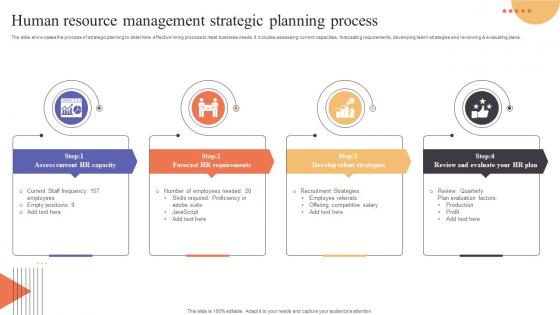
The slide showcases the process of strategic planning to determine effective hiring process to meet business needs. It includes assessing current capacities, forecasting requirements, developing talent strategies and reviewing and evaluating plans.
People who downloaded this PowerPoint presentation also viewed the following :
Human Resource Management Strategic Planning Process with all 6 slides:
Use our Human Resource Management Strategic Planning Process to effectively help you save your valuable time. They are readymade to fit into any presentation structure.





FAQs for Human Resource Management
Effective HRM strategic planning includes workforce analysis, talent acquisition strategies, succession planning, performance management systems, and compensation frameworks. These components work together by aligning human capital with business objectives, identifying skill gaps, and developing targeted recruitment approaches, with many organizations finding that strategic HR integration delivers improved employee retention, enhanced productivity, and sustainable competitive advantage.
HRM aligns with business strategy by integrating talent management with organizational objectives, developing workforce capabilities that support strategic goals, and creating performance metrics that measure strategic outcomes. Through strategic workforce planning, competency-based hiring, and leadership development programs, organizations enhance operational efficiency, employee engagement, and competitive positioning, ultimately delivering sustainable growth and improved organizational performance.
Workforce analytics enables HRM strategic planning by providing data-driven insights into employee performance, retention patterns, skill gaps, and compensation benchmarks. Through predictive modeling and comprehensive data analysis, organizations can optimize talent acquisition, enhance workforce development, and align human capital strategies with business objectives, ultimately delivering improved operational efficiency and competitive advantage in talent management.
Organizations assess talent needs through comprehensive workforce analytics, skills gap analysis, succession planning evaluations, and future role mapping aligned with strategic objectives. By analyzing current capabilities against projected requirements, companies can identify critical talent shortages, determine training investments, and develop targeted recruitment strategies, with many finding that proactive talent assessment significantly enhances organizational agility and competitive positioning.
HR professionals encounter challenges including resistance to change, limited budget allocation, misalignment between HR objectives and business goals, inadequate technology infrastructure, and insufficient stakeholder buy-in. These obstacles often stem from competing organizational priorities, resource constraints, and communication gaps, with many companies finding that successful implementation requires strong leadership support, clear metrics, and phased approaches that demonstrate measurable value.
Technology revolutionizes HRM strategic planning by enabling data-driven workforce analytics, automating recruitment processes, and facilitating predictive modeling for talent management. Through AI-powered platforms, HR teams streamline succession planning, enhance employee engagement tracking, and optimize resource allocation, with many organizations finding that these digital tools deliver faster decision-making and competitive talent advantages.
Essential HRM strategy metrics include employee retention rates, time-to-fill positions, employee engagement scores, training ROI, and performance management effectiveness. These metrics enable organizations to streamline talent acquisition, enhance workforce productivity, and minimize turnover costs, with many companies finding that comprehensive measurement ultimately delivers competitive advantage and improved operational efficiency.
HRM strategies adapt to remote or hybrid workforces by implementing digital performance management systems, establishing clear communication protocols, and creating virtual engagement initiatives. These approaches enhance flexibility through cloud-based HR platforms, structured check-ins, and online collaboration tools, with many organizations finding that strategic remote policies ultimately deliver improved work-life balance and broader talent acquisition opportunities.
Stakeholder engagement ensures HRM strategic planning aligns with organizational goals, employee needs, and operational realities through comprehensive input from leadership, managers, and staff representatives. This collaborative approach enhances buy-in, identifies potential implementation challenges early, and creates more effective policies, with many organizations finding that engaged stakeholders deliver stronger adoption rates and sustainable HR outcomes.
Global trends significantly impact HRM strategic planning through remote work normalization, AI-driven recruitment processes, evolving employee expectations around flexibility, and increasing emphasis on diversity and inclusion initiatives. These shifts require HR leaders to redesign talent acquisition strategies, implement digital collaboration tools, and develop adaptive workforce policies, with many organizations finding that proactive trend integration delivers competitive advantage in attracting top talent.
HRM continuous improvement cultures thrive through regular performance feedback systems, cross-functional collaboration initiatives, data-driven decision making, employee-led innovation programs, and structured learning opportunities. These practices streamline talent development by encouraging knowledge sharing, enhancing skill building, and promoting adaptability, with many organizations finding that empowered employees drive significant operational efficiency and sustained competitive advantage.
Diversity and inclusion initiatives integrate into HRM strategic plans through targeted recruitment strategies, inclusive leadership development programs, bias-free performance management systems, and comprehensive cultural competency training. These approaches enhance organizational innovation, improve employee engagement, and expand talent pools, with companies like Microsoft and Johnson & Johnson finding that strategic D&I integration delivers measurable improvements in retention rates and market competitiveness.
Employee feedback serves as a critical foundation for HRM strategic planning by identifying skill gaps, revealing retention challenges, uncovering workplace culture issues, and highlighting development opportunities. This input enables HR teams to design targeted recruitment strategies, enhance employee engagement programs, and optimize talent management approaches, with many organizations finding that feedback-driven strategies significantly improve retention rates and operational efficiency.
Crisis management strategies can be incorporated into HRM planning through developing contingency staffing models, establishing remote work protocols, creating cross-training programs, and implementing flexible resource allocation frameworks. These approaches enable organizations to maintain operational continuity during disruptions, with many companies finding that proactive crisis planning enhances workforce resilience, accelerates recovery times, and ultimately delivers competitive advantage through adaptable human capital management.
Leadership development significantly enhances HRM strategy effectiveness by improving talent retention, succession planning, employee engagement, and organizational adaptability. Through structured leadership programs, companies streamline workforce management, accelerate decision-making processes, and build stronger management capabilities, with many organizations finding that well-developed leaders drive better HR outcomes and sustainable competitive advantage.
-
Thanks for all your great templates they have saved me lots of time and accelerate my presentations. Great product, keep them up!
-
“Excellent information with easy access.”