

Implementing Agile Marketing In Your Organization Complete Deck





Try Before you Buy Download Free Sample Product
 Impress Your
 Audience
 100%
100% Editable
 Save Hours
 of Time


Download our Agile Marketing PowerPoint presentation to learn about this new approach to marketing that takes inspiration from Agile software development. It is marked by quick response to changes, testing, data and rapid iterations, empowered teams, shared accountability, cross functional collaboration, and customer focus. The deck is extensively researched by our market researchers and covers the principles of agile marketing and the methodology. It begins by setting up an agile marketing team that includes team members from different departments to break down silos. The team identifies the most important projects that need attention, develop campaigns, and execute strategies to quickly achieve the set goals. Also known as scrum marketing, the marketing approach involves working in short sprints often two week sprints to execute the campaign. Daily standup meetings to review work done, work being done and work finished are an integral part of this approach. You need to have with you an agile story template, agile workflow template, sprint template, Kanban template, and more to smoothly implement agile marketing in your organization. Our scrum marketing PPT covers all these sections thoroughly and give you a perfect starting point to help your organization switch from traditional marketing to this tactical approach and achieve marketing results faster and better.
People who downloaded this PowerPoint presentation also viewed the following :
Content of this Powerpoint Presentation
Slide 1: This slide introduces Implementing Agile Marketing in Your Organization. State your Company name and begin.
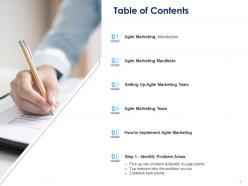
Slide 2: This slide displays Table of Contents of the presentation.
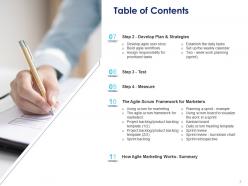
Slide 3: This slide displays Table of Contents of the presentation.
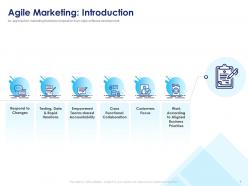
Slide 4: This slide represents Agile Marketing: Introduction
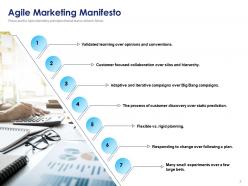
Slide 5: This slide depicts Agile Marketing Manifesto.
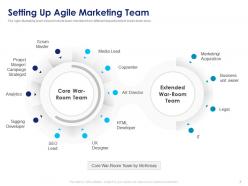
Slide 6: This slide shows Setting Up Agile Marketing Team. The Agile Marketing team should include team members from different departments to break down silos.
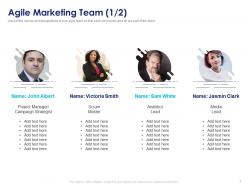
Slide 7: This slide displays Agile Marketing Team.
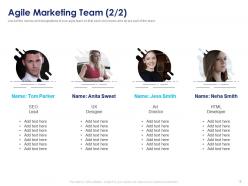
Slide 8: This slide depicts Agile Marketing Team.
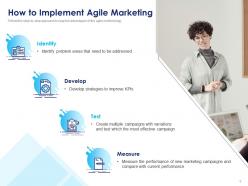
Slide 9: This slide describes How to Implement Agile Marketing. Follow this step-by-step approach to reap full advantages of the agile methodology.
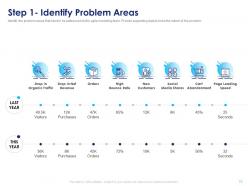
Slide 10: This slide depicts Step 1- Identify Problem Areas. Identify the problem areas that need to be addressed by the agile marketing team. Provide supporting data to know the extent of the problem.
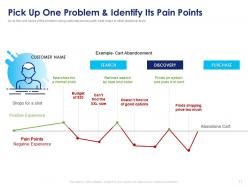
Slide 11: This slide shows to Pick Up One Problem & Identify Its Pain Points
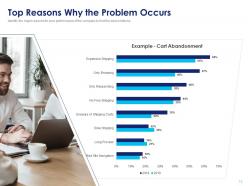
Slide 12: This slide presents Top Reasons Why the Problem Occurs. Identify the major reasons for poor performance of the company to find the best solutions.
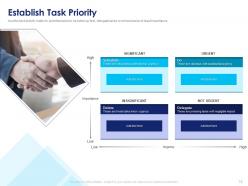
Slide 13: This slide showcases to Establish Task Priority
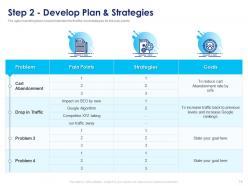
Slide 14: This slide displays Step 2 - Develop Plan & Strategies.
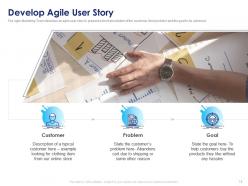
Slide 15: This slide describes to Develop Agile User Story.
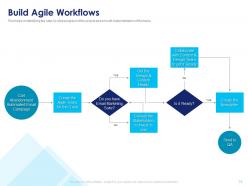
Slide 16: This slide showcases Build Agile Workflows. This helps in identifying the step-by-step progress of the project and smooth implementation of the tasks.
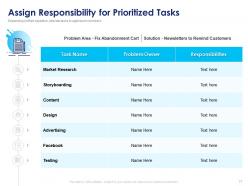
Slide 17: This slide showcases to Assign Responsibility for Prioritized Tasks.
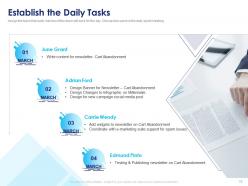
Slide 18: This slide describes to Establish the Daily Tasks.
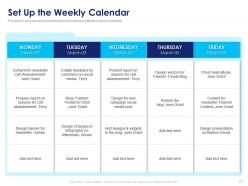
Slide 19: This slide depicts Set Up the Weekly Calendar.
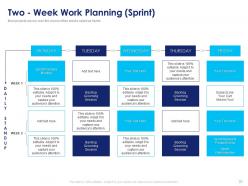
Slide 20: This slide displays Two - Week Work Planning.
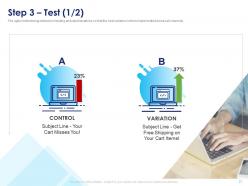
Slide 21: This slide depicts Step 3 – Test describing Variation and Control.
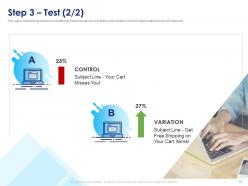
Slide 22: This slide depicts Step 3 – Test with Control and Variation.
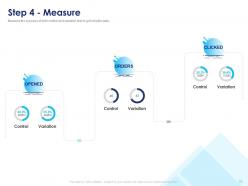
Slide 23: This slide displays Step 4 - Measure. Measure the success of both control and variation test to get reliable data.
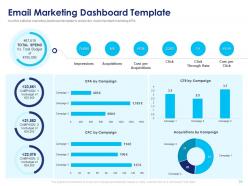
Slide 24: This slide dispays Email Marketing Dashboard Template.
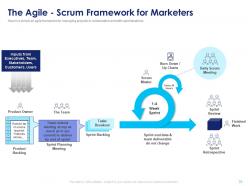
Slide 25: This slide presents Using Scrum for Marketing.
Slide 26: This slide showcases Daily Scrum Meeting.
Slide 27: This slide displays Black Friday Campaign.
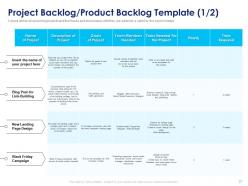
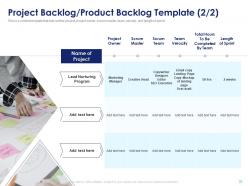
Slide 28: This slide displays Project Backlog/Product Backlog Template.
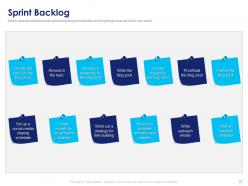
Slide 29: This slide showcases Sprint Backlog.
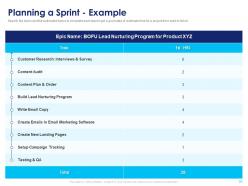
Slide 30: This slide showcases to Plan a Sprint - Example.
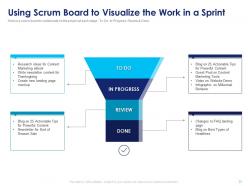
Slide 31: This slide depicts Using Scrum Board to Visualize the Work in a Sprint.
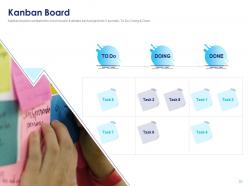
Slide 32: This slide displays Kanban Board.
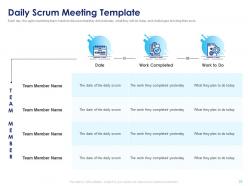
Slide 33: This slide showcases Daily Scrum Meeting Template. Each day, the agile marketing team meets to discuss what they did yesterday, what they will do today and challenges blocking their work.
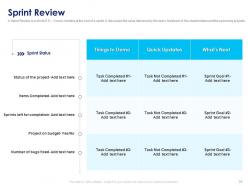
Slide 34: This slide shows Sprint Review. It discusses the value delivered by the team, feedback of the stakeholders and the upcoming projects.
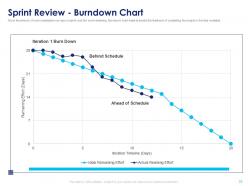
Slide 35: This slide displays Sprint Review - Burndown Chart.
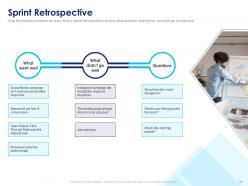
Slide 36: This slide displays Sprint Retrospective.
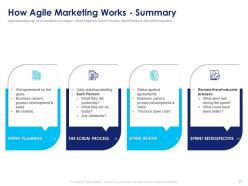
Slide 37: This slide showcases How Agile Marketing Works with Summary.
Slide 38: This is Icons Slide for Implementing Agile Marketing in Your Organization.
Slide 39: This slide is titled as Additional Slides for moving forward.
Slide 40: This is Agenda slide. State your agendas here.
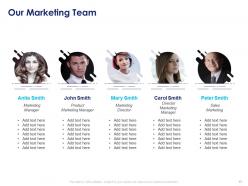
Slide 41: This slide depicts Our Marketing Team with names and designation.
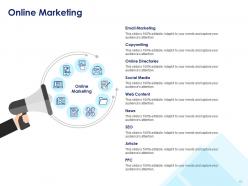
Slide 42: This slide displays Online Marketing with- Email Marketing, Copywriting, Web Content, SEO, Article, PPC, News, Social Media, Online Directories, Online Marketing.
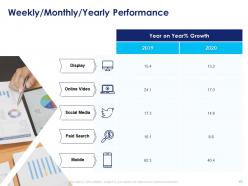
Slide 43: This slide depicts Weekly/Monthly/Yearly Performance.
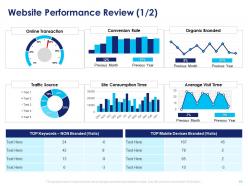
Slide 44: This slide shows Website Performance Review.
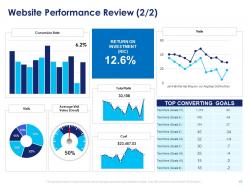
Slide 45: This slide showcases Website Performance Review.
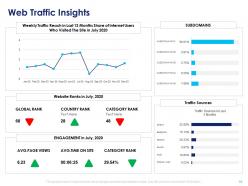
Slide 46: This slide depicts Web Traffic Insights.
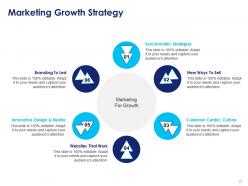
Slide 47: This slide represents Marketing Growth Strategy.
Slide 48: This is Thank You slide with Address, Email address and Contact number.
Implementing Agile Marketing In Your Organization Complete Deck with all 48 slides:
Use our Implementing Agile Marketing In Your Organization Complete Deck to effectively help you save your valuable time. They are readymade to fit into any presentation structure.


FAQs for Implementing Agile Marketing In Your
Agile Marketing emphasizes iterative campaigns, cross-functional collaboration, customer-centric approaches, data-driven decision making, and rapid adaptation to market changes, contrasting with traditional marketing's rigid annual planning cycles. Through sprint-based methodologies and continuous testing, organizations streamline campaign development, enhance customer responsiveness, and deliver faster time-to-market, with many companies finding significantly improved ROI and competitive advantage.
Agile Marketing improves team collaboration through cross-functional sprints, daily standups, and iterative feedback loops that eliminate communication silos and accelerate decision-making. By implementing these frameworks, marketing teams achieve faster campaign launches, enhanced creative alignment, and real-time performance optimization, with many organizations finding that collaborative workflows reduce project timelines by 30-40% while improving overall campaign effectiveness.
Essential Agile Marketing tools include project management platforms like Jira and Trello, collaboration software such as Slack and Microsoft Teams, analytics dashboards, content management systems, and automation platforms like HubSpot or Marketo. These technologies streamline campaign planning, enhance cross-functional communication, and enable rapid iteration, with many marketing teams finding that integrated toolsets significantly accelerate campaign delivery and improve performance tracking.
Agile Marketing success is measured through velocity metrics like sprint completion rates, customer engagement scores, conversion rates, time-to-market improvements, and iterative performance gains from campaign testing cycles. These KPIs enable marketing teams to track real-time campaign effectiveness, optimize resource allocation, and deliver faster customer acquisition, with many organizations finding that prioritizing lead quality over quantity ultimately drives higher ROI and sustainable growth.
Customer feedback serves as the primary driver for iterative improvements, campaign optimization, and strategic pivots in Agile Marketing, enabling teams to rapidly test hypotheses, measure real-world responses, and adjust messaging or targeting accordingly. Through continuous feedback loops, marketing teams can streamline campaign performance, enhance customer experiences, and minimize resource waste, with many organizations finding that this data-driven approach ultimately delivers higher conversion rates and stronger competitive advantage.
Agile Marketing adapts through iterative campaign development, real-time data analysis, cross-functional collaboration, and rapid testing protocols that enable quick pivots when market conditions shift. Through sprint-based planning and continuous feedback loops, marketing teams can adjust messaging, channels, and targeting within weeks rather than months, ultimately delivering more responsive customer experiences and competitive positioning in volatile markets.
Common Agile Marketing adoption challenges include resistance to change, lack of cross-functional collaboration, insufficient training, misaligned stakeholder expectations, and difficulty measuring iterative results. While these obstacles can initially slow implementation, organizations increasingly find that addressing cultural shifts, investing in proper training, and establishing clear communication channels ultimately delivers enhanced campaign flexibility, faster time-to-market, and improved customer responsiveness.
Marketing teams foster continuous improvement through regular retrospectives, sprint reviews, and data-driven feedback loops that identify optimization opportunities and refine strategies. By implementing cross-functional collaboration, A/B testing protocols, and performance metrics analysis, teams streamline campaign effectiveness, enhance customer engagement, and accelerate time-to-market, ultimately delivering measurable ROI improvements and competitive advantage.
Best practices for Agile marketing sprints include defining clear sprint goals, maintaining 1-2 week iteration cycles, conducting daily standups, prioritizing high-impact campaigns, and performing retrospective reviews after each sprint. These practices enable marketing teams to adapt quickly to market changes, test campaign effectiveness in real-time, and optimize resource allocation, ultimately delivering faster campaign launches and improved ROI.
Agile Marketing aligns with business objectives through iterative campaign development, data-driven decision making, cross-functional collaboration, and rapid response to market changes. This strategic approach enables organizations to optimize resource allocation, accelerate time-to-market, and enhance customer engagement, with many companies finding that agile methodologies deliver measurable ROI improvements and competitive advantage.
Agile marketing teams use methods like MoSCoW prioritization, value-based scoring matrices, customer impact assessments, sprint backlog ranking, and ROI-focused frameworks to prioritize tasks and campaigns. These approaches enable marketers to focus resources on high-impact initiatives, respond quickly to market changes, and deliver measurable results, with many organizations finding that systematic prioritization improves campaign effectiveness and resource allocation.
Agile Marketing transforms budgeting by enabling flexible resource allocation through shorter sprint cycles, iterative campaign testing, and real-time performance adjustments based on data insights. This approach allows marketing teams to shift budgets toward high-performing initiatives while minimizing waste on underperforming campaigns, ultimately delivering improved ROI and faster market responsiveness.
Cross-functional teams benefit from Agile Marketing through enhanced collaboration, diverse skill integration, continuous learning opportunities, and accelerated knowledge transfer across departments. These collaborative sprints enable marketing professionals to gain technical insights from developers, while IT teams understand customer personas, ultimately delivering more cohesive campaigns and fostering organizational agility that strengthens competitive positioning.
Successful Agile Marketing implementations include Spotify's rapid campaign iterations, ING Bank's cross-functional marketing teams, and Coca-Cola's real-time content optimization strategies. These brands streamline campaign development, enhance customer responsiveness, and accelerate time-to-market through iterative testing, collaborative workflows, and data-driven pivots, ultimately delivering increased engagement rates and competitive advantage in dynamic markets.
Agile Marketing facilitates better personalization by enabling rapid testing, iterative campaign optimization, and real-time data analysis to understand consumer preferences and behaviors. Through continuous feedback loops and sprint-based executions, marketing teams can quickly adjust messaging, segment audiences more precisely, and deliver targeted content that resonates, ultimately enhancing customer engagement and conversion rates.
-
It saves your time and decrease your efforts in half.
-
Nice and innovative design.
-
Colors used are bright and distinctive.