

Implementing Quality Assurance Transformation Qa Transformation Dashboard Test





Try Before you Buy Download Free Sample Product
 Impress Your
Audience
 100%
Editable
 Save Hours
of Time


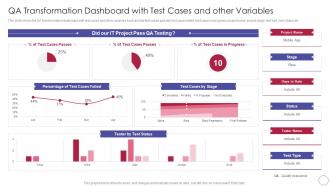
This slide shows the QA transformation dashboard with test cases and other variables such as total test cases passed, test cases failed, test cases in progress, project name, project stage, test type, test status etc.
People who downloaded this PowerPoint presentation also viewed the following :
Implementing Quality Assurance Transformation Qa Transformation Dashboard Test with all 7 slides:
Use our Implementing Quality Assurance Transformation Qa Transformation Dashboard Test to effectively help you save your valuable time. They are readymade to fit into any presentation structure.






FAQs for Implementing Quality Assurance Transformation Qa
Key drivers behind QA transformation include digital acceleration, customer experience demands, competitive pressures, regulatory compliance requirements, and cost optimization needs. These factors compel organizations to modernize testing approaches through automation, AI-driven testing, and continuous integration practices, with many financial services and healthcare institutions finding that streamlined QA processes deliver faster time-to-market and enhanced product reliability.
Automation enhances QA efficiency by executing repetitive tests faster, reducing manual errors, and enabling continuous testing throughout development cycles. Through automated test suites, organizations streamline regression testing, accelerate release cycles, and improve test coverage, with many software companies finding that automation ultimately delivers faster time-to-market and significantly lower testing costs.
QA transformation success metrics include defect detection rates, test automation coverage, cycle time reduction, cost per defect, and customer satisfaction scores. These measurements enable organizations to track operational efficiency, resource optimization, and quality improvements across development cycles, with many enterprises finding that combining technical metrics with business outcomes delivers comprehensive insights into transformation ROI and competitive advantage.
Shift-left approach significantly enhances software quality by identifying defects earlier in development cycles, reducing fix costs, and accelerating delivery timelines through integrated testing processes. By embedding quality assurance into design and coding phases, organizations streamline debugging workflows, minimize production issues, and deliver more reliable products, with many software teams finding that early detection ultimately reduces overall project risks and improves customer satisfaction.
CI/CD serves as the backbone of QA transformation by automating testing processes, enabling faster feedback loops, and integrating quality checks throughout the development pipeline. Through automated test execution, real-time defect detection, and seamless deployment workflows, organizations streamline their quality assurance operations while reducing manual testing overhead, ultimately delivering faster releases and enhanced product reliability in increasingly competitive markets.
QA transformation typically faces challenges including resistance to change, legacy system integration complexities, skill gaps in new technologies, budget constraints, and maintaining quality during transition periods. These obstacles can be overcome through comprehensive training programs, phased implementation approaches, and strategic stakeholder engagement, with many organizations finding that clear communication, adequate resource allocation, and executive support ultimately deliver smoother transitions and enhanced testing capabilities.
Stakeholder involvement is critical for QA transformation success, as it ensures alignment between testing objectives and business goals, secures necessary resources, and drives organizational buy-in. Active engagement from executives, development teams, and end-users enables comprehensive requirement gathering, streamlined implementation processes, and sustainable adoption, with many organizations finding that collaborative approaches deliver faster time-to-market and significantly improved quality outcomes.
Machine learning and AI enhance QA practices by automating test case generation, predicting defect-prone areas, optimizing test execution sequences, and providing intelligent test data management. These technologies streamline quality assurance by reducing manual effort, accelerating release cycles, and improving defect detection accuracy, with many software development teams finding that AI-driven testing delivers faster deployment timelines and enhanced product reliability.
QA teams require training in test automation frameworks, continuous integration tools, API testing, performance testing methodologies, and agile practices during transformation initiatives. These skills enable teams to streamline testing processes, accelerate delivery cycles, and enhance software quality, with many organizations finding that upskilled QA professionals deliver faster deployment times and improved product reliability.
Organizations effectively integrate manual testing with automated testing by establishing clear test case categorization, implementing continuous integration pipelines, and maintaining shared test data management systems. Through strategic automation of repetitive regression tests while preserving manual testing for exploratory and usability scenarios, teams streamline quality assurance processes, reduce testing cycles, and ultimately deliver more reliable software products with enhanced user experiences.
Fostering a quality-centric culture requires comprehensive leadership commitment, continuous training programs, cross-functional collaboration initiatives, performance metrics aligned with quality outcomes, and employee recognition systems. These strategies enhance organizational performance by embedding quality principles into daily operations, empowering teams through skill development, and creating accountability structures, with many organizations finding that sustained cultural transformation ultimately delivers improved customer satisfaction and competitive advantage.
QA transformation accelerates product delivery timelines by implementing automated testing, continuous integration, shift-left testing practices, and real-time feedback loops. Through these strategic approaches, organizations streamline release cycles, reduce manual testing bottlenecks, and catch defects earlier in development, with many software companies finding that transformed QA processes deliver 40-60% faster time-to-market while maintaining quality standards.
Best practices for implementing agile methodologies in QA include integrating testing throughout development cycles, establishing cross-functional collaboration, implementing continuous integration pipelines, adopting test automation frameworks, and maintaining sprint-based testing cycles. These approaches streamline quality assurance by reducing defect detection time, enhancing team communication, and accelerating release schedules, with many software organizations finding that agile QA ultimately delivers faster deployment and improved product reliability.
Teams can assess QA transformation ROI by measuring defect reduction rates, testing cycle time improvements, cost per defect decreases, and production incident frequency changes. Through comprehensive metrics tracking, organizations quantify faster release cycles, reduced manual testing costs, and enhanced customer satisfaction scores, with many finding that strategic QA investments deliver measurable competitive advantages within six months.
QA transformation significantly enhances customer satisfaction by enabling faster issue resolution, proactive defect prevention, and more reliable product releases through automated testing and continuous feedback integration. Organizations implementing comprehensive QA transformation, particularly in software development, e-commerce, and financial services, typically see improved customer experiences, reduced support tickets, and stronger feedback loops that drive product improvements and competitive advantage.
-
Content of slide is easy to understand and edit.
-
The PPTs are extremely simple to modify. Thank you for providing the slides that are ready to be used. They assist me in saving a lot of time.