

Importance Of Cyber Security Policy For IT Organisation




Try Before you Buy Download Free Sample Product
 Impress Your
Audience
 100%
Editable
 Save Hours
of Time


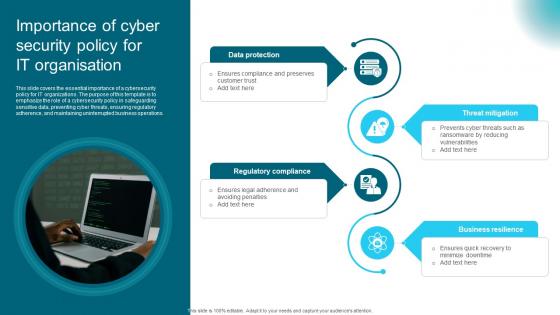
This slide covers the essential importance of a cybersecurity policy for IT organizations. The purpose of this template is to emphasize the role of a cybersecurity policy in safeguarding sensitive data, preventing cyber threats, ensuring regulatory adherence, and maintaining uninterrupted business operations.
People who downloaded this PowerPoint presentation also viewed the following :
Importance Of Cyber Security Policy For IT Organisation with all 9 slides:
Use our Importance Of Cyber Security Policy For IT Organisation to effectively help you save your valuable time. They are readymade to fit into any presentation structure.









FAQs for Importance Of Cyber Security Policy
**INPUT**: What are the key components of an effective cyber security policy? **OUTPUT**: Effective cyber security policies include access controls, incident response protocols, data protection standards, employee training requirements, and regular security assessments. These components work together by establishing clear authorization frameworks, enabling rapid threat containment, and ensuring consistent security practices across organizations, with many financial institutions and healthcare providers finding that comprehensive policies significantly reduce breach risks while enhancing operational resilience. **Word count: 60 words**
Organizations ensure regulatory compliance through cyber security policies by implementing comprehensive frameworks that address data protection requirements, access controls, incident response procedures, and audit trails mandated by industry standards. These policies streamline compliance with regulations like GDPR, HIPAA, and SOX by establishing clear protocols for data handling, employee training, and continuous monitoring, ultimately delivering operational transparency and reduced regulatory risk.
Employee training serves as the critical foundation for cyber security policy effectiveness, transforming policies from static documents into actionable defense mechanisms through awareness, behavior modification, and incident response capabilities. Well-trained employees become the first line of defense against phishing attacks, social engineering, and data breaches, with organizations finding that comprehensive training programs significantly reduce security incidents while enhancing overall policy compliance and organizational resilience.
Organizations should assess cyber security policies through quarterly risk evaluations, penetration testing, compliance audits, threat landscape analysis, and employee feedback sessions. This strategic combination enables companies to identify emerging vulnerabilities, adapt to new regulatory requirements, and strengthen defenses, with many financial institutions and healthcare providers finding that regular updates significantly reduce breach incidents while maintaining operational efficiency.
A cybersecurity policy defines specific rules, procedures, and responsibilities for protecting an organization's digital assets, while a cybersecurity framework provides the foundational structure and guidelines for developing comprehensive security programs. Organizations typically use frameworks like NIST or ISO 27001 to build their policies, with many finding that this strategic combination delivers consistent governance, regulatory compliance, and streamlined risk management across all business operations.
Organizations balance usability and security by implementing risk-based authentication, providing comprehensive user training, and designing intuitive security interfaces that don't hinder productivity. This strategic approach enables seamless workflows while maintaining protection, with many companies finding that user-friendly security measures actually improve compliance rates and reduce human error incidents.
**INPUT**: What measures can be included in a policy to protect sensitive customer data? **OUTPUT**: Customer data protection policies include encryption protocols, access controls, regular security audits, employee training programs, and incident response procedures. These measures work by restricting data access to authorized personnel, ensuring secure transmission and storage, and establishing clear protocols for data breaches, with many financial institutions and healthcare organizations finding that comprehensive policies significantly reduce security risks while enhancing customer trust. **Word count: 60 words**
A cybersecurity policy addresses emerging threats by implementing multi-layered defense strategies, regular security awareness training, automated threat detection systems, and incident response protocols. Through proactive measures like email filtering, endpoint protection, and employee education, organizations can significantly reduce ransomware and phishing vulnerabilities, while establishing clear recovery procedures that minimize downtime and financial losses when attacks occur.
Best practices for incident response planning include establishing clear escalation procedures, defining roles and responsibilities, creating communication protocols, implementing automated detection systems, and conducting regular simulation exercises. These frameworks streamline response times by enabling faster threat containment, coordinated team actions, and systematic recovery processes, with many organizations finding that well-rehearsed incident plans significantly minimize operational disruption and financial impact.
Third-party vendor relationships should be managed through comprehensive risk assessments, contractual security requirements, regular audits, and continuous monitoring protocols within cyber security policies. Organizations must establish clear data handling standards, incident response procedures, and compliance verification processes, with many financial institutions and healthcare providers finding that structured vendor management significantly reduces supply chain vulnerabilities while maintaining operational efficiency.
Remote work significantly expands attack surfaces, requiring cyber security policies to address endpoint protection, secure connectivity protocols, multi-factor authentication requirements, and cloud-based data governance frameworks. Organizations must now balance employee flexibility with stringent security measures, with many financial services and healthcare institutions finding that adaptive policies incorporating zero-trust architectures ultimately deliver enhanced protection while enabling productive remote operations.
Organizations can communicate their cyber security policy effectively through regular training sessions, interactive workshops, clear visual materials, accessible digital portals, and role-specific guidelines tailored to different departments. These approaches enhance understanding by combining formal presentations with hands-on simulations, easy-to-reference documentation, and continuous reinforcement campaigns, ultimately delivering stronger security awareness and consistent policy adherence across all organizational levels.
Cybersecurity policy effectiveness metrics include incident response times, breach detection rates, compliance audit scores, employee training completion rates, and vulnerability remediation timelines. These measurements enable organizations to assess their security posture comprehensively, with many financial institutions and healthcare providers finding that regular metric tracking ultimately delivers improved threat detection, reduced response costs, and enhanced regulatory compliance.
Cultural and geographical differences significantly influence cyber security policy formulation through varying privacy expectations, regulatory frameworks, threat landscapes, and technological infrastructure capabilities. Organizations operating globally must navigate diverse legal requirements, from Europe's GDPR emphasis on data protection to Asia-Pacific's focus on national security, while adapting policies to local cultural attitudes toward surveillance, data sharing, and government oversight, ultimately requiring flexible frameworks that maintain security effectiveness across different regional contexts.
Common pitfalls include inadequate employee training, inconsistent policy enforcement, outdated threat assessments, insufficient incident response planning, and poor cross-departmental coordination. These challenges often result from treating cybersecurity as purely technical rather than strategic, with many organizations finding that comprehensive staff education and regular policy updates significantly enhance their security posture and operational resilience.
-
“Slides are formally built and the color theme is also very exciting. This went perfectly with my needs and saved a good amount of time.”
-
Great designs, Easily Editable.