

Importance of interpersonal skills at workplace





Try Before you Buy Download Free Sample Product
 Impress Your
 Audience
 100%
100% Editable
 Save Hours
 of Time


Our Importance Of Interpersonal Skills At Workplace never fuss about. All distractions are kept at arms distance.
People who downloaded this PowerPoint presentation also viewed the following :
Importance of interpersonal skills at workplace with all 5 slides:
Fuse our Importance Of Interpersonal Skills At Workplace with your thoughts. They will create an electric environment.
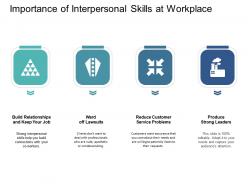


FAQs for Importance of interpersonal
Key components include active listening, clear communication, emotional intelligence, conflict resolution, and collaborative problem-solving. These skills enhance workplace relationships by fostering trust, reducing misunderstandings, and improving team dynamics, with many organizations finding that employees with strong interpersonal abilities ultimately drive higher productivity and create more positive work environments.
Active listening enhances team communication by demonstrating respect, building trust, and reducing misunderstandings through focused attention, empathetic responses, and clarifying questions. This approach enables team members to feel valued and heard, while facilitating more effective collaboration, faster problem-solving, and stronger working relationships, ultimately delivering improved project outcomes and team cohesion.
Emotional intelligence serves as the foundation for strong interpersonal skills by enabling individuals to recognize, understand, and manage their own emotions while effectively perceiving and responding to others' emotional states. This self-awareness and empathy enhances communication, builds trust, and facilitates conflict resolution, with many organizations finding that emotionally intelligent employees create more collaborative work environments and deliver superior customer experiences.
Non-verbal communication significantly impacts workplace relationships by conveying confidence, trustworthiness, and engagement through body language, facial expressions, and tone of voice. These subtle cues influence team collaboration, leadership effectiveness, and client interactions, with many organizations finding that employees with strong non-verbal awareness build stronger professional networks, enhance meeting outcomes, and ultimately advance their careers more effectively.
Conflict resolution strategies include active listening, empathy building, clear communication, finding common ground, and collaborative problem-solving. These interpersonal approaches streamline workplace tensions by addressing underlying concerns, fostering mutual understanding, and creating win-win solutions, with many organizations finding that employees trained in these skills deliver faster resolutions and enhanced team productivity.
Interpersonal skills influence leadership effectiveness by enhancing communication clarity, building trust with team members, facilitating conflict resolution, and creating stronger stakeholder relationships. These capabilities enable leaders to motivate diverse teams, navigate complex organizational dynamics, and drive collaborative decision-making, with many executives finding that strong interpersonal competencies ultimately deliver improved employee engagement and organizational performance.
Cultural differences significantly impact interpersonal interactions through varying communication styles, decision-making approaches, conflict resolution methods, and relationship-building preferences within diverse teams. These variations present both challenges and opportunities, with many organizations finding that embracing cultural diversity through structured training and inclusive practices ultimately enhances creativity, problem-solving capabilities, and global market competitiveness.
**INPUT**: What techniques can improve empathy in communication between colleagues? **OUTPUT**: Empathy-building techniques include active listening, perspective-taking exercises, regular feedback sessions, emotional intelligence training, and structured dialogue practices. These approaches enhance workplace relationships by encouraging understanding of different viewpoints, fostering psychological safety, and creating collaborative environments, with many organizations finding that empathetic communication ultimately delivers improved team performance and reduced workplace conflicts. [Word count: 54 words]
Effective feedback strengthens relationships through specific, timely observations focused on behaviors rather than personality, delivered with empathy and genuine intent to help. Active listening, asking clarifying questions, and expressing appreciation for the feedback creates psychological safety, with many teams finding that regular, constructive exchanges ultimately enhance trust, collaboration, and overall performance.
Strong interpersonal skills in remote environments enhance team collaboration, build trust across digital channels, improve communication clarity, reduce misunderstandings, and strengthen workplace relationships. These capabilities enable remote teams to maintain productivity, foster innovation through effective virtual brainstorming, and create cohesive company culture, with many organizations finding that employees with strong interpersonal skills deliver better customer service and project outcomes.
Storytelling enhances interpersonal connections during presentations by creating emotional engagement, building trust through vulnerability, and making complex concepts relatable through shared human experiences. When presenters weave personal anecdotes or customer success stories into their content, audiences connect on deeper levels, remember key messages more effectively, and feel genuinely engaged rather than simply informed.
Building rapport with clients involves active listening, finding common ground, mirroring communication styles, showing genuine interest in their needs, and maintaining consistent follow-through on commitments. These interpersonal strategies enhance trust and loyalty by demonstrating empathy, reliability, and understanding, with many sales professionals and service representatives finding that personalized attention and authentic engagement ultimately deliver stronger client relationships and increased business retention.
Interpersonal skills enhance networking success by building authentic relationships, facilitating meaningful conversations, and creating lasting professional connections through active listening and emotional intelligence. These capabilities enable professionals to navigate diverse industry events, maintain valuable contacts across sectors like finance and healthcare, and ultimately leverage relationships for career advancement, mentorship opportunities, and strategic business collaborations.
Interpersonal skills can be assessed through 360-degree feedback, peer evaluations, behavioral interviews, team collaboration metrics, and communication effectiveness surveys. Organizations enhance these skills by implementing mentorship programs, cross-functional team projects, active listening workshops, and conflict resolution training, ultimately delivering improved team dynamics, enhanced leadership capabilities, and stronger organizational culture that drives competitive advantage.
Mentorship programs cultivate interpersonal skills by pairing employees with experienced guides who model effective communication, active listening, and relationship-building techniques through regular one-on-one interactions. These structured relationships enable mentees to practice conflict resolution, empathy, and collaborative approaches in real workplace scenarios, ultimately delivering enhanced team dynamics and leadership capabilities across organizations.
No Reviews