

Importance Of Real Time Marketing Strategy RTM Guide To Improve MKT SS V




Try Before you Buy Download Free Sample Product
 Impress Your
 Audience
 100%
100% Editable
 Save Hours
 of Time


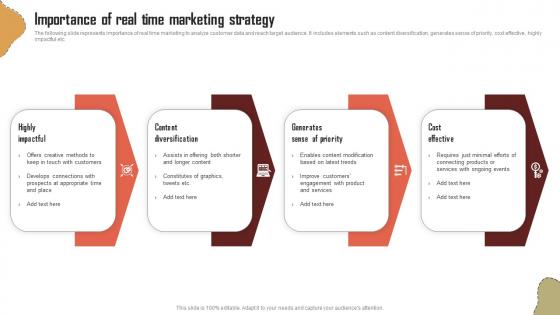
The following slide represents importance of real time marketing to analyze customer data and reach target audience. It includes elements such as content diversification, generates sense of priority, cost effective, highly impactful etc.
People who downloaded this PowerPoint presentation also viewed the following :
Importance Of Real Time Marketing Strategy RTM Guide To Improve MKT SS V with all 9 slides:
Use our Importance Of Real Time Marketing Strategy RTM Guide To Improve MKT SS V to effectively help you save your valuable time. They are readymade to fit into any presentation structure.








FAQs for Importance Of Real Time Marketing Strategy RTM Guide To Improve
Real-time marketing involves creating and deploying content that responds immediately to current events, trends, or customer behaviors, while traditional marketing relies on pre-planned campaigns with fixed timelines and messaging. This approach enables brands to capitalize on viral moments, engage audiences during peak attention periods, and deliver personalized experiences instantly, with companies like retailers and hospitality finding significantly higher engagement rates and competitive advantage.
Brands can effectively leverage social media platforms for real-time marketing by monitoring trending topics, engaging with current events, responding instantly to customer interactions, utilizing live streaming features, and creating timely content that resonates with audiences. Through platforms like Twitter, Instagram, and TikTok, companies streamline customer engagement, enhance brand visibility, and deliver personalized experiences, ultimately building stronger connections while gaining competitive advantage in an increasingly dynamic digital landscape.
Successful real-time marketing strategies include social listening tools, agile content creation processes, cross-functional response teams, pre-approved messaging frameworks, and performance analytics systems. These components work together by monitoring conversations, enabling rapid content development, and facilitating immediate deployment across channels, with many organizations finding that this approach significantly enhances customer engagement and brand relevance.
Businesses can prepare for real-time marketing by establishing agile content creation processes, monitoring social media trends continuously, and developing pre-approved crisis response frameworks with flexible messaging templates. Through dedicated social listening teams and rapid approval workflows, organizations like Oreo during the Super Bowl blackout demonstrate how quick decision-making, creative adaptability, and strategic opportunism ultimately deliver competitive advantage and enhanced brand visibility.
Essential tools include social media monitoring platforms, marketing automation software, customer data platforms (CDPs), real-time analytics dashboards, and AI-powered personalization engines. These technologies streamline campaign execution by enabling instant audience insights, automated trigger-based responses, and dynamic content optimization, with many retail and financial services organizations finding that integrated platforms ultimately deliver faster customer engagement and significantly improved conversion rates.
Brands can measure real-time marketing effectiveness through engagement metrics, conversion rates, social sentiment analysis, brand mention tracking, and sales attribution modeling. These measurement approaches enable organizations to assess campaign reach, audience response, and revenue impact within hours, with many retail and consumer brands finding that real-time analytics ultimately deliver faster optimization and competitive advantage.
Successful real-time marketing examples include Oreo's "Dunk in the Dark" Super Bowl tweet, Arby's creative social media responses to pop culture events, Netflix's personalized content recommendations during trending moments, JetBlue's immediate customer service interactions, and brands leveraging trending hashtags for product promotions. These campaigns demonstrate how organizations can capitalize on current events, cultural moments, and consumer behaviors to drive engagement, increase brand visibility, and boost sales, with many companies finding that timely, relevant content significantly outperforms traditional scheduled marketing approaches.
Consumer behavior and trends directly shape real-time marketing tactics by providing immediate insights into purchasing patterns, social media engagement, and emerging preferences that guide content creation and campaign adjustments. Through social listening tools and behavioral analytics, brands can pivot messaging instantly, capitalize on trending topics, and personalize interactions, ultimately delivering more relevant experiences and higher conversion rates.
Data analytics serves as the foundation for real-time marketing strategies by enabling instant customer behavior tracking, predictive trend analysis, personalization algorithms, and performance measurement across multiple channels. Through advanced analytics platforms, businesses can identify emerging opportunities, optimize campaign targeting, and adjust messaging dynamically, with many retail and financial services companies finding that data-driven real-time strategies deliver significantly higher engagement rates and conversion outcomes.
Companies ensure brand consistency in real-time marketing by establishing clear brand guidelines, training social media teams on core messaging, and creating pre-approved response templates for common scenarios. Through strategic planning and automated approval workflows, organizations like airlines and retail brands maintain their voice while capitalizing on trending moments, ultimately delivering authentic engagement without compromising brand integrity.
Brands should prioritize authenticity, cultural sensitivity, data privacy compliance, and avoiding exploitation of tragedies or controversies in real-time marketing campaigns. These ethical foundations help companies build genuine customer relationships while navigating social media's fast-paced environment, with many organizations finding that transparent, respectful approaches ultimately deliver stronger brand trust and long-term competitive advantage.
Collaboration between marketing and customer service teams enhances real-time marketing by combining customer insights, feedback data, and frontline experiences to create responsive campaigns. Through shared communication platforms and integrated workflows, these teams deliver personalized responses, address concerns proactively, and transform customer interactions into marketing opportunities, ultimately improving brand perception and customer satisfaction.
Real-time marketing fosters deeper engagement by delivering personalized experiences, responding instantly to customer needs, creating timely relevant content, and participating in trending conversations. Through social media monitoring and data analytics, brands build authentic connections, address concerns immediately, and demonstrate genuine care for customer experiences, ultimately strengthening loyalty and encouraging repeat business across all touchpoints.
Brands should respond to negative feedback during real-time marketing by acknowledging concerns quickly, taking responsibility when appropriate, and providing transparent communication across all channels. Successful crisis management involves pausing problematic campaigns immediately, crafting authentic responses that address specific issues, and demonstrating concrete corrective actions, with many organizations finding that genuine accountability ultimately strengthens customer trust and brand credibility.
Real-time marketing risks include brand reputation damage from poorly timed content, legal complications from inadequate compliance checks, customer backlash from insensitive messaging, and operational strain from rapid response demands. These challenges can be mitigated through pre-approved content frameworks, cross-functional approval processes, comprehensive social listening tools, and dedicated response teams, with many organizations finding that structured flexibility ultimately delivers competitive advantage while minimizing exposure.
-
Easily Understandable slides.
-
Their designing team is so expert in making tailored templates. They craft the exact thing I have in my mind…..really happy.