

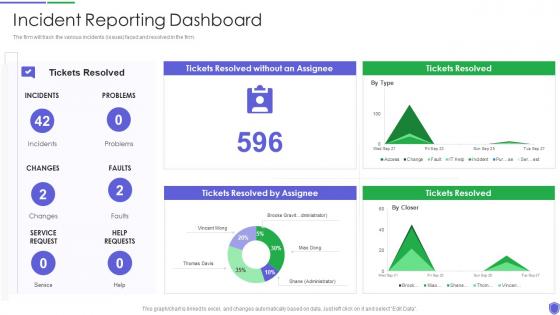
Incident reporting dashboard managing critical threat vulnerabilities and security threats




Try Before you Buy Download Free Sample Product
 Impress Your
Audience
 100%
Editable
 Save Hours
of Time


The firm will track the various incidents issues faced and resolved in the firm.
People who downloaded this PowerPoint presentation also viewed the following :
Incident reporting dashboard managing critical threat vulnerabilities and security threats with all 7 slides:
Use our Incident Reporting Dashboard Managing Critical Threat Vulnerabilities And Security Threats to effectively help you save your valuable time. They are readymade to fit into any presentation structure.







FAQs for Incident reporting dashboard managing critical threat vulnerabilities
Effective incident reporting dashboards include real-time alert systems, incident categorization matrices, status tracking workflows, escalation pathways, and comprehensive analytics modules. These components streamline incident management by enabling faster response times, clearer accountability chains, and data-driven insights, with many organizations finding that integrated dashboards reduce resolution times while enhancing operational transparency.
Real-time data visualization accelerates incident response by providing instant alerts, interactive dashboards showing incident severity and location, and automated workflow triggers that route issues to appropriate teams. Through dynamic heat maps and status indicators, emergency responders, IT teams, and facility managers can prioritize critical incidents faster, coordinate resources more effectively, and reduce average resolution times by up to 40%.
Key metrics include incident frequency by category, severity levels, response times, resolution rates, trend analysis, and resource allocation patterns. These dashboards enable organizations to identify recurring issues, streamline emergency protocols, and enhance operational safety, with many healthcare facilities, manufacturing plants, and corporate environments finding that comprehensive tracking ultimately delivers faster incident resolution and improved workplace safety standards.
UX design enhances incident reporting dashboards by streamlining navigation, implementing intuitive form layouts, providing clear visual hierarchies, and enabling quick data entry through smart defaults and auto-completion features. Through user-centered design principles, organizations create dashboards that reduce reporting time, minimize user errors, and improve incident response accuracy, with many healthcare systems and manufacturing facilities finding that enhanced usability increases reporting compliance and accelerates resolution times.
Automation streamlines incident reporting dashboards by automatically collecting data from multiple systems, categorizing incidents by severity and type, and updating status metrics in real-time. This eliminates manual data entry, reduces human error, and ensures stakeholders receive immediate notifications, with many organizations finding that automated workflows accelerate response times and enhance operational transparency.
Companies integrate existing software tools with incident reporting dashboards through APIs, middleware platforms, and custom connectors that enable seamless data flow between systems. Strategic integration with HRIS platforms, communication tools, and compliance software allows organizations to automate incident data collection, streamline reporting workflows, and enhance response coordination, ultimately delivering faster resolution times and improved safety outcomes.
Common pitfalls in designing incident reporting dashboards include overcrowding with excessive metrics, poor data visualization choices, lack of real-time updates, insufficient filtering options, and missing escalation workflows. These design flaws can overwhelm users and delay critical response times, with many organizations finding that streamlined interfaces focusing on actionable insights rather than comprehensive data dumps ultimately deliver faster incident resolution and improved operational efficiency.
Industries customize incident reporting dashboards by integrating sector-specific metrics, compliance requirements, and risk categories unique to their operational environments. Healthcare systems prioritize patient safety indicators and regulatory compliance tracking, while manufacturing focuses on equipment failures and workplace safety metrics, and financial services emphasize fraud detection and security breaches, ultimately delivering targeted insights that enhance industry-specific risk management and operational efficiency.
Best practices for training staff include conducting role-specific workshops, providing hands-on simulation exercises, creating quick reference guides, establishing clear escalation protocols, and offering ongoing refresher sessions. These training approaches streamline incident response by ensuring consistent data entry, reducing reporting delays, and enhancing communication accuracy, with many organizations finding that comprehensive training ultimately delivers faster resolution times and improved safety outcomes.
Incident reporting dashboards support compliance by centralizing documentation, automating regulatory notifications, maintaining audit trails, and generating standardized reports that meet industry requirements. Through real-time tracking and automated workflows, organizations in healthcare, manufacturing, and financial services streamline compliance processes, reduce reporting errors, and demonstrate regulatory adherence, ultimately minimizing audit risks while enhancing operational transparency.
Incident reporting dashboards should include safety incidents, security breaches, operational disruptions, compliance violations, environmental events, and near-miss occurrences. These comprehensive categories enable organizations to identify patterns, streamline response protocols, and enhance risk management across departments, with many companies finding that broader incident tracking ultimately delivers improved safety outcomes and regulatory compliance.
Dashboards can be customized through configurable risk matrices, weighted scoring systems, priority-based alert hierarchies, customizable KPIs, and role-specific view filters that align with organizational objectives. Organizations across healthcare, manufacturing, and financial services enhance incident visibility by tailoring metrics to their specific compliance requirements and operational risks, ultimately delivering faster response times and more strategic resource allocation.
Cloud-based incident reporting dashboards offer real-time accessibility, automatic data backup, seamless team collaboration, cost-effective scalability, and enhanced security protocols. These platforms streamline incident management by enabling remote monitoring, reducing infrastructure costs, and facilitating faster response times, with many organizations finding that cloud solutions ultimately deliver improved operational efficiency and competitive advantage.
Incident reporting dashboards facilitate post-incident analysis by aggregating incident data, identifying patterns and trends, and enabling root cause analysis through comprehensive visualization tools. These platforms streamline investigations by providing timeline views, impact assessments, and correlation mapping, with many organizations finding that centralized dashboards reduce analysis time while enhancing learning outcomes and prevention strategies.
Data security measures for incident reporting dashboards include end-to-end encryption, role-based access controls, audit trails, secure authentication protocols, and regular security assessments. These safeguards streamline compliance while maintaining operational efficiency, with many healthcare systems and financial institutions finding that multi-layered security approaches ultimately deliver enhanced stakeholder confidence and regulatory adherence.
-
Excellent Designs.
-
Easily Editable.