

Incidents Prioritization Matrix Cybersecurity Risk Management Framework




Try Before you Buy Download Free Sample Product
 Impress Your
 Audience
 100%
100% Editable
 Save Hours
 of Time


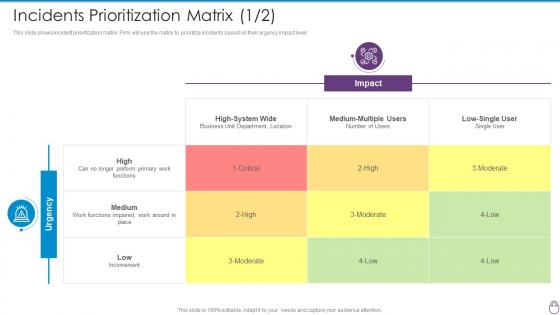
This slide shows incident prioritization matrix. Firm will use the matrix to prioritize incidents based on their urgency impact level.
People who downloaded this PowerPoint presentation also viewed the following :
Incidents Prioritization Matrix Cybersecurity Risk Management Framework with all 6 slides:
Use our Incidents Prioritization Matrix Cybersecurity Risk Management Framework to effectively help you save your valuable time. They are readymade to fit into any presentation structure.





FAQs for Incidents Prioritization Matrix Cybersecurity
The most common cyber attacks include phishing, ransomware, malware, denial-of-service attacks, and social engineering schemes. These threats target organizations by exploiting human vulnerabilities, compromising data systems, and disrupting operations, with many financial institutions and healthcare organizations finding that comprehensive security frameworks significantly reduce breach risks while enhancing operational resilience.
Social engineering tactics contribute to cybersecurity breaches by exploiting human psychology through phishing emails, pretexting calls, baiting schemes, and tailgating attempts that bypass technical security measures. These psychological manipulation techniques enable cybercriminals to gain unauthorized access, steal credentials, and infiltrate networks across industries like banking and healthcare, ultimately compromising sensitive data and operational security.
Employee training serves as a critical defense layer by educating staff on threat recognition, safe browsing practices, password management, phishing identification, and incident reporting protocols. Through comprehensive cybersecurity awareness programs, organizations significantly reduce human error vulnerabilities, enhance threat detection capabilities, and create a security-conscious culture, with many companies finding that well-trained employees become their strongest defense against cyberattacks.
Organizations can effectively assess cybersecurity risks through comprehensive vulnerability assessments, penetration testing, asset inventories, threat modeling, and regular security audits. These strategic evaluations enable companies to identify weaknesses, prioritize critical assets, and allocate resources efficiently, with many financial institutions and healthcare organizations finding that systematic risk assessments ultimately deliver enhanced protection and regulatory compliance.
Key components include incident identification protocols, response team roles, communication procedures, containment strategies, and recovery frameworks. These elements work together by enabling rapid threat detection, coordinating cross-functional teams, and minimizing operational disruption, with many organizations finding that structured response plans significantly reduce breach costs and restore normal operations faster.
Zero-day vulnerabilities significantly compromise organizational cybersecurity by exploiting unknown software flaws before patches become available, leaving systems defenseless against targeted attacks. These vulnerabilities enable cybercriminals to bypass traditional security measures, access sensitive data, and disrupt operations, with many financial institutions and healthcare organizations finding that proactive threat hunting and behavioral analytics help minimize exposure risks.
Multi-factor authentication significantly enhances data protection by requiring multiple verification methods, creating layered security barriers that hackers struggle to breach simultaneously. This approach dramatically reduces successful cyberattacks by combining something users know, have, and are, with financial institutions and healthcare organizations finding that MFA prevents up to 99% of automated attacks while maintaining seamless user experiences.
Businesses can ensure compliance with data protection regulations through comprehensive data audits, clear consent mechanisms, robust security protocols, employee training programs, and regular compliance assessments. These strategic approaches streamline regulatory adherence by establishing transparent data handling processes, implementing automated monitoring systems, and creating accountability frameworks, with many organizations finding that proactive compliance ultimately delivers enhanced customer trust and competitive advantage.
Emerging cybersecurity technologies include artificial intelligence and machine learning for threat detection, zero-trust architecture, quantum cryptography, behavioral analytics, and automated incident response systems. These technologies enhance security by predicting attacks before they occur, continuously verifying user identities, and responding to threats in real-time, with many organizations finding significantly improved protection against sophisticated cyber threats.
The cyber kill chain maps attack stages from reconnaissance through data exfiltration, enabling security teams to identify and disrupt threats at multiple intervention points. This framework enhances threat detection by allowing organizations to monitor for early warning signs, deploy targeted countermeasures at each stage, and prevent attacks from progressing, ultimately delivering proactive defense capabilities rather than reactive responses.
Small businesses face challenges including limited budgets for security tools, lack of dedicated IT staff, insufficient cybersecurity training, outdated systems, and difficulty staying current with evolving threats. These constraints often leave organizations vulnerable to attacks, with many finding that strategic partnerships with managed security providers, employee education programs, and scalable cloud-based solutions help streamline protection while minimizing costs and complexity.
Threat intelligence leverages data analysis, behavioral patterns, and industry threat feeds to identify emerging cyber risks before they materialize into attacks. By monitoring dark web activities, analyzing attack signatures, and sharing intelligence across sectors, organizations like banks and healthcare systems can proactively strengthen defenses, ultimately reducing breach likelihood and enhancing overall security posture.
Remote work significantly expands attack surfaces through unsecured home networks, personal devices, and distributed endpoints, requiring organizations to reimagine traditional perimeter-based security models. This shift presents both challenges and opportunities, with many companies finding that implementing zero-trust architectures, enhanced endpoint protection, and comprehensive employee training ultimately delivers stronger overall security posture and operational resilience.
Companies measure cybersecurity effectiveness through key performance indicators like incident response times, vulnerability assessment scores, security awareness training completion rates, and threat detection accuracy. These metrics enable organizations to track risk reduction, compliance adherence, and operational resilience, with many financial institutions and healthcare providers finding that regular measurement ultimately delivers improved security posture and regulatory confidence.
Cloud security best practices include multi-factor authentication, data encryption, regular security audits, access controls, and network segmentation. These approaches enhance protection by limiting user permissions, monitoring suspicious activities, and isolating critical systems, with many financial institutions and healthcare organizations finding that strategic implementation ultimately delivers reduced breach risks and improved regulatory compliance.
-
SlideTeam was so customer-centric and quick service-provider that I doubted the amount I was paying and literally re-checked the transaction.
-
Thank you for showering me with discounts every time I was reluctant to make the purchase.