

Industrial IOT Security Reference Architecture




Try Before you Buy Download Free Sample Product
 Impress Your
 Audience
 100%
100% Editable
 Save Hours
 of Time


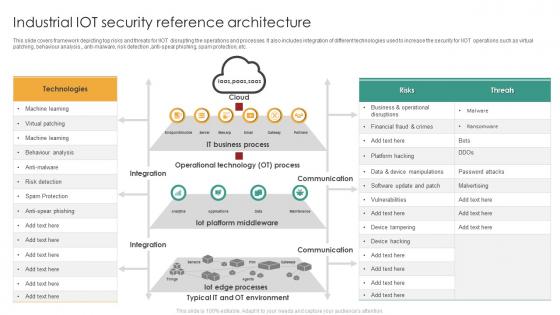
This slide covers framework depicting top risks and threats for IIOT disrupting the operations and processes. It also includes integration of different technologies used to increase the security for IIOT operations such as virtual patching, behaviour analysis,, anti-malware, risk detection, anti spear phishing, spam protection, etc.
People who downloaded this PowerPoint presentation also viewed the following :
Industrial IOT Security Reference Architecture with all 6 slides:
Use our Industrial IOT Security Reference Architecture to effectively help you save your valuable time. They are readymade to fit into any presentation structure.





FAQs for Industrial IOT
Dude, so many attack vectors to worry about. Network stuff like man-in-the-middle and DDoS hits hard. Malware's getting scary good at targeting industrial systems specifically. Default passwords are literally the bane of my existence - I swear nobody changes them! Firmware updates? What's that, right? Half these devices haven't seen an update in years. Data gets snagged during transmission all the time. Don't forget about insider threats either - employees with access can mess things up. Physical security's tricky since devices sit in random remote spots. Map out what you've got first, then focus on anything that'd cause chaos if it went down.
Start with network mapping - you'll probably find devices you forgot even existed (happens to everyone). Use industrial-specific vulnerability scanners, not regular IT ones since OT stuff works totally different. The legacy equipment situation is honestly a nightmare sometimes. Get some pen testing done on your industrial controls too. Remote access points and wireless connections are huge blind spots that need checking. Oh, and document everything as you go. When prioritizing fixes, focus on what'll actually mess up operations rather than just chasing high severity numbers.
So basically end-to-end encryption creates this secure tunnel for your IIoT data - from sensor straight to control systems. No one can peek at it during transit. It's like mailing a locked briefcase vs a postcard, you know? This is honestly your strongest protection against those man-in-the-middle attacks and data tampering. Really crucial when your industrial devices are talking over networks you don't totally control. Oh, and make sure you're encrypting right at the device level, not just network boundaries. Attackers absolutely love finding those coverage gaps to exploit.
So basically ML watches all your IoT devices and learns their normal behavior patterns. Once it knows what's typical, it can spot weird stuff happening - like unusual network traffic or devices acting sketchy. Way better than old-school rule-based security that misses subtle attacks. Honestly, it's like having someone who never forgets how your equipment usually runs. The algorithms catch tampering or compromised devices super fast compared to checking everything manually. You'll want to start with network monitoring tools that can establish baselines first. They're pretty good at picking up on cyberattacks before they spread.
Multi-factor authentication should be your starting point - never stick with default passwords because that's just asking for trouble. Each device needs its own digital certificate, and you've got to rotate those credentials regularly. Keep a current inventory of what devices are actually on your network (sounds boring but trust me on this one). Segment your network so OT devices stay separate from IT systems. Honestly, just treat device access like employee access - verify everything before letting anything connect.
NIST and GDPR basically force you to build security into your IIoT setup from the start - no tacking it on later. You've probably heard of NIST's cybersecurity framework, right? That whole identify-protect-detect-respond-recover thing actually works great for industrial environments. GDPR's more about data privacy though. Makes you question what sensor data you're grabbing and why you need it. Both push zero-trust setups and proper encryption. Honestly, they complement each other well - NIST covers the technical side while GDPR keeps your data practices in check. I'd start by seeing how your current setup stacks up against NIST's categories.
Honestly, your old legacy equipment is probably your biggest headache here. Those systems weren't designed for internet connectivity at all - zero encryption, can't be patched, the works. It's like connecting a 1995 computer to your smart home setup and hoping for the best. Attackers absolutely love finding these weak spots because they can use them to jump into your newer IoT stuff. I'd start by making a list of what legacy gear you've got, then try to wall it off from your IoT devices with network segmentation. Trust me, keeping them separated will save you tons of trouble down the road.
Start by breaking your IIoT devices into micro-networks - makes everything way more manageable. Every single connection needs authentication, even between devices you trust. I'd set up continuous monitoring to catch weird behavior right away. Multi-factor auth is non-negotiable for access points. Honestly, the whole "trust but verify" thing is dead now - it's just constant verification. NAC solutions will auto-quarantine sketchy devices, which is pretty sweet. Encrypt everything in transit and at rest. Oh, and definitely pilot this in one zone first before rolling it out everywhere.
Honestly, third-party vendors are probably your biggest headache in Industrial IoT security. They need network access for maintenance stuff, can push firmware updates, and usually have way too many privileged credentials. One compromised contractor laptop and boom – your whole system's exposed. I've watched this exact scenario play out more times than I'd like to admit. You gotta lock down their access hard. Multi-factor authentication is non-negotiable. Actually audit their security practices too, don't just take their word for it. Those compliance certificates? Pretty much worthless without verification.
Honestly, IIoT incident response is way trickier than regular IT stuff - you can't just reboot everything when things break. Map out all your connected devices first (trust me on this one). Then build procedures for isolating compromised equipment without killing critical operations. The money part gets scary fast since downtime in industrial settings = massive losses or safety issues. Your plan needs clear escalation paths between IT and ops teams. Figure out which systems are absolutely mission-critical and have manual backups ready. It's not like your laptop freezing - industrial systems going down can literally stop production lines.
Start with encryption - both for data moving around and stuff sitting in storage. Multi-factor authentication is a must, and honestly, don't let just anyone access your IIoT systems. Keep those industrial networks separate from everything else. That's saved my ass before. Your cloud provider better have SOC 2 and ISO 27001 certifications or I'd look elsewhere. Set up monitoring from day one because you'll need it when (not if) something weird happens. Oh, and run security audits regularly - can't stress that enough.
Dude, industrial IoT is no joke compared to regular consumer stuff. Your smart thermostat gets hacked? Whatever. But industrial devices control actual power grids and factory equipment - stuff that can shut down entire operations or create real safety disasters. The attack surface is brutal too since most industrial gear runs on ancient protocols that weren't designed with security as a priority. Plus they're always online in rough environments. Honestly, I'd treat every single device like it's already compromised and focus hard on network segmentation first.
Start by checking what update systems you're actually using - half the time it's just basic HTTP which is scary. You'll want cryptographically signed firmware where devices only accept updates signed with your private key. TLS for transmission obviously. Version control prevents rollback attacks too. Honestly, the recovery mechanism is huge - if something breaks you need an out-of-band way to fix it. Nobody wants to explain why they bricked the production line at 2am. Test everything in sandbox first, and yeah I know that sounds obvious but you'd be amazed how often people skip it.
Honestly, data analytics and visualization are total game-changers for IIoT security. You know how you usually drown in all those logs and alerts? Well, visual dashboards actually make sense of that mess - they'll show you anomalies and weird traffic patterns right away. It's like having security radar that catches the sketchy stuff immediately. The analytics help you figure out what "normal" looks like for your devices. When something's acting up, you'll spot it fast. I'd start with a SIEM tool that has decent visualization - makes your response time way quicker. Trust me, your team will thank you for it.
Oh man, this is tricky stuff. Speed kills you here - literally. You need millisecond responses but encryption slows everything down, which could be dangerous in critical systems. Most industrial devices are ancient too, zero security built in. Honestly, it's like they were designed to get hacked. Edge computing can help since you're processing locally instead of shipping data everywhere, but now you've got more nodes to protect. I'd start by figuring out your most critical flows first, then see where you can squeeze in lightweight encryption without breaking timing requirements.
-
Been using SlideTeam for some time now…can’t imagine why I wasted all that time in front of the screen trying to make the perfect presentation.
-
Spacious slides, just right to include text. SlideTeam has also helped us focus on the most important points that need to be highlighted for our clients.