


Industrial Robots Performance Tracking Dashboard Implementation Of Robotic Automation In Business





Try Before you Buy Download Free Sample Product
 Impress Your
Audience
 100%
Editable
 Save Hours
of Time


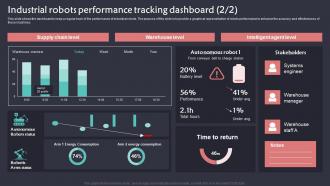
This slide shows the dashboard to keep a regular track of the performance of industrial robots. The purpose of this slide is to provide a graphical representation of robots performance to enhance the accuracy and effectiveness of these machines.
People who downloaded this PowerPoint presentation also viewed the following :
Industrial Robots Performance Tracking Dashboard Implementation Of Robotic Automation In Business with all 11 slides:
Use our Industrial Robots Performance Tracking Dashboard Implementation Of Robotic Automation In Business to effectively help you save your valuable time. They are readymade to fit into any presentation structure.









FAQs for Industrial Robots Performance Tracking Dashboard Implementation Of Robotic
Honestly, I'd start with OEE if I were you - it rolls availability, performance, and quality into one neat number which makes life easier. Track your uptime percentage and cycle time too since those are pretty telling. MTBF is solid for spotting patterns before things break down completely. Don't sleep on energy consumption per unit either, especially with costs going crazy these days. First-pass yield catches quality problems early, and you'll want error rates plus maintenance costs on your dashboard. Throughput rate matters obviously, but if you're just starting out? Focus on OEE and uptime first. They'll show you where the real issues are hiding.
Honestly, real-time monitoring is a game changer - you'll catch problems right when they start instead of finding out days later when everything's already broken. Your robots are pumping out data constantly: speed, temperature, vibration, all that stuff. Think of it like a fitness tracker that never stops watching. You can spot when accuracy starts dropping and actually predict maintenance needs before things go sideways. Just don't go crazy with the data at first or you'll get overwhelmed. Pick maybe 3 key metrics to watch, then add more once you've got the hang of it.
So predictive maintenance is like having a heads up before your robots crap out on you. You're watching sensor data - vibration patterns, temps going crazy, accuracy dropping off. Way better than waiting for things to just die during production (been there, it sucks). The whole point is catching issues early so you can fix stuff during scheduled downtime instead of scrambling when everything goes sideways. I'd start by figuring out which metrics always tank right before major failures happen. That's where you'll build your prediction models from.
Dude, ML is a game changer for robot performance - seriously. Your algorithms will catch patterns in sensor data and vibrations that you'd totally miss otherwise. They predict maintenance needs before stuff breaks down, which is huge. Real-time optimization of movement and energy usage too. What's really neat is how they adapt to your specific setup over time, getting better at spotting weird behavior and inefficiencies. Oh and start with predictive maintenance algorithms first - they'll pay for themselves way faster than other approaches. Trust me on that one.
Honestly, if you're already using FactoryTalk or Siemens stuff, just stick with their analytics platforms - FactoryTalk Analytics or MindSphere. But I'm pretty biased toward Grafana since it's free and super flexible. You can connect it to basically any robot controller and track cycle times, error rates, whatever you need in real-time. Tableau's solid too if your team hates coding - more of a drag-and-drop thing. Oh, and if you've got a data historian already running, just hook Grafana up to that first. Way easier than starting from scratch. You'll probably have decent dashboards up by tomorrow.
So basically, heavier loads mess with everything - your robot moves slower, takes longer between tasks, and gets less precise. Think of it like trying to sprint with a heavy backpack vs. an empty one. Your tracking numbers will show it right away too. Throughput tanks, positioning gets wonky, and power usage goes through the roof. Here's the thing though - most people set their performance benchmarks like every job is the same weight, which is dumb. You've gotta track metrics relative to what the robot's actually carrying, not just use blanket KPIs for everything.
Honestly, flexible robot programming is a game changer for your output numbers. Less downtime during changeovers because your bots can switch tasks way faster. You'll see better utilization rates too - I mean, who wants robots sitting idle, right? The cool part is you won't need a specialist programmer every time you want to tweak something small. Track your changeover times before and after making the switch. That's where you'll really see the difference in throughput. Oh, and it saves money on labor costs which is always nice.
Honestly, the data doesn't lie - that's the biggest thing. You'll catch bottlenecks and weird downtime patterns you'd never notice just eyeballing things. Track your cycle times, error rates, all that stuff across different shifts. I've watched teams freak out about their "broken" robot when really the problem was upstream feeding it garbage parts. Pretty wild how wrong your gut can be sometimes. The numbers show you exactly where things are actually falling apart vs where you think they are. Way better than just throwing money at whatever feels wrong, you know?
Oh man, cobots are such a pain to track compared to regular industrial robots. Traditional ones just repeat the same motions over and over - easy to measure. But collaborative robots? They're constantly changing speed and force based on who's working nearby. Way more variables to deal with. It's kinda like measuring a dancer vs a metronome, if that makes sense. Plus you can't just track cycle times anymore - now you need safety metrics, human-robot efficiency, adaptation quality, all that stuff. I'd honestly start by figuring out which human interaction scenarios actually matter for what you're doing.
Look, IoT sensors on robots are a game changer for monitoring. Motor temps, vibrations, cycle times - you get data on everything in real-time instead of just hoping things work. The data fire hose is kinda nuts at first, not gonna lie. But catching bearing wear or efficiency drops before your line goes down? Totally worth it. You'll actually know when maintenance is due instead of following some random schedule. I'd start with your most expensive robots first - learned that one the hard way. Then just add more sensors as you go.
Honestly, performance data is like your robot's report card - it'll tell you when things are going south. Watch for stuff like efficiency dropping, more downtime, and maintenance bills piling up. Those are red flags screaming "time to upgrade." I know it's tempting to think "just one more fix" but the numbers don't lie. When throughput consistently misses your benchmarks or errors keep climbing, that's your sign. Do the math: replacement cost vs what you'll blow on repairs and lost productivity. Pro tip - set those performance limits ahead of time so you're not making emotional decisions when everything's on fire.
Dude, environmental stuff will totally screw with your robot's numbers. Heat and cold mess up servo accuracy and slow down cycle times. Humidity causes electrical problems that kill your precision. And dust? It's literally everywhere in factories - clogs up sensors and makes joints all jerky. Oh, and vibrations from other machines nearby will throw off your positioning data too. Super annoying. You should probably run some baseline tests in different conditions first. That way when you're looking at your tracking data later, you can tell if it's actually the robot breaking down or just the environment being difficult.
Start with ISO 8373 for basic robotics definitions, then grab ISO 9283 for performance stuff like accuracy and repeatability. ANSI/RIA R15.06 is your safety standard - seriously don't skip this one unless you enjoy workplace incidents. Track your OEE, failure rates, and cycle times against industry benchmarks. If you're doing collaborative robots, you'll need ISO 10218 too. Oh, and get baseline metrics first using these standards. Otherwise you're just shooting in the dark trying to figure out if your robots actually improved or not. Makes a huge difference when you can point to real data.
So automotive and electronics track robots totally differently depending on what matters most. Car manufacturers obsess over cycle times and uptime because downtime costs them insane money - we're talking millions per hour. Electronics companies care way more about precision stuff like component placement and defect rates since those tiny parts don't give you second chances. Oh, and automotive uses way more predictive maintenance tracking since their robots basically run 24/7. Electronics focuses on real-time quality monitoring instead. Honestly, I'd just look at what other companies in your space are measuring first - that's usually the easiest way to figure out what you should be tracking.
Honestly, AI and machine learning are gonna be huge for robot tracking. Predictive analytics can catch problems before they blow up, which is pretty sweet. Real-time optimization tweaks things as they happen. Edge computing speeds everything up since you're not constantly sending data to the cloud - that lag time always bugged me. Digital twins let you mess around with virtual copies of your robots without breaking anything. Oh, and 5G makes monitoring way better across your whole setup. I'd start looking into AI analytics platforms now if I were you.
-
Enough space for editing and adding your own content.
-
Professionally designed slides with color coordinated themes and icons. Perfect for enhancing the style of the presentations.