

Industry trend displaying four key trends





Try Before you Buy Download Free Sample Product
 Impress Your
Audience
 100%
Editable
 Save Hours
of Time


Get all the cues that you desire with our Industry Trend Displaying Four Key Trends. Be able to deliver an extempore address.
People who downloaded this PowerPoint presentation also viewed the following :
Content of this Powerpoint Presentation
Description:
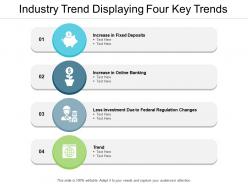
The image shows a PowerPoint slide entitled "Industry Trend Displaying Four Key Trends," which is designed to highlight and discuss current trends within an industry. Each trend is represented by a circular icon and a corresponding number, with space for additional text to elaborate on the trend.
The four key trends identified on the slide are:
1. Increase in Fixed Deposits:
Illustrated by a piggy bank icon, indicating a trend towards more consumers opting to place their money in fixed deposits.
2. Increase in Online Banking:
Depicted by a plant growing out of a pile of coins, symbolizing the organic growth in the adoption of online banking services.
3. Less Investment Due to Federal Regulation Changes:
Represented by an icon of a person with a briefcase, suggesting a decline in investment activity as a result of changes in federal regulations.
4. Trend:
The fourth trend is not specified but is accompanied by a globe icon, which could imply a global trend or international influence on the industry.
Each trend section also includes two placeholder text boxes marked "Text Here" for the presenter to provide detailed explanations and data related to each trend.
Use Cases:
This slide template would be valuable in various industries for discussing market trends and strategic planning:
1. Banking:
Use: Analyzing financial product trends.
Presenter: Market Analyst.
Audience: Bank Executives, Financial Advisors.
2. Technology:
Use: Assessing the impact of digital transformation.
Presenter: Tech Industry Analyst.
Audience: Tech Entrepreneurs, Investors.
3. Energy:
Use: Exploring shifts in renewable energy adoption.
Presenter: Energy Consultant.
Audience: Policy Makers, Industry Stakeholders.
4. Healthcare:
Use: Examining trends in telemedicine and patient care.
Presenter: Healthcare Administrator.
Audience: Medical Professionals, Hospital Management.
5. Retail:
Use: Understanding consumer behavior and e-commerce growth.
Presenter: Retail Strategist.
Audience: Retail Managers, Marketers.
6. Real Estate:
Use: Discussing housing market trends and investment opportunities.
Presenter: Real Estate Analyst.
Audience: Investors, Real Estate Agents.
7. Automotive:
Use: Evaluating trends in electric vehicle adoption and regulation impact.
Presenter: Automotive Market Researcher.
Audience: Auto Manufacturers, Dealerships.
Industry trend displaying four key trends with all 5 slides:
Increase the extent of your accomplishments with our Industry Trend Displaying Four Key Trends. Continue to add to the feathers in your cap.


FAQs for Industry trend displaying
Honestly, AI and machine learning are huge right now - companies are completely changing how they work because of it. Edge computing's another big one. IoT sensors have gotten so cheap it's kind of wild, which means you can do real-time monitoring stuff that would've cost a fortune before. 5G's making everything faster, blockchain's helping with supply chain stuff (though I'm still not 100% sold on all the hype there), and cloud-native setups let teams scale super quick. I'd just pick one that fits what you're already doing and mess around with it. Even a tiny pilot project beats sitting on the sidelines.
People are getting pickier with money now - they actually research stuff before buying and want brands that match their vibe. Quality beats cheap every time. Social media still matters but honestly, people can smell fake influencer posts from a mile away. The whole "experiences over things" trend isn't going anywhere, plus everyone's sick of subscriptions. Oh, and they'll totally wait longer for something good rather than settle. Just be real about what you're offering and build an actual community instead of constantly selling to them. Transparency wins.
Dude, sustainability isn't optional anymore - it's literally make or break for most companies. Consumers are demanding it, regulations are tightening, and your competitors are probably already on it. Industries that used to trash the environment are scrambling to go green now. We're talking circular economy stuff, carbon goals, the whole nine yards. Honestly? If your company isn't tracking sustainability metrics yet, you're behind. Investors and customers will start asking tough questions soon, and "we haven't thought about it" won't cut it. Better to get ahead of this before you're playing catch-up.
Most companies are totally revamping how they work now. Heavy investment in tools like Slack, Zoom, project management stuff to keep everyone connected. Office spaces are shrinking into these "hub" locations, or some places just went fully remote. The good companies (honestly not enough of them) focus on what you actually get done instead of counting hours. Oh, and they're setting clear rules about when you need to be face-to-face versus when you can just work on your own time. If your company's still figuring this mess out, maybe suggest some actual guidelines?
Honestly, everyone's obsessing over AI right now - like, every company thinks they need to automate everything. Supply chains are still a mess from covid so building more flexibility there is smart. Customer personalization is big too, but here's the thing - sustainability actually matters now beyond just looking good. Speed beats perfection these days, which is kinda stressful but whatever. Data analytics isn't even optional anymore, it's just expected. Pick whatever fits your current setup best though, don't try doing all of it at once.
Honestly, digital stuff is making companies completely flip their game plans. Most are ditching the old "sell once and done" approach for subscriptions and ongoing services. Data's become huge for personalizing things - even that weird local bakery near me has targeted Instagram ads now lol. The biggest shift? Everything's way more reactive. Companies can pivot fast based on real-time feedback instead of waiting months to see what works. If you haven't updated your business model recently, competitors using these tools are probably eating your lunch already.
Ugh, there's actually a bunch of new stuff you need to know about. The data privacy rules got way more intense last quarter - now you need explicit consent for basically everything customer-related. Also the environmental compliance finally got updated (about time honestly), so you'll have to audit your whole supply chain by December. Oh and if you're over 50M in revenue there are new financial reporting things too. Definitely hit up your legal team soon because some of these have grace periods but others kick in immediately. It's kind of a mess right now tbh.
Honestly, smaller companies are crushing it right now by moving fast on digital stuff. Cloud tech, automation, analytics - they're adopting this way quicker than huge corporations because there's less bureaucratic BS to deal with. What's wild is how many are teaming up with suppliers or even competitors now. Makes total sense though - why reinvent the wheel? They test ideas super quickly and actually talk to their customers instead of hiding behind layers of management. My advice? Pick one or two things to focus on hard rather than spreading yourself thin across everything.
Honestly, everything's moving so fast right now. AI's everywhere, remote work isn't going anywhere, and companies are finally realizing degrees don't mean as much as they used to. Half the stuff I use at work literally didn't exist three years ago - it's wild. Everyone's scrambling to upskill their teams because waiting around means you're already behind. Soft skills matter more now too since robots are doing the boring stuff. Those quick micro-courses are replacing those painful 6-month certifications, thank god. My take? Figure out what skills your people will actually need next year, not just today.
Honestly, everything's moving toward real-time conversations now instead of just blasting ads everywhere. Companies are getting pretty smart with AI chatbots and personalized content that doesn't feel totally generic. Social commerce is exploding too - like, people literally buy stuff straight from TikTok and Instagram without bouncing around to different sites. I think the biggest shift is meeting customers where they already hang out rather than trying to drag them to your website. Oh, and building actual relationships instead of just spamming sales pitches works way better long-term.
Honestly, globalization throws local businesses into this massive competition pool - can be brutal or amazing depending where you sit. More international competitors, sure, but also way better access to global supply chains and customers. Companies that pivot with tech or find their niche usually do well. Traditional businesses that don't adapt? They struggle hard. It's pretty Darwinian when you think about it. My advice would be to check out what your international competition is doing, not just the local guys. Oh and strategic partnerships can be game-changers too.
So companies are basically using data to predict what's coming next - it's pretty crazy how good they're getting at it. Machine learning spots trends months early by analyzing everything from shopping habits to social media buzz. Like, some algorithms probably saw the whole remote work thing coming before we did. The trick is mixing different data sources together for better accuracy. Honestly though, you gotta start backwards - figure out what trends would actually impact your business first. Then work out which data points might signal those changes early. Supply chain info, market signals, consumer behavior patterns... it all feeds into these predictive models that are getting scary accurate.
Honestly, the biggest game-changers right now are AI forecasting tools that can predict customer demand before people even realize they want something. Real-time supply chain tracking is everywhere too - you can literally see where everything is at any moment. After COVID screwed everyone over, companies are moving production closer to home instead of relying on factories halfway across the world. Smart move, honestly. Warehouse automation is exploding, and don't get me started on how obsessed everyone is with green logistics. But seriously, start with visibility tools first - can't fix what you can't actually see happening.
Most companies are throwing everything at cybersecurity these days. AI threat detection is huge right now, plus zero-trust setups where nobody gets automatic access to anything. The old "build a wall around everything" mentality? Pretty much useless when everything's in the cloud anyway. Regular pen testing keeps teams on their toes, and honestly, employee training is critical since people are still the weakest link. You might want to audit what your company's actually doing - I bet there are some glaring holes in access controls that nobody's thought about.
Dude, personalization is huge right now - companies are using AI to make products that actually learn from how you use them. Sustainability isn't just trendy anymore either, it's becoming the baseline. Modular stuff is everywhere too, where you swap parts instead of buying new. Digital twins are kinda cool actually (virtual copies for testing things out). Bio-based materials and circular design are standard now. Honestly, the biggest thing you could do is get user feedback way earlier in your process. Most people wait too long and it bites them later.
No Reviews