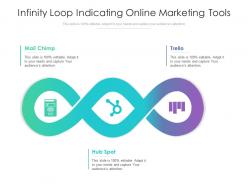
Infinity loop indicating online marketing tools
Try Before you Buy Download Free Sample Product
Audience
Editable
of Time
Our Infinity Loop Indicating Online Marketing Tools are topically designed to provide an attractive backdrop to any subject. Use them to look like a presentation pro.
People who downloaded this PowerPoint presentation also viewed the following :
Infinity loop indicating online marketing tools with all 2 slides:
Use our Infinity Loop Indicating Online Marketing Tools to effectively help you save your valuable time. They are readymade to fit into any presentation structure.
FAQs for Infinity loop indicating
Key components include customer journey mapping, personalized content creation, multi-channel engagement platforms, advanced analytics systems, and automated nurturing workflows. These tools work together by capturing prospects at multiple touchpoints, delivering targeted messaging throughout the buyer's journey, and continuously optimizing engagement strategies, with many organizations finding that this integrated approach significantly increases conversion rates and customer lifetime value.
Marketers leverage data analytics within the infinity loop framework by continuously collecting customer insights, tracking engagement patterns, and measuring conversion rates across touchpoints. This data-driven approach enables real-time campaign optimization, personalized content delivery, and predictive customer behavior modeling, with retail and e-commerce companies finding that continuous analytics refinement ultimately delivers higher ROI and enhanced customer experiences.
Businesses face challenges including data integration complexity across multiple touchpoints, resource allocation for continuous optimization, and measuring long-term customer lifetime value versus short-term ROI. While implementing comprehensive tracking systems and cross-channel coordination requires significant investment, many organizations find that strategic automation and analytics tools ultimately streamline operations, delivering enhanced customer experiences and sustainable competitive advantage.
Infinity loop concepts enhance customer journey mapping by creating continuous feedback cycles, enabling real-time optimization, and fostering ongoing customer relationships beyond single transactions. This approach transforms traditional linear mapping into dynamic, iterative processes where businesses continuously refine touchpoints, personalize experiences, and adapt strategies based on customer behavior, ultimately delivering sustained engagement and long-term loyalty.
Automation streamlines infinity loop marketing by enabling continuous customer journey tracking, personalized content delivery, and real-time campaign adjustments across multiple touchpoints. Through automated email sequences, behavioral triggers, and data analytics, businesses enhance customer retention, reduce manual oversight, and accelerate conversion cycles, ultimately delivering consistent engagement and improved ROI.
Social media integrates with the infinity loop marketing model through awareness campaigns, engagement strategies, lead nurturing sequences, conversion optimization, and retention programs. These platforms enable businesses to seamlessly guide prospects through each loop stage, with brands like Nike and Starbucks leveraging social content for continuous customer journey enhancement, ultimately delivering sustained engagement and competitive advantage.
Different customer touchpoints significantly influence infinity loop dynamics by creating varied entry points, engagement depths, and conversion pathways throughout the customer journey. Social media interactions might spark initial awareness while email campaigns nurture consideration, and customer service experiences drive advocacy, with many organizations finding that optimizing touchpoint integration ultimately delivers seamless customer experiences and accelerated loop momentum.
**INPUT**: What are the best tools for tracking and measuring the effectiveness of an infinity loop strategy? **OUTPUT**: Effective infinity loop tracking tools include Google Analytics, HubSpot, Salesforce, marketing automation platforms, and customer journey mapping software. These technologies streamline measurement by tracking multi-touchpoint interactions, analyzing customer lifecycle progression, and identifying conversion optimization opportunities, with many organizations finding that integrated analytics deliver comprehensive visibility and enhanced campaign performance. *[Word count: 54 words]*
A/B testing integrates seamlessly into the infinity loop marketing framework by enabling continuous optimization at each stage, from awareness campaigns and content variations to conversion funnels and retention strategies. Through systematic testing of headlines, email sequences, landing pages, and customer touchpoints, businesses can refine their approach iteratively, with many organizations finding that this data-driven refinement significantly enhances customer experiences and marketing ROI.
**INPUT**: What are some case studies showcasing successful implementation of the infinity loop in marketing? **OUTPUT**: Successful infinity loop implementations include Amazon's personalized recommendations driving repeat purchases, Netflix's content optimization based on viewing patterns, and Starbucks' mobile app creating seamless purchase-to-loyalty cycles. These approaches enhance customer retention through continuous data collection, personalized experiences, and strategic touchpoint optimization, with many organizations finding that integrated feedback loops ultimately deliver higher lifetime value and sustained competitive advantage. [Word count: 60 words]
Branding and messaging evolve continuously throughout the infinity loop by adapting to customer feedback, behavioral data, and engagement insights at each touchpoint. Through real-time analytics and A/B testing, companies refine their brand voice, visual elements, and messaging strategies, with many retail and SaaS organizations finding that this iterative approach delivers stronger customer connections and higher conversion rates.
Emerging trends in infinity loop marketing tools include AI-powered predictive analytics, omnichannel automation platforms, real-time personalization engines, voice and conversational marketing integration, and blockchain-based customer journey tracking. These technologies enhance continuous customer engagement by delivering hyper-personalized experiences, streamlining cross-platform interactions, and providing deeper behavioral insights, with many organizations finding that advanced automation ultimately drives higher retention rates and competitive advantage.
Businesses maintain audience engagement throughout the infinity loop by delivering personalized content at each stage, leveraging data analytics to understand customer preferences, and implementing retargeting campaigns that nurture relationships continuously. Through strategic email marketing, social media interactions, and dynamic website experiences, companies create seamless touchpoints that guide prospects from awareness to advocacy, ultimately building lasting customer loyalty and maximizing lifetime value.
Customer feedback and reviews serve as crucial data inputs that continuously refine and optimize each stage of the infinity loop marketing approach, enabling real-time adjustments to content, targeting, and customer experience strategies. This feedback-driven optimization helps businesses enhance conversion rates, improve customer retention, and identify new growth opportunities, with many organizations finding that systematic review integration ultimately delivers more personalized campaigns and stronger competitive advantage.
Content marketing integrates with the infinity loop by continuously attracting prospects through valuable content, nurturing leads with targeted materials, and retaining customers through ongoing educational resources. This perpetual content cycle enhances brand authority, builds lasting relationships, and generates recurring engagement, with many organizations finding that strategic content distribution across multiple touchpoints ultimately delivers sustained growth and customer loyalty.
-
It saves your time and decrease your efforts in half.