

Information security framework ppt slides download




Try Before you Buy Download Free Sample Product
 Impress Your
 Audience
 100%
100% Editable
 Save Hours
 of Time


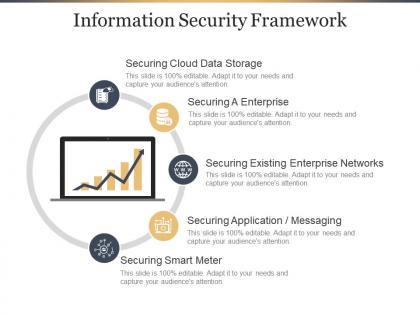
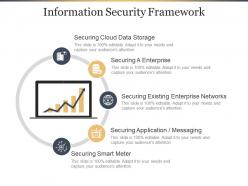
Avail the information security framework PPT slides download PowerPoint presentation to describe the various controls to your viewers which your organization may need to implement to ensure that the data is sensibly protecting the confidentiality, availability and integrity of the assets from threats and vulnerabilities. The cyber security standards layout provides the user a platform to present a business presentation to initiate the process to study and assess the circumstances of the risks of the organization and how the same may be dealt with, in a proper way for the management, protection of assets and the dissemination of the risks to all appropriate stakeholders. The features and components of the information security management design avails the user to evaluate the course which requires proper asset identification and valuation steps including the evaluation the value of confidentiality, integrity, availability and replacement of assets. As we all know that the managing the information security in its essence means managing and mitigating the various threats and vulnerabilities to assets, while at the same time balancing the management efforts expanded on the potential threats and vulnerabilities, the usage of this template provides the presenter to express his / her opinions and ideas to the viewers regarding the relevant steps which can be considered to jettison the risk factors. Be better equipped with our Information Security Framework Ppt Slides Download. Employ the best available in the business.
People who downloaded this PowerPoint presentation also viewed the following :
Information security framework ppt slides download with all 5 slides:
In a hurry to finish up that important presentation? We have thousands of Information Security Framework Ppt Slides Download ready to use ready in moments.



FAQs for Information security framework
**INPUT**: What are the primary components of an effective information security framework? **OUTPUT**: Effective information security frameworks include risk assessment protocols, access control management, incident response procedures, security awareness training, and continuous monitoring systems. These components work together by identifying vulnerabilities, restricting unauthorized access, and enabling rapid threat response, with many organizations finding that this comprehensive approach ultimately delivers enhanced operational security and competitive advantage. **Word count: 54 words**
Risk assessment contributes to information security framework development by identifying vulnerabilities, evaluating threat likelihood, and prioritizing security controls based on business impact. This systematic evaluation enables organizations to allocate resources strategically, implement targeted protections, and establish policies that address their most critical exposures, ultimately delivering cost-effective security while supporting operational continuity.
Compliance acts as a foundational driver for information security frameworks, establishing mandatory security controls, risk assessment protocols, audit requirements, and governance structures. Organizations in regulated sectors like healthcare, finance, and government find that compliance standards such as HIPAA, PCI DSS, and SOX ultimately streamline security implementation while delivering competitive advantage through enhanced customer trust.
Organizations can align their information security frameworks with industry-specific regulations by conducting comprehensive compliance gap analyses, implementing regulatory mapping processes, and establishing continuous monitoring systems. Financial institutions, healthcare providers, and energy companies increasingly integrate frameworks like NIST or ISO 27001 with sector requirements such as PCI DSS, HIPAA, or NERC CIP, ultimately delivering regulatory compliance while enhancing overall security posture and operational efficiency.
Best practices for implementing a security framework across departments include establishing clear governance structures, conducting comprehensive risk assessments, standardizing security policies, providing role-specific training, and creating cross-departmental communication protocols. These approaches streamline compliance by ensuring consistent implementation, reducing vulnerabilities through coordinated oversight, and enhancing organizational resilience, with many enterprises finding that integrated frameworks ultimately deliver improved operational efficiency and stronger competitive positioning.
Emerging technologies drive information security frameworks to evolve through enhanced threat detection, automated response capabilities, and adaptive risk management protocols. AI-powered security systems, blockchain verification, and zero-trust architectures enable organizations to address sophisticated cyber threats while streamlining compliance processes, ultimately delivering faster incident response and stronger data protection across increasingly complex digital environments.
Information security framework effectiveness should be measured through incident response time, vulnerability remediation rates, compliance audit scores, security awareness training completion, and risk assessment frequency. These metrics enable organizations to track operational efficiency, regulatory adherence, and threat mitigation across sectors like banking, healthcare, and retail, ultimately delivering enhanced security posture and reduced operational risks.
Incident response plans integrate into information security frameworks through clearly defined escalation procedures, automated threat detection systems, cross-functional communication protocols, and regular testing schedules. These strategic components streamline organizational responses by minimizing downtime, containing threats rapidly, and ensuring compliance adherence, with many enterprises finding that integrated frameworks ultimately deliver faster recovery times and enhanced security posture.
Training and awareness programs are fundamental to information security frameworks, as they transform employees from potential security vulnerabilities into active defense assets through regular education, simulated phishing exercises, and policy updates. These programs significantly reduce human error incidents, enhance threat recognition capabilities, and foster a security-conscious culture, with organizations increasingly finding that well-trained staff deliver stronger overall security posture and faster incident response.
International standards like ISO/IEC 27001 significantly influence information security frameworks by providing structured methodologies, comprehensive risk assessment protocols, and globally recognized compliance benchmarks that organizations can adopt and customize. These standards enable companies across sectors like banking, healthcare, and manufacturing to streamline their security postures, enhance regulatory compliance, and demonstrate credibility to stakeholders, ultimately delivering competitive advantage in an increasingly security-conscious business environment.
Common challenges when adopting new information security frameworks include resistance to change, budget constraints, skill gaps, complex integration with existing systems, and ensuring regulatory compliance. Organizations often find that addressing these challenges requires strategic planning, comprehensive training, and phased implementation approaches, with many companies discovering that early stakeholder engagement and clear communication ultimately streamline adoption processes.
Organizations ensure continuous improvement within their information security framework through regular security assessments, threat monitoring, vulnerability testing, incident analysis, and policy updates. By implementing automated monitoring tools, conducting quarterly reviews, and analyzing emerging threats, companies like financial institutions and healthcare providers enhance their defensive capabilities, reduce response times, and maintain competitive advantage in an increasingly complex threat landscape.
Governance establishes strategic direction, accountability structures, and decision-making processes that guide information security implementation across organizations. It ensures security initiatives align with business objectives, regulatory requirements, and risk tolerance levels, while defining roles, responsibilities, and oversight mechanisms that enable consistent policy enforcement, resource allocation, and continuous improvement throughout the enterprise.
Organizations incorporate threat intelligence by integrating real-time data feeds, automated threat detection systems, incident response protocols, and risk assessment processes into their existing security infrastructure. Through platforms that analyze external threat data, companies in banking, healthcare, and retail can proactively identify vulnerabilities, accelerate response times, and strengthen defenses, ultimately delivering enhanced protection and competitive advantage.
Zero-trust models fundamentally shift traditional security frameworks from perimeter-based defense to continuous verification, requiring organizations to authenticate every user, device, and transaction regardless of location. This transformation demands significant infrastructure updates, policy restructuring, and staff retraining, while ultimately delivering enhanced threat detection, reduced breach impact, and improved compliance capabilities for modern distributed environments.
-
Topic best represented with attractive design.
-
Innovative and attractive designs.