

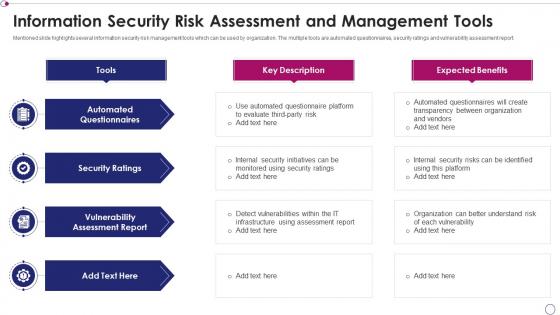
Information security risk assessment and management tools




Try Before you Buy Download Free Sample Product
 Impress Your
Audience
 100%
Editable
 Save Hours
of Time


Our Information Security Risk Assessment And Management Tools are topically designed to provide an attractive backdrop to any subject. Use them to look like a presentation pro.
People who downloaded this PowerPoint presentation also viewed the following :
Information security risk assessment and management tools with all 6 slides:
Use our Information Security Risk Assessment And Management Tools to effectively help you save your valuable time. They are readymade to fit into any presentation structure.






FAQs for Information security risk assessment
Key components include risk identification, vulnerability assessments, threat analysis, impact evaluation, and mitigation strategies. These frameworks enhance organizational security by systematically cataloging digital assets, quantifying potential threats, and implementing layered defenses, with many financial institutions and healthcare organizations finding that comprehensive risk management ultimately delivers regulatory compliance, reduced breach costs, and sustained competitive advantage.
Organizations identify and prioritize information security risks through comprehensive risk assessments, threat modeling, vulnerability scanning, asset classification, and stakeholder interviews across all business units. This systematic approach enables companies to map critical assets, evaluate potential impact scenarios, and allocate resources strategically, with many enterprises finding that regular risk prioritization matrices ultimately streamline security investments and enhance operational resilience.
Risk assessment serves as the foundational cornerstone of information security risk management, systematically identifying vulnerabilities, evaluating potential threats, and quantifying the likelihood and impact of security breaches across organizational assets. Through comprehensive risk assessment, organizations can prioritize security investments, allocate resources strategically, and develop targeted mitigation strategies, ultimately enabling data-driven decisions that enhance overall security posture.
Businesses can measure potential security breach impact through quantitative analysis including data loss costs, regulatory fines, operational downtime expenses, customer acquisition costs, and reputation damage assessments. Financial institutions and healthcare organizations increasingly use risk modeling frameworks that calculate direct costs, business interruption losses, and long-term customer trust erosion, ultimately enabling strategic resource allocation for cybersecurity investments.
Common vulnerabilities include outdated software systems, weak authentication protocols, unencrypted data transmission, inadequate access controls, and insufficient employee security training. These security gaps create significant operational risks by exposing organizations to data breaches, financial losses, and regulatory penalties, with many enterprises finding that proactive vulnerability management delivers enhanced customer trust and competitive advantage.
Organizations ensure compliance by implementing comprehensive governance frameworks, conducting regular audits, maintaining detailed documentation, training employees on security protocols, and establishing continuous monitoring systems. Through structured approaches like ISO 27001 or NIST frameworks, companies across healthcare, finance, and retail sectors streamline regulatory adherence while enhancing operational security, ultimately delivering reduced compliance costs and stronger stakeholder trust.
**INPUT**: What methods can be employed to continuously monitor and evaluate security risks? **OUTPUT**: Continuous security risk monitoring employs automated threat detection systems, vulnerability scanning tools, security information and event management platforms, penetration testing, and compliance auditing frameworks. These methods streamline risk assessment by identifying emerging threats, tracking system vulnerabilities, and analyzing security incidents in real-time, with many organizations finding that integrated monitoring ultimately delivers enhanced threat response and operational resilience. **Word count: 60 words**
Emerging technologies like AI and IoT significantly transform information security risk management by introducing new vulnerabilities, expanding attack surfaces, and requiring adaptive security frameworks. While AI enhances threat detection through predictive analytics and automated responses, IoT devices create distributed security challenges, with organizations increasingly implementing zero-trust architectures and continuous monitoring to maintain comprehensive protection across interconnected systems.
Employee training is critical for mitigating information security risks because human error accounts for the majority of security breaches, while educated employees become the first line of defense against cyber threats. Through comprehensive security awareness programs, organizations significantly reduce phishing susceptibility, improve incident response times, and enhance overall security posture, with many companies finding that regular training decreases security incidents by up to 70%.
Organizations effectively communicate risk management policies through clear, role-specific documentation, regular training sessions, executive briefings, and accessible digital platforms. Financial institutions and healthcare organizations find that combining visual risk dashboards with tailored messaging for different stakeholder groups, from board members to frontline employees, ultimately enhances compliance awareness and creates a shared security culture.
Strategies include regular security training programs, phishing simulation exercises, clear security policies, leadership engagement, incident reporting systems, and recognition programs for security-conscious behavior. These approaches enhance organizational security by building employee awareness, encouraging proactive threat identification, and establishing accountability, with many companies finding that comprehensive awareness programs significantly reduce security incidents while strengthening overall cyber resilience.
Organizations balance risk appetite with innovation by implementing adaptive security frameworks, establishing risk tolerance thresholds for different project types, and creating innovation sandboxes with controlled environments. Through strategic risk assessment processes, companies like financial institutions and healthcare providers can pursue digital transformation initiatives while maintaining security standards, ultimately enabling competitive advantage without compromising critical assets.
Third-party vendors introduce significant complexities to information security risk management, including expanded attack surfaces, data sharing vulnerabilities, compliance challenges, and limited direct control over security practices. Organizations increasingly implement vendor risk assessment programs, contractual security requirements, and continuous monitoring frameworks, with many financial institutions and healthcare providers finding that strategic vendor partnerships require robust due diligence processes to maintain regulatory compliance.
Incident response plans integrate into risk management frameworks by establishing clear escalation procedures, defining roles and responsibilities, and creating continuous feedback loops that inform future risk assessments. Through structured post-incident analysis, organizations enhance their threat detection capabilities, refine security protocols, and strengthen operational resilience, ultimately delivering faster recovery times and reduced business impact from security events.
Technology automates information security risk management through continuous monitoring systems, AI-powered threat detection, automated vulnerability scanning, risk assessment algorithms, and real-time compliance tracking. These solutions streamline identification and response processes by reducing manual oversight, accelerating threat analysis, and enabling proactive risk mitigation, with many organizations finding significantly enhanced security postures and operational efficiency.
-
Informative design.
-
Great product with effective design. Helped a lot in our corporate presentations. Easy to edit and stunning visuals.