

Information Security Vulnerability Management Program




Try Before you Buy Download Free Sample Product
 Impress Your
Audience
 100%
Editable
 Save Hours
of Time


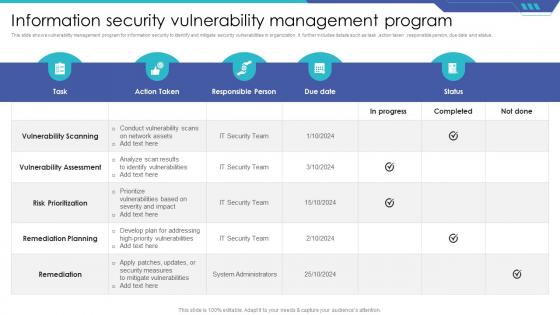
This slide shows vulnerability management program for information security to identify and mitigate security vulnerabilities in organization. It further includes details such as task, action taken, responsible person, due date and status.
People who downloaded this PowerPoint presentation also viewed the following :
Information Security Vulnerability Management Program with all 9 slides:
Use our Information Security Vulnerability Management Program to effectively help you save your valuable time. They are readymade to fit into any presentation structure.








FAQs for Information Security
A successful vulnerability management program includes asset discovery and inventory, vulnerability scanning and assessment, risk prioritization based on business impact, remediation planning and implementation, and continuous monitoring with reporting. These steps work together by identifying security gaps, prioritizing critical vulnerabilities, and streamlining patch management processes, with many organizations finding that systematic approaches ultimately deliver reduced attack surfaces and enhanced security posture.
Organizations prioritize vulnerabilities through risk-based scoring systems that evaluate threat severity, asset criticality, exploit probability, and potential business impact. Financial institutions and healthcare systems increasingly combine automated CVSS scoring with contextual factors like data sensitivity and system exposure, ultimately enabling security teams to address high-risk vulnerabilities first while optimizing resource allocation.
Effective vulnerability scanning automation tools include Nessus, OpenVAS, Qualys VMDR, Rapid7 InsightVM, and Checkmarx for code analysis. These technologies streamline security operations by providing continuous monitoring, prioritized remediation guidance, and integrated threat intelligence, with many financial services and healthcare organizations finding that automated scanning reduces response times while enhancing overall security posture.
Organizations should conduct vulnerability assessments monthly for critical systems, quarterly for standard infrastructure, and continuously through automated scanning tools that monitor networks in real-time. This multi-layered approach enables businesses to identify emerging threats, prioritize patch management, and maintain security compliance, with many financial institutions and healthcare organizations finding that regular assessments significantly reduce breach risks while enhancing operational resilience.
Continuous monitoring serves as the backbone of effective vulnerability management by providing real-time visibility into system changes, emerging threats, and security posture drift across IT environments. Through automated scanning and threat intelligence integration, organizations can detect vulnerabilities immediately upon discovery, prioritize remediation based on actual risk exposure, and maintain compliance standards, ultimately reducing attack windows from months to hours while enabling proactive rather than reactive security strategies.
Organizations effectively balance vulnerability remediation and operational efficiency by implementing risk-based prioritization, automated patch management systems, and scheduled maintenance windows that minimize business disruption. Through strategic vulnerability scoring and phased deployment approaches, companies in sectors like banking and healthcare streamline security updates while maintaining service continuity, ultimately delivering enhanced protection without compromising productivity.
Effective vulnerability communication strategies include automated alerting systems, risk-based prioritization frameworks, standardized reporting templates, multi-channel notification protocols, and stakeholder-specific dashboards. These approaches streamline information flow by delivering contextualized threat data, establishing clear escalation paths, and enabling real-time visibility across security teams, with many organizations finding that structured communication reduces response times and enhances overall security posture.
Vulnerability management varies significantly across environments, with cloud requiring automated scanning and shared responsibility models, on-premises demanding internal control and manual processes, and hybrid needing unified visibility across both infrastructures. These approaches streamline security by addressing specific architectural challenges, compliance requirements, and resource allocation needs, with many organizations finding that integrated platforms ultimately deliver consistent protection and operational efficiency.
Common vulnerability management challenges include resource constraints, alert fatigue from false positives, lack of skilled personnel, complex multi-vendor environments, and difficulty prioritizing critical vulnerabilities. These obstacles can be mitigated through automated scanning tools, risk-based prioritization frameworks, and integrated security platforms, with many organizations finding that strategic staff training and cross-functional collaboration ultimately streamline remediation processes while reducing operational overhead.
Employee training and awareness are crucial for vulnerability management, as human error accounts for significant security breaches through poor password practices, phishing susceptibility, and inadequate incident reporting. Through comprehensive security education programs, organizations enhance threat detection capabilities, reduce response times, and strengthen overall security posture, with many financial institutions and healthcare systems finding that well-trained staff serve as the first line of defense against emerging cyber threats.
Organizations should track metrics including mean time to detection, mean time to remediation, vulnerability recurrence rates, patch compliance percentages, and risk exposure reduction across different severity levels. These measurements enable security teams to identify bottlenecks, optimize resource allocation, and demonstrate program value, with many enterprises finding that tracking remediation velocity alongside business impact metrics ultimately delivers improved security posture and stakeholder confidence.
Threat intelligence enhances vulnerability management by prioritizing critical vulnerabilities based on active threats, providing context about exploitation methods, and enabling proactive defense strategies. Through real-time threat feeds, organizations streamline patch prioritization, accelerate incident response, and reduce security gaps, with many financial services and healthcare institutions finding this approach significantly improves their security posture while optimizing resource allocation.
Regulatory compliance significantly shapes vulnerability management strategies by mandating specific timelines, reporting requirements, documentation standards, and risk assessment protocols across industries like healthcare, finance, and government sectors. These frameworks drive organizations to implement more structured approaches, automated scanning tools, and comprehensive remediation processes, ultimately delivering enhanced security posture and reduced legal exposure while streamlining audit preparations.
Vulnerability management integrates into SDLC through security requirements definition, threat modeling during design, automated security testing in development, and continuous monitoring post-deployment. These practices enable organizations to identify vulnerabilities early when remediation costs are lower, streamline secure coding practices, and ultimately deliver more robust applications while reducing security debt and compliance risks.
Emerging technologies shaping vulnerability management include artificial intelligence for automated threat detection, machine learning for predictive risk assessment, blockchain for secure patch distribution, quantum-resistant cryptography, and cloud-native security orchestration platforms. These technologies streamline identification processes, enhance response times, and enable proactive defense strategies, with many organizations finding that automated vulnerability prioritization significantly reduces security gaps while optimizing resource allocation.
-
SlideTeam provides PPTs on every single topic. Their templates suit my job very well. I am very grateful!
-
It saves your time and decrease your efforts in half.