


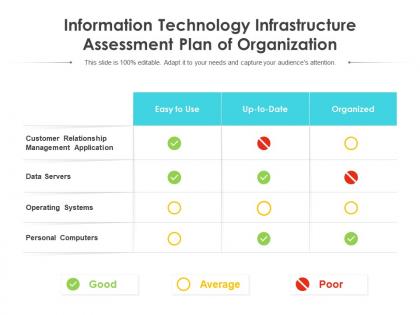
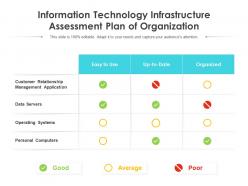
Information technology infrastructure assessment plan of organization




Try Before you Buy Download Free Sample Product
 Impress Your
 Audience
 100%
100% Editable
 Save Hours
 of Time


Our Information Technology Infrastructure Assessment Plan Of Organization are topically designed to provide an attractive backdrop to any subject. Use them to look like a presentation pro.
People who downloaded this PowerPoint presentation also viewed the following :
Information technology infrastructure assessment plan of organization with all 2 slides:
Use our Information Technology Infrastructure Assessment Plan Of Organization to effectively help you save your valuable time. They are readymade to fit into any presentation structure.
FAQs for Information technology infrastructure assessment
Key components include network architecture, server performance, security protocols, data storage systems, and backup procedures. These elements work together to identify vulnerabilities, optimize resource allocation, and enhance operational efficiency, with many organizations finding that comprehensive assessments ultimately deliver improved system reliability and reduced operational costs.
Cloud adoption fundamentally transforms IT infrastructure assessment by shifting focus from physical hardware evaluation to hybrid environments, network connectivity, data migration pathways, and security frameworks. Organizations increasingly assess legacy systems for cloud compatibility, bandwidth requirements, and integration capabilities, with many enterprises finding that strategic cloud migration delivers enhanced scalability, reduced operational costs, and improved disaster recovery.
Common pitfalls during IT infrastructure assessment include incomplete inventory documentation, overlooking legacy system dependencies, inadequate security vulnerability analysis, insufficient capacity planning, and poor stakeholder communication. These oversights can lead to costly misconfigurations and project delays, with many organizations finding that thorough preliminary planning and cross-departmental collaboration ultimately delivers more accurate assessments and strategic technology roadmaps.
Organizations align business goals with IT infrastructure needs by mapping strategic objectives to technology requirements, evaluating current system capabilities against future growth plans, and identifying gaps that could hinder operational efficiency. Through comprehensive stakeholder interviews and performance analysis, companies can prioritize infrastructure investments that directly support revenue growth, cost reduction, and competitive advantage, ultimately ensuring their technology foundation scales with business ambitions.
Cybersecurity plays a critical role in IT infrastructure assessments by evaluating security protocols, identifying vulnerabilities, assessing compliance frameworks, and analyzing threat detection capabilities. Through comprehensive security audits, organizations can streamline risk management, enhance data protection, and strengthen network defenses, with many enterprises finding that integrated security assessments ultimately deliver improved operational resilience and competitive advantage.
Performance metrics enhance infrastructure assessments by measuring system responsiveness, resource utilization, throughput capacity, availability rates, and security incident frequencies. These quantitative indicators enable organizations to identify bottlenecks, predict scaling requirements, and prioritize upgrade investments, with many enterprises finding that data-driven assessments deliver more accurate modernization strategies and improved operational efficiency.
Effective IT infrastructure assessment tools include network scanners like Nmap, vulnerability assessment platforms such as Nessus, asset management systems, performance monitoring solutions, and cloud readiness analyzers. These technologies streamline evaluation processes by automating discovery, identifying security gaps, and benchmarking performance metrics, with many organizations finding that comprehensive toolsets ultimately deliver faster assessments and more strategic infrastructure modernization decisions.
A thorough IT infrastructure assessment improves disaster recovery plans by identifying critical system dependencies, potential failure points, data backup gaps, recovery time objectives, and communication protocols. These comprehensive evaluations enable organizations to prioritize asset protection, streamline recovery procedures, and minimize downtime costs, with many enterprises finding that strategic assessments reduce recovery times significantly while enhancing business continuity resilience.
Organizations should conduct comprehensive IT infrastructure assessments annually, with quarterly reviews for critical systems and immediate assessments following major changes, security incidents, or technology implementations. This strategic approach enables businesses to identify vulnerabilities, optimize performance, and plan upgrades proactively, with many enterprises finding that regular assessments reduce downtime by 40% while improving operational efficiency.
Involving cross-departmental teams in IT infrastructure assessment delivers comprehensive insights, diverse perspectives, enhanced buy-in, improved accuracy, and better strategic alignment across organizational functions. This collaborative approach enables organizations to identify interdependencies, streamline workflows, and minimize blind spots, with many enterprises finding that cross-functional involvement ultimately accelerates implementation and ensures solutions meet varied departmental needs.
An IT infrastructure assessment supports digital transformation by identifying system gaps, evaluating current capacity, assessing security vulnerabilities, and determining integration capabilities with emerging technologies. This comprehensive evaluation enables organizations to prioritize upgrades strategically, allocate resources efficiently, and ensure their foundation can support cloud migration, automation, and data analytics, ultimately delivering faster implementation and competitive advantage.
Key indicators include frequent system downtime, slow application performance, rising maintenance costs, security vulnerabilities, and difficulty scaling operations to meet growing demands. These warning signs often appear in organizations experiencing network bottlenecks, outdated hardware failures, or compliance gaps, with many companies finding that proactive assessments ultimately deliver enhanced operational efficiency and competitive advantage.
Regulatory compliance requirements significantly influence IT infrastructure assessments by mandating specific security protocols, data protection measures, and audit trail documentation throughout the evaluation process. Organizations in heavily regulated sectors like healthcare, financial services, and manufacturing must ensure their assessments address HIPAA, SOX, or industry-specific standards, ultimately delivering compliant frameworks that minimize legal risks while enhancing operational security.
**INPUT**: What strategies can be employed to communicate assessment findings to stakeholders? **OUTPUT**: Effective communication strategies include executive dashboards with key metrics, risk-prioritized reports, visual network diagrams, budget impact analyses, and phased implementation roadmaps. These approaches streamline complex technical findings by presenting actionable insights, clear timelines, and cost-benefit ratios, with many organizations finding that visual presentations and structured recommendations enhance stakeholder buy-in and accelerate decision-making processes. [Word count: 58]
Organizations can prioritize improvement areas by evaluating business impact, cost-effectiveness, implementation complexity, and alignment with strategic objectives, while considering risk mitigation and regulatory requirements. Many companies use scoring matrices to rank initiatives, focusing first on high-impact, low-complexity projects that deliver quick wins, then tackling comprehensive modernization efforts that enhance operational efficiency and competitive advantage.
-
Commendable slides with attractive designs. Extremely pleased with the fact that they are easy to modify. Great work!