Innovation through product conceptualization funnel

Rating:
90%
Innovation through product conceptualization funnel
Slide 1 of 2
Favourites Favourites

Try Before you Buy Download Free Sample Product

Audience Impress Your
Audience
Editable 100%
Editable
Time Save Hours
of Time
The Biggest Sale is ending soon in
0
0
:
0
0
:
0
0
Rating:
90%
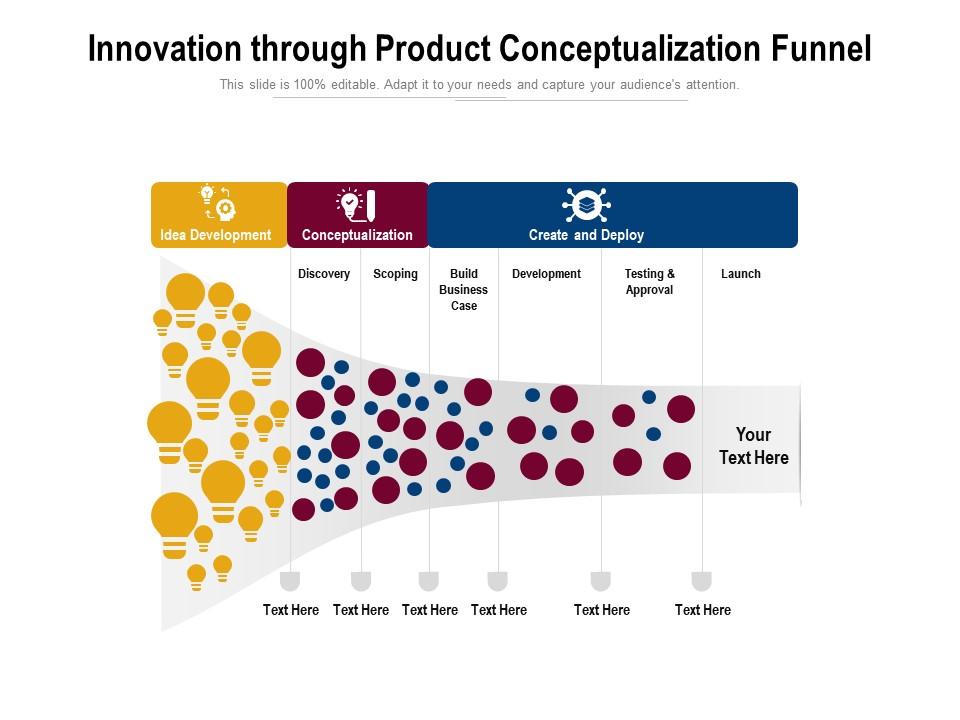
Presenting this set of slides with name Innovation Through Product Conceptualization Funnel. This is a three stage process. The stages in this process are Idea Development, Conceptualization, Create And Deploy. This is a completely editable PowerPoint presentation and is available for immediate download. Download now and impress your audience.

FAQs for Innovation through

The innovation funnel is a structured framework that guides ideas from initial conception through development stages to final implementation, filtering concepts based on feasibility, market potential, and strategic alignment. Unlike linear innovation models, it emphasizes systematic evaluation and resource allocation at each stage, with organizations across industries finding that this approach significantly reduces development risks while maximizing successful product launches and competitive advantage.

The innovation funnel process includes idea generation, concept screening, feasibility analysis, prototype development, testing and validation, and market launch. These stages systematically filter concepts through progressively rigorous evaluation criteria, enabling organizations to allocate resources efficiently, minimize risks, and ultimately deliver viable innovations that create competitive advantage.

Organizations effectively manage innovation funnels through structured stage-gate processes, cross-functional collaboration, clear criteria for advancement, and data-driven decision making at each phase. By implementing systematic evaluation frameworks, resource allocation strategies, and regular portfolio reviews, companies like 3M and Google streamline innovation pipelines, ultimately delivering higher success rates and competitive market advantages.

Key metrics include idea generation rates, concept feasibility scores, prototype development timelines, market validation indicators, and commercialization success rates at respective funnel stages. These measurements enable organizations to track innovation velocity, resource allocation efficiency, and conversion rates between phases, with many companies finding that systematic metric tracking streamlines decision-making and ultimately delivers higher innovation ROI.

Idea generation serves as the critical entry point of the innovation funnel, where diverse concepts are collected through brainstorming, customer feedback, market research, and employee suggestions. This initial stage feeds the subsequent filtering phases, with organizations like 3M and Google systematically capturing thousands of ideas annually, then applying structured evaluation criteria to identify the most promising concepts for development, ultimately transforming raw creativity into strategic innovation opportunities.

Cross-functional teams drive innovation funnels by combining diverse expertise, accelerating decision-making, reducing silos, and ensuring market viability throughout development stages. These collaborative structures enable organizations to streamline idea evaluation, enhance problem-solving capabilities, and deliver customer-focused solutions more efficiently, with many companies finding that integrated teams significantly reduce time-to-market while improving innovation success rates.

Technology enhances the innovation funnel through AI-powered idea screening, digital collaboration platforms, predictive analytics for market validation, and automated workflow management systems. These tools streamline ideation, accelerate prototyping, and enable data-driven decision making, with many organizations finding that integrated innovation management software reduces time-to-market while improving project success rates.

Organizations should avoid insufficient resource allocation at each stage, lack of clear evaluation criteria, premature idea elimination, and poor cross-functional collaboration throughout the funnel process. These pitfalls often result in promising innovations being abandoned too early, with many companies finding that establishing structured gates, dedicated funding, and regular stakeholder alignment ultimately delivers more successful outcomes and sustainable competitive advantage.

Customer feedback integrates into innovation funnel stages through systematic collection during ideation, validation testing in development phases, and iterative refinement based on user insights. Organizations like tech companies and retail brands increasingly embed customer advisory panels, beta testing programs, and feedback loops throughout their innovation processes, ultimately delivering products that better meet market demands and reduce development risks.

Prioritization techniques include impact-effort matrices, scoring models, strategic alignment assessments, customer validation metrics, and resource requirement analysis. These methods enable organizations to systematically evaluate ideas against business objectives, market potential, and feasibility constraints, with many companies finding that combining quantitative scoring with qualitative strategic fit delivers optimal innovation portfolio outcomes.

The innovation funnel supports risk management by systematically filtering ideas through structured evaluation stages, eliminating high-risk concepts early, and allocating resources to validated opportunities with higher success potential. This staged approach enables organizations to minimize costly late-stage failures while maximizing portfolio returns, with many companies finding that systematic screening reduces development costs by up to 40% and accelerates time-to-market significantly.

Corporate culture significantly impacts innovation funnel effectiveness by influencing idea generation, risk tolerance, collaboration levels, and decision-making speed throughout the process. Organizations with cultures that encourage experimentation, cross-functional teamwork, and learning from failure see higher innovation success rates, while rigid, risk-averse environments often stifle creativity and slow the funnel's progression from ideation to implementation.

Innovation funnels require different scaling approaches, with small businesses focusing on rapid prototyping, lean validation, and resource-efficient testing, while large enterprises emphasize structured governance, cross-functional collaboration, and comprehensive market analysis. Small businesses can streamline decision-making and pivot quickly, whereas enterprises benefit from systematic processes and broader resource allocation, ultimately delivering competitive advantage tailored to organizational capacity.

Best practices for facilitating brainstorming sessions include establishing psychological safety, setting clear objectives, encouraging wild ideas, building on others' contributions, and maintaining focus without judgment. These approaches streamline idea generation by creating inclusive environments, leveraging diverse perspectives, and capturing maximum creative input, with many organizations finding that structured facilitation ultimately delivers higher-quality concepts and enhanced team engagement.

Organizations ensure diversity of thought by establishing cross-functional teams, implementing structured brainstorming methodologies, and creating inclusive feedback mechanisms throughout their innovation funnel. Through strategic recruitment from various departments, backgrounds, and expertise levels, companies like tech firms and healthcare organizations enhance creative problem-solving, minimize blind spots, and ultimately deliver more comprehensive solutions that resonate with diverse market segments.

Ratings and Reviews

90% of 100
Review Form
Write a review
Most Relevant Reviews
  1. 80%

    by Chi Ward

    Appreciate the research and its presentable format.
  2. 100%

    by Eddie Sandoval

    Professional and unique presentations.

2 Item(s)

per page: