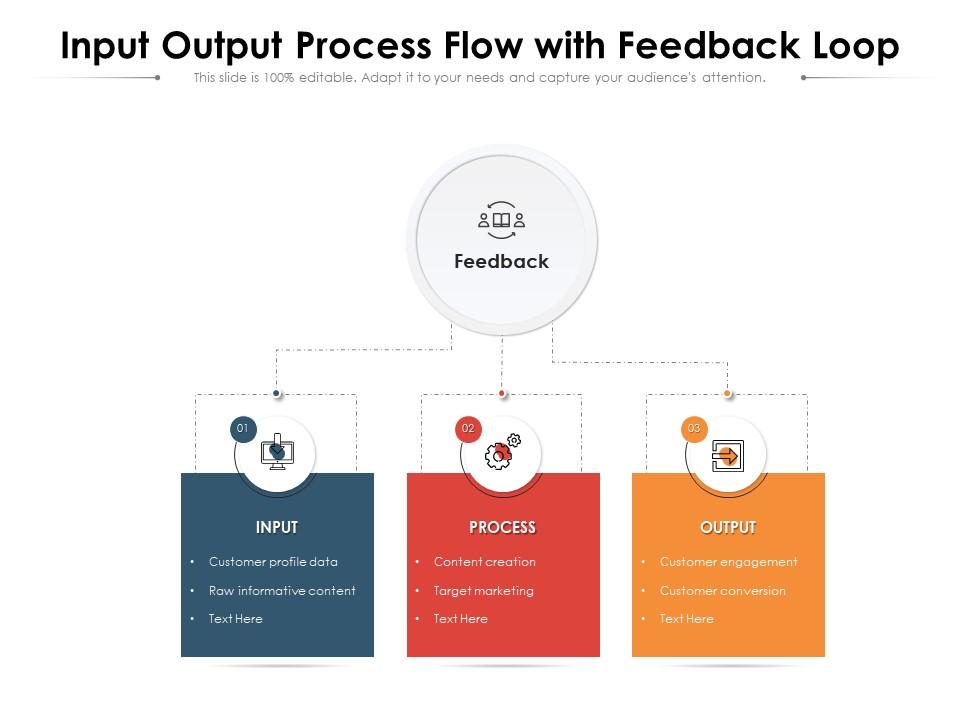
Input output process flow with feedback loop
Try Before you Buy Download Free Sample Product
Audience
Editable
of Time
Our Input Output Process Flow With Feedback Loop are topically designed to provide an attractive backdrop to any subject. Use them to look like a presentation pro.
People who downloaded this PowerPoint presentation also viewed the following :
Input output process flow with feedback loop with all 2 slides:
Use our Input Output Process Flow With Feedback Loop to effectively help you save your valuable time. They are readymade to fit into any presentation structure.
FAQs for Input output process flow
Key components of an input-output feedback loop include sensors for data collection, controllers for processing information, actuators for system adjustments, reference signals for target comparison, and error detection mechanisms for continuous monitoring. These components work together by measuring system performance, comparing results against desired outcomes, and automatically implementing corrections, with many engineering organizations finding that effective feedback loops ultimately deliver enhanced system stability, reduced operational errors, and improved overall performance efficiency.
Input-output feedback loops enhance system stability and performance by continuously monitoring outputs, comparing them against desired targets, and automatically adjusting inputs to minimize deviations. Through real-time correction mechanisms, organizations streamline manufacturing processes, optimize supply chains, and improve service delivery, while reducing waste and operational costs, ultimately delivering consistent quality and competitive advantage in increasingly dynamic markets.
Feedback loops enhance product development through continuous user testing, iterative prototyping, cross-functional team reviews, performance analytics, and market validation cycles. These mechanisms streamline development by identifying issues early, accelerating design improvements, and ensuring market alignment, with many technology companies finding that systematic feedback integration reduces time-to-market while delivering products that better meet customer needs and competitive demands.
Real-time data enables organizations to monitor performance instantly, identify bottlenecks immediately, and adjust processes dynamically, creating more responsive and efficient feedback loops. Through continuous data streams, companies in manufacturing, healthcare, and financial services can optimize resource allocation, reduce operational delays, and enhance customer experiences, ultimately delivering competitive advantages and improved business outcomes.
Positive feedback amplifies system outputs by reinforcing inputs, creating exponential growth or acceleration, while negative feedback stabilizes systems by counteracting deviations and maintaining equilibrium. In business applications, positive feedback drives viral marketing campaigns and rapid scaling, whereas negative feedback enables quality control systems, automated inventory management, and performance optimization, with many organizations strategically combining both to achieve sustainable growth and operational stability.
Common challenges include data quality issues, delayed response times, system integration complexities, feedback noise filtering, and calibration difficulties. These obstacles often arise in manufacturing automation, financial trading systems, and customer service platforms, where inconsistent data sources, legacy system compatibility, and real-time processing demands can disrupt loop effectiveness, ultimately requiring strategic planning and robust testing protocols.
Businesses leverage input-output feedback loops by collecting customer data, monitoring performance metrics, analyzing operational outcomes, and implementing iterative adjustments based on insights gathered. Through systematic feedback integration, organizations streamline processes, enhance product development, and optimize service delivery, with many companies finding that consistent loop implementation drives sustained competitive advantage and measurable growth.
Methodologies include performance metrics analysis, stakeholder surveys, process mapping, retrospective assessments, and data-driven evaluation frameworks. These approaches streamline project outcomes by identifying communication gaps, measuring response times, and tracking implementation success, with many project teams finding that systematic feedback analysis ultimately delivers improved efficiency, enhanced stakeholder satisfaction, and competitive advantage in project delivery.
**INPUT**: How do feedback loops differ in various industries, such as manufacturing vs. software development? **OUTPUT**: Feedback loops in manufacturing focus on physical quality control, supply chain optimization, and equipment performance monitoring, while software development emphasizes iterative testing, user experience data, and code performance metrics. Manufacturing typically operates with longer feedback cycles due to production timelines, whereas software enables real-time adjustments and continuous deployment, with both industries increasingly leveraging automated systems to accelerate decision-making and enhance operational efficiency. [Word count: 60 words]
**INPUT**: What tools and software are available for modeling input-output feedback loops? **OUTPUT**: Tools for modeling input-output feedback loops include MATLAB/Simulink, Python libraries like SciPy and Control, R statistical packages, Vensim, and AnyLogic simulation platforms. These technologies streamline complex system analysis by enabling dynamic modeling, real-time simulation, and predictive analytics, with many organizations finding that integrated feedback modeling ultimately delivers enhanced operational efficiency and strategic decision-making capabilities.
Organizations measure feedback loop impact through customer satisfaction scores, retention rates, response times, and complaint resolution metrics. These measurement systems enable companies to track improvements in service delivery, product quality, and customer experiences, with many retail and hospitality businesses finding that systematic feedback analysis ultimately delivers higher loyalty and competitive advantage.
Successful implementations include Netflix's recommendation algorithms, Amazon's inventory management systems, Tesla's autonomous driving improvements, financial institutions' fraud detection systems, and manufacturing quality control processes. These systems continuously enhance performance by analyzing user behavior, market demand, driving data, transaction patterns, and production metrics, ultimately delivering personalized experiences, optimized operations, and competitive advantages across industries.
Understanding feedback loops enables organizations to make data-driven decisions by revealing cause-and-effect relationships between actions and outcomes, identifying performance patterns, and highlighting areas requiring strategic adjustments. Through continuous monitoring of key metrics, companies can quickly adapt strategies, minimize risks, and optimize resource allocation, with many financial services and retail organizations finding that systematic feedback analysis ultimately delivers improved operational efficiency and competitive advantage.
Ethical considerations include data privacy protection, algorithmic bias prevention, transparency in decision processes, consent for data usage, and fairness in automated outcomes. These safeguards enhance organizational trust by ensuring responsible AI implementation, protecting user rights, and maintaining accountability, with many institutions finding that ethical frameworks ultimately deliver sustainable competitive advantage while minimizing regulatory risks.
Teaching input-output feedback loops to non-technical stakeholders requires using familiar business analogies, visual demonstrations, and real-world examples from sectors like retail inventory management, customer service operations, and marketing campaigns. These educational approaches work by connecting abstract concepts to tangible outcomes, using interactive workshops with practical scenarios, and emphasizing how feedback loops drive continuous improvement, ultimately enabling stakeholders to recognize and leverage these systems for competitive advantage.
-
Qualitative and comprehensive slides.
-
Informative design.
-
Really like the color and design of the presentation.
-
Much better than the original! Thanks for the quick turnaround.
-
Very unique, user-friendly presentation interface.
-
Easily Editable.
-
Excellent work done on template design and graphics.
-
Colors used are bright and distinctive.