

Insurance sector challenges and opportunities in rural areas case competition complete deck





Try Before you Buy Download Free Sample Product
 Impress Your
 Audience
 100%
100% Editable
 Save Hours
 of Time


Our Insurance Sector Challenges And Opportunities In Rural Areas Case Competition Complete Deck are topically designed to provide an attractive backdrop to any subject. Use them to look like a presentation pro.
People who downloaded this PowerPoint presentation also viewed the following :
Content of this Powerpoint Presentation
Slide 1: In this slide, introduce the title for your presentation i.e. Insurance sector - challenges & opportunities in rural areas (case competition). Add your company name here.
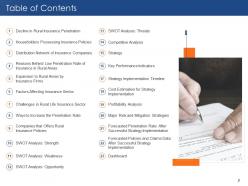
Slide 2: Use this slide to highlight the titles of your Table of contents. Focus on SWOT analysis, distribution of insurance companies, factors affecting the insurance sector, etc.
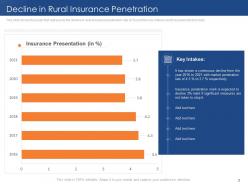
Slide 3: This slide shows the graph that represents the decline in rural insurance penetration rate (in %) and the key intakes and forecasted decline mark.
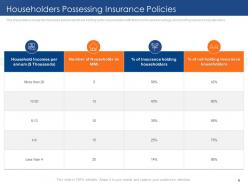
Slide 4: This presentation shows the householders' insurance policies with their income and percentage of not having insurance householders.
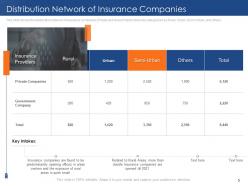
Slide 5: This slide shows the distribution network of insurance companies (Private and Government) categorized as Rural, Urban, Semi-Urban, and Others.
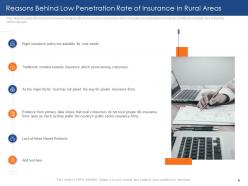
Slide 6: This slide provides the reasons for the low penetration rate of insurance in rural areas, which includes the unavailability of products, traditional mindset, lack of trust by consumers, etc.
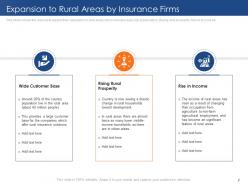
Slide 7: This slide shows the reasons to expand their operations in rural areas, including the large population size, rising rural prosperity, rise in income, etc.
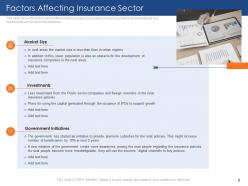
Slide 8: This slide shows the factors that influence the insurance companies in rural areas, including market size, investments, and government initiatives.
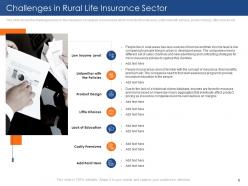
Slide 9: This slide shows the challenges faced by the insurance companies in rural areas, which include remote areas, unfamiliar with policies, product design, little choices, etc.
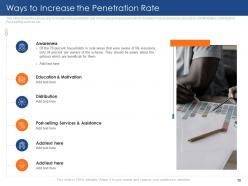
Slide 10: This slide shows the various ways to increase insurance penetration rate in rural areas, including product Awareness, Education and Motivation, Distribution, Post-selling services, etc.
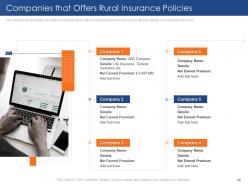
Slide 11: This slide shows the companies that offer insurance policies in rural areas with their details, net earned premium, etc.
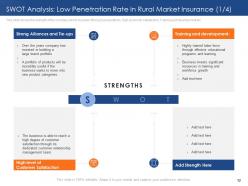
Slide 12: This slide shows the company's strengths, including a strong brand portfolio, high customer satisfaction, training, development, etc, for this project.
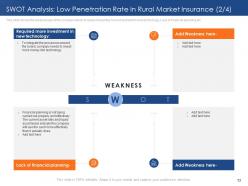
Slide 13: This slide shows the company's weaknesses, which include requiring more investment in new technology, lack of financial planning, etc, for this project.
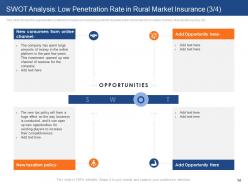
Slide 14: This slide shows the opportunities related to insurance in rural areas, which includes new consumers from online channels, new taxation policies, etc.
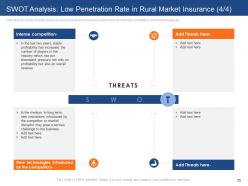
Slide 15: This slide shows the threats related to the insurance sector in rural areas, including Intense competition, New technologies, etc.
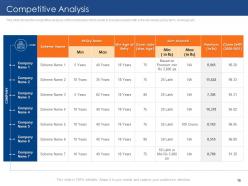
Slide 16: This slide shows the competitive analysis of the companies which deal in insurance plans with scheme names, policy terms, coverage, etc.
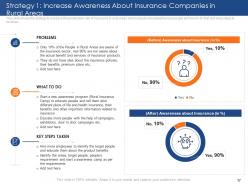
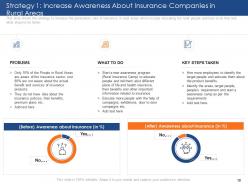
Slide 17: This slide shows the strategy to increase the penetration rate of insurance in rural areas which includes educating the rural people and how to do that and what steps to be taken.
Slide 18: This slide is in continuation to the previous slide and can communicate the problem and the solution steps in a more detailed manner.
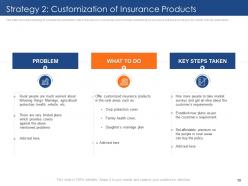
Slide 19: This slide shows the strategy to increase insurance penetration rate in rural areas, which includes customizing the insurance policies according to the needs with key steps taken. Rural people are much worried about the following things: Marriage, agricultural protection, health, vehicle, etc.
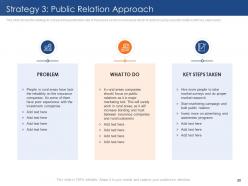
Slide 20: This slide shows the strategy to increase the penetration rate of the insurance sector in rural areas, which includes focusing on public relations with key steps taken.
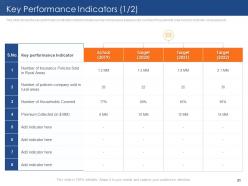
Slide 21: This slide shows the key performance indicators, including the number of insurance policies sold, the number of households, the total number of private companies, etc.
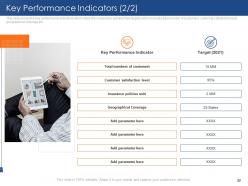
Slide 22: This slide shows the Key performance indicators that help the company achieve its targets, including the total number of customers, customer satisfaction level, geographical coverage, etc.
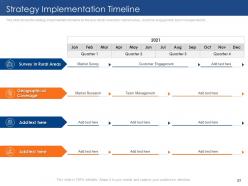
Slide 23: This slide shows the strategy implementation timeline for the year, covering the market survey, customer engagement, team management, etc.
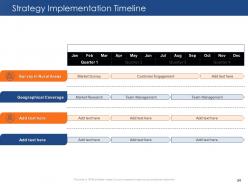
Slide 24: This slide is in continuation with the previous slide as a part of annual assessment to perform surveys of rural areas, and the geographical coverage analysis of research and management over the year.
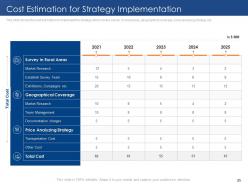
Slide 25: This slide shows the cost estimation to implement the strategy, covering surveys in rural areas, geographical coverage, price analyzing strategy, etc.
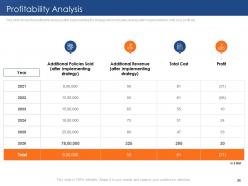
Slide 26: This slide shows the profitability analysis after implementing the strategy, including revenue after implementation, total cost, profit, etc.
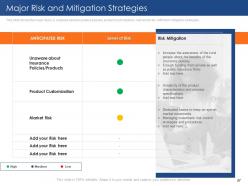
Slide 27: This slide shows the significant risks, i.e. unaware of insurance policies, product customization, market risk, etc, with their mitigation strategies.
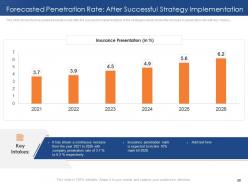
Slide 28: This slide shows the forecasted penetration rate after successfully implementing the strategies, which shows the increase in penetration rate with key intakes.
Slide 29: This slide shows the forecasted policies and claims data after successfully implementing the strategies, including policies sold, GWP, average premium, etc.
Slide 30: This slide shows the dashboard related to your insurance company, including sales per broker, average time to settle by policy type, sales growth, etc.
Slide 31: This is the Icons' slide for the presentation titled "Insurance Sector - Challenges & Opportunities in rural areas (Case Competition)."
Slide 32: This slide marks the start of the Additional slides, comprising metrics and miscellaneous slides.
Slide 33: This is the 'About Us' slide. Highlight your characteristic features, target audience, and distinct clients in this slide.
Slide 34: This slide provides the mission, vision, and goal of your company.
Slide 35: Introduce your team in this slide, including the core members involved in this project along with their designation.
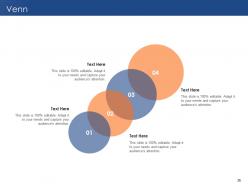
Slide 36: This slide provides a Venn diagram that can be used to show interconnectedness and overlap between various departments, projects, etc.
Slide 37: This is the Post-It Notes slide to share any additional information related to this project.
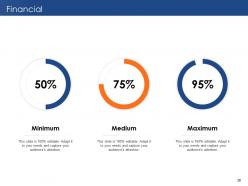
Slide 38: This is the slide to represent the financial highlights of your project.
Slide 39: This is another handy additional slide to highlight your company's core principles, units, or functions that complete it in a creative puzzle format.
Slide 40: Share your 30, 60, and 90 Days plans in this PPT slide.
Slide 41: This is a Thank You slide where details such as the address, contact number, and email address are added.
Insurance sector challenges and opportunities in rural areas case competition complete deck with all 41 slides:
Use our Insurance Sector Challenges And Opportunities In Rural Areas Case Competition Complete Deck to effectively help you save your valuable time. They are readymade to fit into any presentation structure.










FAQs for Insurance sector challenges and opportunities in rural areas case
Rural communities face unique challenges including limited physical insurance offices, inadequate internet connectivity for online services, lower population density making service delivery costly, and reduced agent availability for personalized consultations. These barriers often result in underinsurance and higher premiums, with many rural residents finding that geographic isolation and economic constraints limit their access to comprehensive coverage options.
Cultural perceptions significantly influence rural insurance adoption through trust concerns, unfamiliarity with risk transfer concepts, and preference for traditional community-based support systems. Many rural communities view insurance with skepticism, favoring informal networks and family support, while successful programs increasingly incorporate local leaders, culturally relevant messaging, and community education, ultimately building trust and demonstrating tangible value.
Technology enhances rural insurance accessibility through mobile apps, telemedicine integration, satellite data analysis, digital payment systems, and AI-powered risk assessment tools. These innovations streamline policy applications, enable remote health screenings for life insurance, and facilitate crop monitoring for agricultural coverage, while reducing operational costs and delivery times, ultimately bringing comprehensive insurance services directly to underserved rural communities.
Local agents serve as crucial intermediaries in rural insurance distribution, providing personalized service, building community trust, educating customers about coverage options, and bridging the gap between insurance companies and remote populations. These agents leverage deep local knowledge and relationships to navigate cultural barriers, explain complex policies in accessible terms, and offer ongoing support, with many rural communities finding that this personal approach significantly enhances insurance adoption and customer satisfaction.
Government policies can enhance rural insurance coverage through subsidized premium programs, regulatory incentives for insurers, mobile technology infrastructure investments, and partnerships with local cooperatives and community organizations. These strategic approaches enable broader access by reducing costs, encouraging market participation, and leveraging trusted local networks, with many agricultural communities finding that government-backed crop insurance and health coverage programs ultimately deliver greater financial security and economic stability.
Rural areas most need crop insurance, livestock coverage, property insurance for agricultural equipment, health insurance with telemedicine access, and weather-indexed microinsurance products. These specialized offerings address unique rural risks through flexible premium structures, mobile claim processing, and satellite-based damage assessment, with many agricultural communities finding that bundled coverage delivers comprehensive protection while reducing administrative costs and improving claim resolution times.
Urban populations typically demonstrate higher insurance awareness through greater access to financial education, digital resources, and insurance professionals, while rural communities often rely more on word-of-mouth and traditional information channels. However, rural areas increasingly show growing appreciation for crop, livestock, and health insurance benefits, with many agricultural communities finding that targeted outreach programs and mobile insurance services significantly enhance their understanding of risk protection and financial security options.
**INPUT**: What strategies can be implemented to educate rural residents about insurance essentials? **OUTPUT**: Effective strategies include community workshops, mobile education units, partnerships with local organizations, digital literacy programs, and peer-to-peer learning initiatives. These approaches streamline information delivery by leveraging trusted local networks, utilizing accessible communication channels, and providing hands-on demonstrations, with many rural communities finding that culturally relevant, simplified educational materials ultimately enhance insurance understanding and adoption rates. [Word count: 58 words]
Insurance companies can better tailor products to rural needs by developing crop-specific coverage, offering flexible payment schedules aligned with harvest cycles, and creating simplified application processes. Through mobile technology and local agent partnerships, insurers can deliver affordable livestock protection, weather-based policies, and community-focused plans, ultimately enhancing accessibility while addressing unique agricultural risks and seasonal income variations.
Common misconceptions include believing insurance is too expensive, unnecessary for rural lifestyles, overly complex to understand, unavailable in remote areas, and only beneficial for wealthy individuals. These perceptions often stem from limited exposure to insurance education and agents, with many rural communities finding that modern digital platforms, flexible payment options, and specialized rural insurance products actually deliver affordable protection tailored to agricultural and rural needs.
Climate change significantly impacts rural insurance through increased natural disasters, shifting agricultural risks, and evolving coverage needs for farming operations, infrastructure, and property protection. These changes drive insurers to reassess risk models, adjust premiums, and develop specialized products for drought, flood, and extreme weather events, with many rural communities finding that proactive risk management and diversified coverage strategies ultimately deliver better financial protection and operational resilience.
Cooperatives play a crucial role in expanding rural insurance access by pooling resources, sharing risks among members, and reducing administrative costs through collective bargaining. These community-based organizations enable farmers and rural businesses to access affordable coverage for crops, livestock, and property, while building local capacity for risk assessment and claims processing, ultimately delivering enhanced financial security.
Socioeconomic factors significantly influence rural insurance decisions through limited disposable income, education levels about insurance benefits, and cultural attitudes toward risk management. Lower-income farming communities often prioritize immediate needs over premiums, while higher-educated rural professionals increasingly recognize insurance as essential protection, ultimately creating varied adoption patterns across different socioeconomic segments within rural markets.
Innovative solutions include mobile-based micro-insurance products, weather-indexed policies, community pooling models, blockchain-enabled parametric insurance, and pay-as-you-go premium structures. These approaches streamline costs by reducing administrative overhead, automating claims processing, and leveraging local data, with many rural cooperatives and agricultural institutions finding that technology-driven solutions ultimately deliver affordable coverage while maintaining comprehensive protection.
Partnerships between private insurers and government agencies improve rural insurance penetration by combining private sector efficiency with public sector reach, shared risk models, and subsidized premium structures. Through these strategic collaborations, insurers access government distribution networks and regulatory support while agencies leverage private expertise, ultimately delivering affordable coverage options and enhanced financial inclusion, with many rural communities finding significantly improved access to essential insurance services.
-
Really like the color and design of the presentation.
-
Amazing product with appealing content and design.
-
Illustrative design with editable content. Exceptional value for money. Highly pleased with the product.
-
Thanks for all your great templates they have saved me lots of time and accelerate my presentations. Great product, keep them up!
-
The content is very helpful from business point of view.
-
Topic best represented with attractive design.
-
Content of slide is easy to understand and edit.
-
Great designs, Easily Editable.