

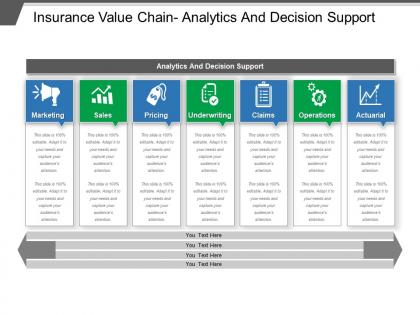
Insurance value chain analytics and decision support




Try Before you Buy Download Free Sample Product
 Impress Your
 Audience
 100%
100% Editable
 Save Hours
 of Time


Build the basis for consensus with our Insurance Value Chain Analytics And Decision Support. Arrive at decisions agreeable to all.
People who downloaded this PowerPoint presentation also viewed the following :
Insurance value chain analytics and decision support with all 5 slides:
Advise folks on avoiding inflammation with our Insurance Value Chain Analytics And Decision Support. Explain the factors that cause the condition.




FAQs for Insurance value chain analytics
Key components of insurance analytics include predictive modeling, real-time data processing, customer segmentation, risk assessment algorithms, and automated claims processing. These technologies streamline underwriting decisions, enhance fraud detection, and improve customer experiences by enabling faster policy approvals, more accurate pricing models, and personalized coverage options, ultimately delivering competitive advantage in an increasingly data-driven marketplace.
Predictive analytics enhances insurance risk assessment by analyzing historical claims data, demographic patterns, behavioral indicators, and external risk factors to identify potential claims before they occur. Through machine learning algorithms, insurers can price policies more accurately, detect fraudulent applications earlier, and optimize underwriting decisions, ultimately reducing claim costs while improving customer segmentation and competitive positioning.
Big data revolutionizes insurance underwriting by enabling real-time risk assessment, predictive modeling, automated decision-making, and personalized pricing strategies through comprehensive data analysis. Traditional insurers increasingly leverage telematics, social media insights, and IoT sensors to streamline approval processes, reduce manual reviews, and deliver more accurate risk predictions, ultimately enhancing operational efficiency while providing competitive pricing advantages.
Insurers leverage customer segmentation by analyzing demographics, risk profiles, claims history, and behavioral patterns to create tailored service offerings. Through advanced analytics, companies develop personalized premiums, targeted products, and customized communication strategies, while streamlining underwriting processes and enhancing customer experiences, ultimately delivering improved retention rates and competitive advantage in an increasingly data-driven marketplace.
Insurers face data quality issues, regulatory compliance requirements, legacy system integration complexities, and skilled talent shortages when implementing machine learning models. While these challenges present initial hurdles, many insurance companies find that strategic partnerships with technology providers and phased implementation approaches enable them to overcome obstacles, ultimately delivering enhanced risk assessment capabilities and competitive advantages in an increasingly data-driven market.
Insurance analytics detects fraudulent claims by analyzing patterns in claim data, cross-referencing policyholder information, monitoring unusual claim frequencies, and flagging suspicious behaviors through predictive algorithms. These technologies streamline investigations by identifying high-risk claims early, automating routine assessments, and enabling faster claim processing, with many insurers finding that analytics reduces fraudulent payouts while improving legitimate customer experiences.
Insurers should track claim processing speed, fraud detection accuracy, customer acquisition costs, policy pricing precision, and predictive model performance scores. These metrics enable organizations to streamline operations, reduce losses, and enhance customer experiences, with many financial services companies finding that comprehensive analytics tracking ultimately delivers competitive advantage and improved profitability.
Real-time data analytics revolutionizes insurance decision-making by enabling instant risk assessment, automated claims processing, and dynamic pricing adjustments based on current market conditions. Through machine learning algorithms, insurers streamline underwriting decisions, detect fraudulent claims immediately, and personalize customer policies, ultimately delivering faster services, reduced operational costs, and enhanced competitive positioning in an increasingly data-driven marketplace.
**INPUT**: What ethical considerations should insurers keep in mind when using data analytics? **OUTPUT**: Insurers should prioritize data privacy, algorithmic fairness, transparency in decision-making, consent management, and bias prevention when implementing analytics solutions. These ethical frameworks enable companies to build customer trust while ensuring compliance, with many financial institutions finding that responsible data practices ultimately deliver competitive advantage, enhanced reputation, and sustainable growth in increasingly regulated markets. **Word count: 54 words**
Insurers can balance privacy and analytics through anonymization techniques, granular consent management, federated learning, and privacy-preserving algorithms that analyze patterns without exposing individual data. These approaches enable competitive advantages like personalized pricing and fraud detection while maintaining customer trust, with many financial institutions finding that transparent data practices ultimately enhance customer relationships and regulatory compliance.
Emerging trends in insurance analytics include artificial intelligence-driven risk assessment, real-time telematics for usage-based policies, predictive modeling for fraud detection, IoT sensors for property monitoring, and blockchain for claims transparency. These technologies streamline underwriting processes, enhance customer personalization, and reduce operational costs, with many insurers finding that strategic analytics integration delivers faster claim resolutions and improved competitive positioning.
Visual analytics tools enhance stakeholder communication in insurance by transforming complex data into interactive dashboards, clear charts, and real-time reports that simplify risk assessments, claims patterns, and performance metrics. These platforms enable executives, underwriters, and analysts to collaborate more effectively through shared visualizations, ultimately streamlining decision-making processes and improving strategic alignment across departments.
Predictive modeling enables insurance companies to identify at-risk customers before they cancel policies, analyze behavioral patterns and satisfaction indicators, and implement targeted retention strategies. Through advanced analytics, insurers can personalize offerings, optimize pricing strategies, and proactively address customer concerns, ultimately reducing churn rates and increasing lifetime customer value significantly.
Collaborative data sharing enables insurers to enhance risk assessment through pooled fraud detection patterns, comprehensive market intelligence, standardized risk models, and shared catastrophic event data. This strategic combination delivers more accurate underwriting, reduced fraud losses, and improved pricing precision, with many insurers finding that collective insights significantly strengthen their competitive positioning in increasingly complex markets.
IoT data enhances underwriting accuracy by providing real-time behavioral insights, continuous risk monitoring, usage-based assessments, and predictive maintenance indicators from connected devices and sensors. Through telematics in auto insurance, smart home sensors for property coverage, and wearable health devices for life policies, insurers can streamline risk evaluation, reduce fraud, and deliver more personalized pricing models.
-
Thanks for all your great templates they have saved me lots of time and accelerate my presentations. Great product, keep them up!
-
Out of the box and creative design.