

Interleaving Techniques Enhance Learning And Memory PPT Template ST AI





Try Before you Buy Download Free Sample Product
 Impress Your
Audience
 100%
Editable
 Save Hours
of Time


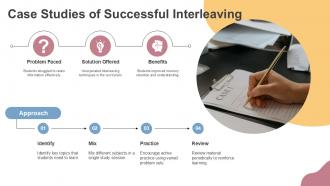
Unlock the power of effective learning with our Interleaving Techniques Enhance Learning and Memory PPT Template. This professional presentation deck offers engaging visuals and insights into interleaving strategies, designed to boost retention and understanding. Perfect for educators and trainers aiming to elevate their teaching methods.
People who downloaded this PowerPoint presentation also viewed the following :
Interleaving Techniques Enhance Learning And Memory PPT Template ST AI with all 44 slides:
Use our Interleaving Techniques Enhance Learning And Memory PPT Template ST AI to effectively help you save your valuable time. They are readymade to fit into any presentation structure.












FAQs for Interleaving Techniques Enhance Learning And Memory PPT
Interleaving techniques deliver enhanced memory retention, improved problem-solving skills, better pattern recognition, increased cognitive flexibility, and stronger transfer of learning across contexts. This approach helps learners distinguish between similar concepts while building robust neural pathways, with many educational institutions and corporate training programs finding that interleaved practice ultimately produces more durable knowledge and superior long-term performance outcomes.
Interleaving techniques outperform traditional block practice by mixing different topics or skills within study sessions, rather than focusing on one subject at a time. While block practice feels easier and builds initial confidence, interleaving enhances long-term retention, improves discrimination between concepts, and develops stronger problem-solving abilities, with many educational institutions finding that students demonstrate superior transfer of knowledge to real-world applications.
Interleaving can be effectively applied across mathematics, language learning, history, and sciences by mixing different problem types, vocabulary sets, or concept categories within study sessions. This cross-subject approach enhances cognitive flexibility and pattern recognition, with students finding improved retention when alternating between algebraic equations and geometric proofs, or switching between grammar exercises and vocabulary acquisition, ultimately delivering stronger long-term learning outcomes.
Interleaving enhances cognitive processing by forcing the brain to repeatedly switch between different concepts, strengthening neural pathways through varied retrieval practice and improving discrimination between similar topics. This technique promotes deeper encoding and flexible thinking patterns, with studies showing students and professionals experience better long-term retention and transfer of knowledge across domains, ultimately delivering superior learning outcomes.
Interleaving techniques significantly enhance problem-solving skills by forcing learners to discriminate between different problem types, strengthen retrieval processes, and develop flexible thinking patterns. Through mixed practice sessions, students in mathematics, engineering, and medical training demonstrate improved pattern recognition, faster diagnostic abilities, and enhanced transfer of knowledge to novel situations, ultimately delivering superior long-term retention and adaptive expertise.
Educators face challenges including resistance from students accustomed to blocked practice, difficulty designing effective mixed-topic sequences, and initial drops in performance that concern parents and administrators. While interleaving requires more complex lesson planning and assessment strategies, schools implementing these approaches find that students develop stronger problem-solving skills and better long-term retention, ultimately delivering improved academic outcomes.
Technology facilitates interleaving through adaptive algorithms that automatically rotate different topics, AI-powered content sequencing that mixes subjects based on learning patterns, and smart scheduling systems that space varied concepts strategically. These platforms enhance retention by creating dynamic learning paths, personalized topic rotation, and intelligent content mixing, with many educational institutions finding that automated interleaving delivers improved comprehension and long-term knowledge retention across diverse student populations.
Interleaving techniques enhance competitive sports skill acquisition by mixing different skills, drills, and scenarios within training sessions rather than practicing one skill repeatedly. This approach improves decision-making, adaptability, and transfer between related movements, with tennis players, basketball teams, and soccer academies finding that varied practice schedules ultimately deliver better performance under competitive pressure.
Interleaving techniques particularly benefit kinesthetic learners who thrive on varied practice, visual learners who need diverse pattern recognition, and students in middle to high school ages when cognitive flexibility peaks. While effective across demographics, these methods especially enhance learning for individuals who struggle with traditional blocked practice, with many educators finding that mixed-ability classrooms see improved retention and transfer skills.
Professionals in high-skill industries can integrate interleaving by rotating between different skill sets within practice sessions, mixing case studies from various scenarios, and alternating between theoretical concepts and practical applications throughout their workday. Through strategic scheduling, professionals in fields like medicine, engineering, and finance enhance problem-solving adaptability, strengthen knowledge retention, and develop more robust decision-making capabilities, ultimately delivering improved performance and competitive advantage.
Practical interleaving techniques include mixing math problem types within single sessions, alternating between different historical periods during history lessons, combining various writing styles in English classes, and switching between scientific concepts like chemistry and physics principles. These approaches enhance retention by forcing students to discriminate between concepts and apply appropriate strategies, with many educators finding that students develop stronger problem-solving skills and improved long-term knowledge transfer.
Interleaving techniques enhance motivation and engagement by preventing monotony, creating cognitive challenges that maintain learner interest, and providing varied practice opportunities that feel more dynamic than blocked learning. This approach keeps students mentally active through constant switching between topics, while the increased difficulty and novelty stimulate deeper engagement, with many educational institutions finding that learners demonstrate improved focus and sustained attention.
Research studies from cognitive psychology consistently demonstrate interleaving's superiority, with Rohrer and Taylor's mathematics studies showing 43% better retention, while Kornell and Bjork's categorization experiments revealed significantly improved discrimination abilities. These findings span multiple disciplines including motor learning, language acquisition, and problem-solving contexts, with educational institutions increasingly adopting interleaved curricula to enhance long-term knowledge transfer and application skills.
Interleaving techniques adapt effectively for self-directed learners through mixed practice schedules, alternating study topics within sessions, and deliberately switching between related skills or concepts. Independent learners can apply this by rotating subjects during study blocks, mixing problem types in practice sessions, and combining complementary skills, ultimately enhancing retention and transfer while building more flexible knowledge networks than traditional blocked practice methods.
Common misconceptions include believing interleaving always outperforms blocked practice, that it works equally well for all skill levels, that more mixing automatically means better results, and that immediate performance reflects long-term retention. While interleaving enhances learning through varied practice, organizations implementing training programs find that strategic timing, appropriate difficulty levels, and learner readiness significantly impact effectiveness, with many discovering that balanced approaches combining both methods deliver optimal skill development and knowledge transfer.
-
I took a chance with SlideTeam. I never looked back. Great products and great service.
-
A beautiful, professional design paired with high-quality images and content that is sure to impress. It is a must-use PPT template in my opinion.