

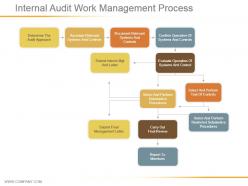
Internal audit work management process ppt example file





Try Before you Buy Download Free Sample Product
 Impress Your
Audience
 100%
Editable
 Save Hours
of Time


You have everything to gain with our Internal Audit Work Management Process Ppt Example File. Get access to facilities beyond imagination.
People who downloaded this PowerPoint presentation also viewed the following :
Internal audit work management process ppt example file with all 5 slides:
Encourage constructive ideas with our Internal Audit Work Management Process Ppt Example File. Applaud attempts o generate improvements.




FAQs for Internal audit work management process
Internal audit process objectives include assessing risk management effectiveness, evaluating internal controls, ensuring regulatory compliance, verifying financial accuracy, and identifying operational inefficiencies. These assessments enable organizations to streamline processes, minimize compliance risks, and enhance decision-making capabilities, with many companies finding that systematic internal audits ultimately deliver improved governance, reduced operational costs, and stronger competitive positioning.
Internal audits are conducted by employees within the organization to assess internal controls, risk management, and operational efficiency, while external audits are performed by independent third-party firms to verify financial statement accuracy and regulatory compliance. Internal audits focus on continuous improvement and strategic recommendations, whereas external audits deliver statutory requirements and investor assurance, with many organizations finding that combining both approaches enhances overall governance and competitive advantage.
Internal audit planning involves defining audit scope and objectives, conducting risk assessments, reviewing prior audit findings, developing detailed audit programs, and allocating appropriate resources and timelines. These steps enable organizations to systematically evaluate controls across departments like finance, operations, and compliance, with many companies finding that thorough planning ultimately delivers more targeted findings and enhanced operational efficiency.
Organizations assess internal audit effectiveness through stakeholder feedback surveys, audit quality metrics, recommendation implementation rates, risk coverage analysis, and compliance with professional standards. Through regular evaluation frameworks, management teams can measure audit cycle efficiency, identify process gaps, and enhance resource allocation, with many financial institutions and healthcare organizations finding that systematic assessments ultimately deliver improved governance and stronger operational controls.
Risk assessment serves as the foundation of internal audit processes, helping auditors identify, prioritize, and evaluate potential threats to organizational objectives, compliance requirements, and operational efficiency. Through comprehensive risk mapping, auditors can allocate resources strategically, focus on high-impact areas, and develop targeted testing procedures, ultimately enabling organizations to strengthen controls and enhance overall governance frameworks.
Auditors ensure compliance by establishing comprehensive audit programs aligned with regulatory frameworks, conducting systematic testing of controls and processes, and maintaining detailed documentation of findings and remediation efforts. Through risk-based sampling, continuous monitoring systems, and regular training updates, organizations streamline compliance verification while reducing regulatory exposure, ultimately delivering enhanced transparency and stakeholder confidence.
Internal audit tools include audit management software, data analytics platforms, continuous monitoring systems, risk assessment applications, and automated testing solutions. These technologies streamline audit workflows by enhancing data analysis capabilities, automating routine procedures, and improving documentation processes, with many organizations finding that integrated platforms deliver faster audit cycles, better risk detection, and more comprehensive reporting.
Internal audit reporting typically follows a structured format including executive summary, audit objectives, scope and methodology, detailed findings with risk ratings, management responses, and implementation timelines. These reports enhance organizational transparency by presenting clear, actionable recommendations, prioritizing high-risk areas, and tracking remediation progress, with many organizations finding that standardized reporting templates streamline communication between auditors, management, and board committees, ultimately delivering improved governance and faster issue resolution.
Internal auditors typically face challenges including incomplete documentation, resistance from auditees, tight deadlines, complex regulatory requirements, and limited access to key personnel or systems. These obstacles can significantly impact audit quality and timeline, with many auditing teams finding that proactive stakeholder engagement, robust planning processes, and leveraging audit management software ultimately streamlines investigations and delivers more comprehensive, actionable insights for organizational improvement.
Organizations can foster better communication by establishing regular meetings, creating open feedback channels, ensuring transparent reporting processes, and promoting collaborative planning sessions. Through structured dialogue frameworks, management and auditors can align on risk priorities, share operational insights, and address concerns proactively, ultimately strengthening governance while building trust that enhances organizational effectiveness.
Follow-up actions after internal audit completion are crucial for translating findings into operational improvements, ensuring identified risks are mitigated, and validating that corrective measures achieve intended outcomes. These actions enable organizations to close audit loops systematically, demonstrate regulatory compliance to stakeholders, and ultimately strengthen internal controls, with many companies finding that structured follow-up processes significantly enhance overall governance effectiveness.
Internal audit frequency depends on organizational size, risk profile, regulatory requirements, and industry complexity, with most organizations conducting comprehensive audits annually while implementing quarterly or semi-annual reviews for high-risk areas. Through risk-based scheduling, companies in sectors like banking, healthcare, and manufacturing often find that continuous monitoring combined with formal annual assessments delivers optimal compliance coverage and operational transparency.
Key performance metrics for internal audit functions include audit completion rates, stakeholder satisfaction scores, recommendation implementation percentages, cycle time efficiency, and risk coverage ratios. These measurements enable organizations to evaluate audit effectiveness, resource allocation, and strategic value delivery, with many companies finding that balanced scorecards combining operational efficiency with stakeholder feedback ultimately enhance audit credibility and organizational impact.
Internal audit contributes to risk management strategy by identifying vulnerabilities, assessing control effectiveness, and providing independent oversight across operational processes. Through systematic evaluations, organizations can proactively address compliance gaps, financial irregularities, and operational inefficiencies, while enhancing governance frameworks and strategic decision-making, ultimately delivering stronger risk mitigation and competitive advantage.
Best practices for training internal auditors include comprehensive technical skills development, regulatory compliance education, risk assessment methodologies, communication skills enhancement, and continuous professional certification programs. These approaches streamline audit effectiveness by building analytical capabilities, ensuring regulatory adherence, and fostering critical thinking, with many organizations finding that well-trained auditors deliver more accurate assessments, faster reporting cycles, and stronger risk mitigation across all business operations.
-
Innovative and Colorful designs.
-
Easily Understandable slides.