


Internal Sales Growth Strategy Playbook Powerpoint Presentation Slides






Try Before you Buy Download Free Sample Product
 Impress Your
 Audience
 100%
100% Editable
 Save Hours
 of Time


Growth achieved by the organization by enhancing its internal strategy is referred to as organic growth. This growth is essential for any organization willing to sustain itself for the long term. Thus, grab our insightful Internal Sales Growth Strategy Playbook, a detailed playbook to serve as a blueprint for your organization and help you achieve organic growth. The following presentation slide is helpful for organizations intending to attain growth organically through internal strategies. This playbook is divided into 4 major parts; these parts serve as a step-by-step guide for the organization. This presentation also provides an overview of organic growth as a strategy. It also helps understand the impact of organic growth by highlighting its critical advantages. The second part of the playbook highlights key stats of how organic growth can help your organization. The third part displays the key strategies that can help your organization attain organic growth. These strategies can be selling your product to existing customers, new customers, etc. The last part of this playbook focuses on identifying the critical KPIs that help the organization track its growth. Get access now.
People who downloaded this PowerPoint presentation also viewed the following :
Content of this Powerpoint Presentation
Slide 1: This slide introduces Internal Sales Growth Strategy Playbook. State your company name and begin.
Slide 2: This slide presents purpose of the playbook.
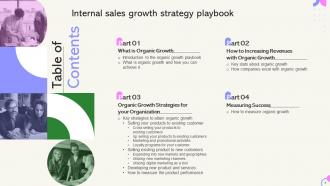
Slide 3: This slide exhibits table of contents.
Slide 4: This slide depicts title for two topics that are to be covered next in the template.
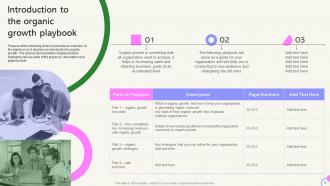
Slide 5: This slide provide an overview of the playbook as it displays an introduction to organic growth.
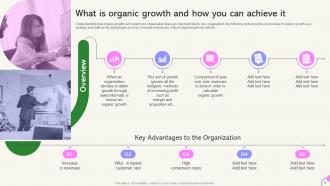
Slide 6: This slide provides an overview of organic growth as a strategy and outlines key advantages such as: increase in revenues, influx in repeat customer rate etc.
Slide 7: This slide depicts title for two topics that are to be covered next in the template.
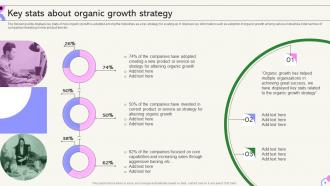
Slide 8: This slide displays key stats of how organic growth is adopted among the Industries as a key strategy for scaling up.
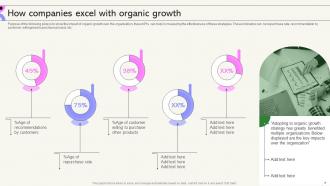
Slide 9: This slide is to show the impact of organic growth over the organization, these KPIs can help in measuring the effectiveness of these strategies.
Slide 10: This slide depicts title for one topic that is to be covered next in the template.
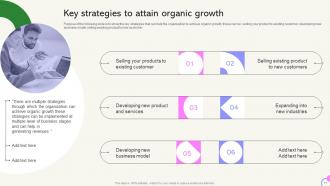
Slide 11: This slide show the key strategies that can help the organization to achieve organic growth, these can be: selling your product to existing customer, etc.
Slide 12: This slide depicts title for five topics that are to be covered next in the template.
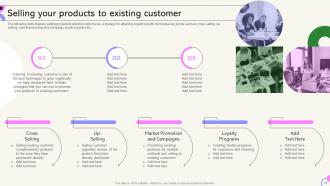
Slide 13: This slide displays selling products to existing customer as a strategy for attaining organic growth.
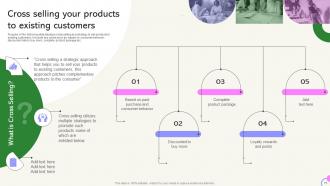
Slide 14: This slide displays cross selling as a strategy to sell products to existing customers.
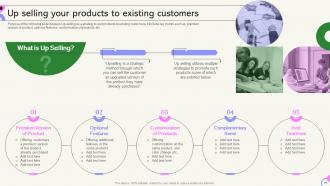
Slide 15: This slide displays Up-selling as a strategy to sell products to existing customers.
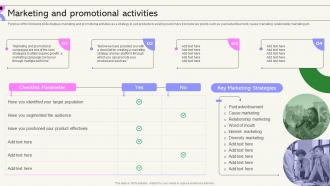
Slide 16: This slide displays marketing and promotional activities as a strategy to sell products to existing customers.
Slide 17: This slide displays Loyalty program as a strategy to sell products to existing customers.
Slide 18: This slide depicts title for four topics that are to be covered next in the template.
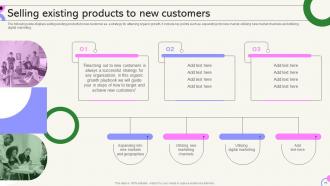
Slide 19: This slide displays selling existing products to new customer as a strategy for attaining organic growth.
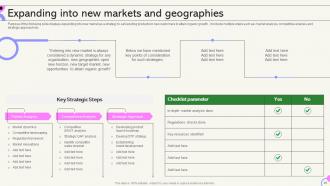
Slide 20: This slide displays expanding into new market as a strategy to sell existing products to new customers to attain organic growth.
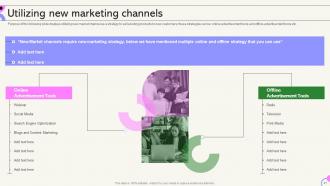
Slide 21: This slide displays utilizing new market channel as a strategy to sell existing products to new customers.
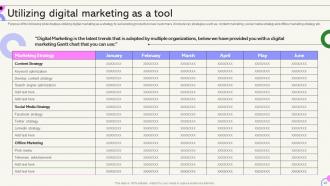
Slide 22: This slide displays utilizing digital marketing as a strategy to sell existing products to new customers.
Slide 23: This slide depicts title for two topics that are to be covered next in the template.
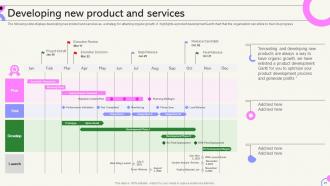
Slide 24: This slide displays developing new product and services as a strategy for attaining organic growth.
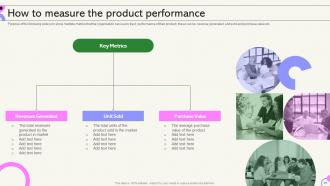
Slide 25: This slide show multiple metrics that the organization can use to track performance of their product.
Slide 26: This slide depicts title for one topic that is to be covered next in the template.
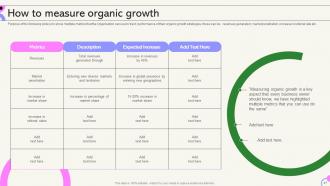
Slide 27: This slide show multiple metrics that the organization can use to track performance of their organic growth strategies.
Slide 28: This slide is titled as Additional Slides for moving forward.
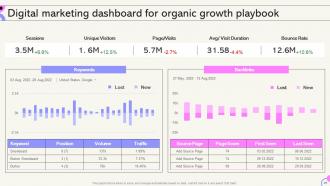
Slide 29: This slide presents Digital marketing dashboard for organic growth playbook.
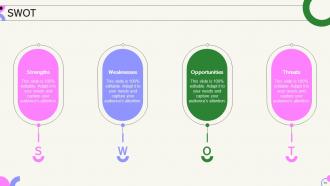
Slide 30: This slide shows SWOT describing- Strength, Weakness, Opportunity, and Threat.
Slide 31: This is About Us slide to show company specifications etc.
Slide 32: This is Our Goal slide. State your firm's goals here.
Slide 33: This is Our Team slide with names and designation.
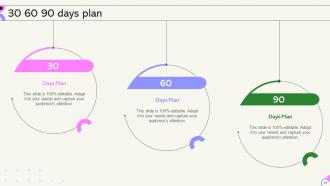
Slide 34: This slide provides 30 60 90 Days Plan with text boxes.
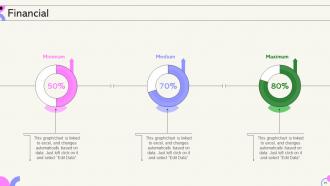
Slide 35: This is a Financial slide. Show your finance related stuff here.
Slide 36: This is a Timeline slide. Show data related to time intervals here.
Slide 37: This slide presents Roadmap with additional textboxes.
Slide 38: This slide contains Puzzle with related icons and text.
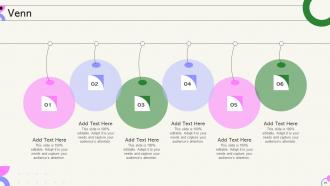
Slide 39: This slide depicts Venn diagram with text boxes.
Slide 40: This is a Thank You slide with address, contact numbers and email address.
Internal Sales Growth Strategy Playbook Powerpoint Presentation Slides with all 45 slides:
Use our Internal Sales Growth Strategy Playbook Powerpoint Presentation Slides to effectively help you save your valuable time. They are readymade to fit into any presentation structure.

















FAQs for Internal Sales Growth Strategy Playbook
Key metrics include conversion rates, average deal size, sales cycle length, customer acquisition cost, and revenue per employee. These indicators enable organizations to optimize resource allocation, identify bottlenecks in their sales processes, and enhance overall performance, with many companies finding that tracking these metrics simultaneously delivers improved forecasting accuracy and ultimately drives sustainable competitive advantage.
Companies align their sales and marketing teams through shared goals, integrated CRM systems, collaborative content creation, regular cross-functional meetings, and unified customer journey mapping. This strategic combination streamlines lead qualification processes, enhances customer messaging consistency, and accelerates deal closure rates, with many organizations finding that aligned teams generate significantly higher revenue growth and improved competitive advantage in increasingly complex markets.
Training and development enhance internal sales growth by improving product knowledge, refining communication skills, strengthening negotiation techniques, and building customer relationship management capabilities. These programs enable sales teams to identify opportunities more effectively, close deals faster, and retain clients longer, with many organizations finding that well-trained salespeople consistently outperform peers and drive sustainable revenue increases.
Organizations foster cross-departmental collaboration by establishing shared goals, regular communication channels, integrated performance metrics, and cross-functional project teams. Through joint planning sessions, shared customer data platforms, and collaborative incentive structures, sales teams work seamlessly with marketing, customer service, and product development, ultimately delivering enhanced customer experiences and accelerated revenue growth.
Technologies that enhance internal sales communication and workflow include CRM platforms, sales automation tools, video conferencing systems, project management software, and real-time messaging applications. These solutions streamline lead tracking, automate follow-ups, and facilitate seamless collaboration, with many sales organizations finding that integrated communication platforms significantly reduce response times, improve pipeline visibility, and ultimately deliver higher conversion rates and enhanced team productivity.
Customer feedback and insights significantly influence internal sales strategies by identifying product gaps, revealing customer pain points, and highlighting competitive advantages that sales teams can leverage. Through systematic feedback analysis, organizations streamline their sales approaches, enhance product positioning, and develop targeted messaging, with many companies finding that customer-driven strategies ultimately deliver higher conversion rates and stronger client relationships.
Internal lead generation strategies include employee referral programs, cross-selling initiatives, customer feedback mining, internal networking events, and leveraging existing client relationships for testimonials and case studies. These approaches streamline sales processes by utilizing established trust networks, reducing acquisition costs, and enhancing customer retention rates, with many organizations finding that internal teams deliver higher-quality leads and faster conversion cycles.
Internal sales teams leverage data analytics by analyzing customer behavior patterns, identifying high-value prospects, tracking sales funnel performance, and predicting revenue trends through predictive modeling. Through CRM integration and real-time dashboards, organizations streamline lead qualification, optimize pricing strategies, and personalize customer interactions, with many sales teams finding that data-driven approaches ultimately deliver 15-20% higher conversion rates and significantly improved quota attainment.
Best practices for setting realistic internal sales targets include analyzing historical performance data, conducting thorough market research, assessing team capabilities, considering seasonal trends, and establishing incremental growth benchmarks. These approaches enable organizations to create achievable yet challenging goals by balancing past results with future potential, ultimately delivering improved team motivation and sustainable revenue growth across departments.
Employee engagement is crucial for internal sales success, directly impacting productivity, customer relationships, and revenue generation through higher motivation, better performance, and reduced turnover. Engaged sales teams consistently deliver superior results, with many organizations finding that companies with highly engaged employees achieve 23% higher profitability, faster deal closures, and stronger client retention rates.
Effective sales team incentivization techniques include performance-based commission structures, tiered bonus systems, recognition programs, professional development opportunities, and team-based rewards. These approaches enhance motivation by combining financial rewards with career advancement, while many organizations find that blending individual achievements with collaborative goals ultimately delivers higher engagement and sustained revenue growth.
Businesses can identify high-potential sales talent by analyzing performance metrics, customer feedback scores, adaptability during challenges, and leadership qualities in collaborative settings. Through mentorship programs, cross-functional training, and progressive responsibility assignments, organizations develop these individuals into strategic sales leaders, with many companies finding that internal talent development reduces turnover while enhancing team cohesion and competitive advantage.
Accountability ensures internal sales growth strategy success by establishing clear performance metrics, regular progress reviews, and ownership of specific outcomes across all team members. Through structured reporting systems and defined responsibilities, sales teams achieve higher conversion rates, improved pipeline management, and consistent revenue targets, with many organizations finding that accountability-driven cultures ultimately deliver sustained growth and competitive advantage.
Companies can effectively use CRM systems to support internal sales by centralizing customer data, automating lead tracking, enabling personalized communication, and providing real-time analytics for decision-making. These systems streamline sales processes by improving collaboration between teams, identifying high-value prospects, and optimizing follow-up strategies, ultimately delivering faster conversion rates and enhanced customer relationships across the organization.
Common pitfalls include inadequate market research, misaligned sales and marketing efforts, unrealistic revenue targets, insufficient training programs, and poor performance tracking systems. These challenges often stem from rushed implementation and lack of cross-departmental collaboration, with many organizations finding that addressing these issues systematically enhances sales effectiveness and ultimately delivers sustainable revenue growth.
-
Use of icon with content is very relateable, informative and appealing.
-
Loved the fact that SlideTeam provides clean, high-definition, and professional PowerPoint products.