

Interpersonal Skills To Handle Sales Objections Training Ppt




Try Before you Buy Download Free Sample Product
 Impress Your
 Audience
 100%
100% Editable
 Save Hours
 of Time


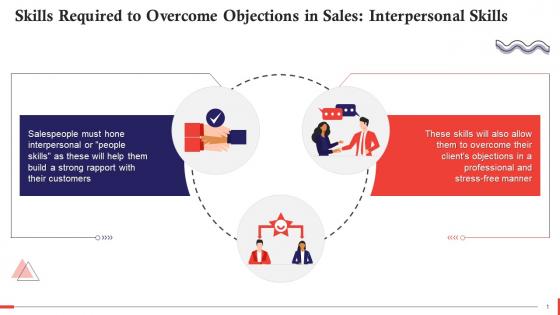
This slide discusses the importance of interpersonal skills for objection handling. Salespeople must hone interpersonal or people skills as these will help them build a strong rapport with their customers.
People who downloaded this PowerPoint presentation also viewed the following :
Interpersonal Skills To Handle Sales Objections Training Ppt with all 16 slides:
Use our Interpersonal Skills To Handle Sales Objections Training Ppt to effectively help you save your valuable time. They are readymade to fit into any presentation structure.









FAQs for Interpersonal Skills To Handle Sales
Key interpersonal skills that enhance workplace communication include active listening, emotional intelligence, empathy, clear verbal expression, and nonverbal awareness. These skills streamline collaboration by fostering trust, reducing misunderstandings, and improving team dynamics, with many organizations finding that employees with strong interpersonal abilities deliver better client relationships, enhanced project outcomes, and increased operational efficiency.
Active listening improves interpersonal relationships by demonstrating genuine respect, building trust through focused attention, and ensuring accurate understanding of colleagues' perspectives and concerns. Through techniques like paraphrasing, asking clarifying questions, and maintaining eye contact, professionals enhance collaboration, reduce workplace conflicts, and create stronger team dynamics, ultimately delivering improved project outcomes and organizational efficiency.
Emotional intelligence serves as the foundation for strong interpersonal skills by enabling individuals to recognize, understand, and manage both their own emotions and those of others effectively. Through enhanced self-awareness and empathy, professionals can navigate workplace relationships, resolve conflicts, and communicate more strategically, ultimately delivering improved collaboration, stronger team dynamics, and competitive advantage in leadership roles.
Individuals can cultivate empathy by actively listening without judgment, asking thoughtful questions about colleagues' perspectives, and practicing emotional awareness through regular self-reflection. In customer service and healthcare settings, professionals who engage in perspective-taking exercises, seek diverse viewpoints during team discussions, and respond thoughtfully to others' concerns ultimately build stronger collaborative relationships and enhance overall workplace communication.
Conflict resolution strategies include active listening, empathy development, clear communication, emotional regulation, and collaborative problem-solving. These interpersonal skills enable professionals to de-escalate tensions, identify underlying concerns, and facilitate win-win solutions, with many organizations finding that teams with strong interpersonal capabilities resolve disputes faster, maintain better working relationships, and ultimately deliver improved project outcomes.
Non-verbal communication significantly impacts interpersonal interactions by conveying emotions, establishing trust, and reinforcing or contradicting verbal messages through body language, facial expressions, and tone. These silent signals influence relationship building, team dynamics, and professional credibility, with many organizations finding that employees with strong non-verbal awareness enhance collaboration, reduce misunderstandings, and ultimately deliver more effective communication outcomes.
Effective feedback methods include specific observations rather than generalizations, timing conversations appropriately, using "I" statements, active listening, and creating safe dialogue spaces. These approaches enhance workplace relationships by building trust, improving performance clarity, and fostering collaborative problem-solving, with many organizations finding that structured feedback processes ultimately deliver stronger team cohesion and operational efficiency.
Cultural awareness significantly enhances interpersonal skills by enabling better communication, reducing misunderstandings, and fostering inclusive collaboration across diverse teams. Through cultural sensitivity training and cross-cultural competency development, organizations streamline workplace interactions, improve employee engagement, and deliver stronger team performance, with many global companies finding that culturally aware leaders ultimately drive better business outcomes.
Effective interpersonal skills training methods include role-playing exercises, peer feedback sessions, communication workshops, conflict resolution simulations, and collaborative project assignments. These approaches enhance team dynamics by developing active listening, emotional intelligence, and cross-functional collaboration skills, with many organizations finding that structured practice sessions and real-world application ultimately deliver stronger workplace relationships and improved operational efficiency.
Interpersonal skills significantly enhance team dynamics by fostering clear communication, building trust, resolving conflicts constructively, and encouraging active listening among members. These capabilities streamline collaboration across departments, with many organizations finding that teams with strong interpersonal foundations deliver projects faster, reduce workplace tensions, and ultimately achieve higher productivity and employee satisfaction.
Storytelling enhances interpersonal communication during presentations by creating emotional connections, simplifying complex concepts, and making messages more memorable and relatable. Through narrative techniques, presenters can engage audiences more effectively, build trust and rapport, and deliver key insights that resonate personally, ultimately transforming information transfer into compelling experiences that drive understanding and action.
Self-assessment tools for interpersonal skills include 360-degree feedback surveys, emotional intelligence assessments, communication style inventories, personality tests like DISC or Myers-Briggs, and peer evaluation forms. These techniques enable professionals to identify strengths and development areas through structured feedback, with many organizations finding that regular assessment drives improved collaboration, enhanced team dynamics, and ultimately stronger workplace relationships.
Mentors leverage interpersonal skills through active listening, empathy, clear communication, and emotional intelligence to build trust and rapport with mentees. These capabilities enable mentors to provide personalized guidance, offer constructive feedback, and create supportive environments, with many organizations finding that strong mentor-mentee relationships accelerate professional development and improve retention rates.
Remote workers face interpersonal challenges including reduced face-to-face interaction, communication delays, difficulty reading non-verbal cues, weakened team cohesion, and limited relationship-building opportunities. These obstacles can be overcome through regular video calls, virtual team-building activities, structured communication protocols, and digital collaboration tools, with many organizations finding that intentional relationship management ultimately enhances remote team connectivity.
Trust serves as the foundation for strong interpersonal relationships by enabling open communication, fostering collaboration, and reducing workplace conflicts. In organizations, trust enhances team dynamics, streamlines decision-making processes, and ultimately delivers improved productivity and employee engagement, with many companies finding that trust-based cultures significantly boost retention and operational efficiency.
-
It makes easy work of my work presentations. I’ve never had to be nervous about my presentations for meetings.
-
SlideTeam never fails to surprise me with its amazing PPT designs. Thanks team for providing me with your constant support!