

Introducing Three Line Of Defense Model To Mitigate Risk Improving Customer Service And Ensuring




Try Before you Buy Download Free Sample Product
 Impress Your
Audience
 100%
Editable
 Save Hours
of Time


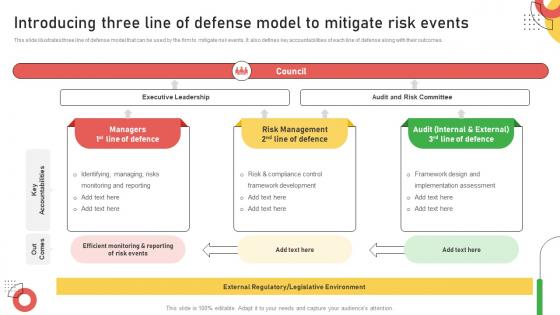
This slide illustrates three line of defense model that can be used by the firm to mitigate risk events. It also defines key accountabilities of each line of defense along with their outcomes.
People who downloaded this PowerPoint presentation also viewed the following :
Introducing Three Line Of Defense Model To Mitigate Risk Improving Customer Service And Ensuring with all 6 slides:
Use our Introducing Three Line Of Defense Model To Mitigate Risk Improving Customer Service And Ensuring to effectively help you save your valuable time. They are readymade to fit into any presentation structure.






FAQs for Introducing Three Line Of Defense Model To Mitigate Risk Improving Customer
The Three Lines of Defense Model establishes three distinct layers: operational management as the first line owning and managing risks, risk management and compliance functions as the second line providing oversight and guidance, and internal audit as the third line delivering independent assurance. This structured approach enhances organizational accountability, streamlines risk governance across departments, and enables clearer reporting structures, with many financial institutions finding that this segregation ultimately delivers stronger regulatory compliance and more effective risk mitigation.
The Three Lines of Defense Model enhances organizational governance by establishing clear accountability structures, improving risk oversight through defined responsibilities, and creating systematic communication channels between operational management, risk functions, and internal audit. This framework enables organizations to streamline compliance processes, minimize regulatory gaps, and strengthen decision-making transparency, ultimately delivering more robust governance and competitive operational advantage.
The first line involves operational management implementing controls and risk mitigation, the second line encompasses risk management and compliance functions providing oversight and guidance, while the third line comprises internal audit delivering independent assurance. These distinct roles create comprehensive risk governance by establishing accountability at operational levels, ensuring regulatory compliance through specialized oversight, and validating effectiveness through independent assessment, ultimately delivering robust organizational protection.
Effective implementation requires clearly defining roles across operational management, risk management, and internal audit functions, establishing robust communication channels, and ensuring adequate resources and executive support. Organizations successfully deploy this model by creating detailed policies, providing comprehensive training to all three lines, and implementing regular coordination meetings, ultimately delivering enhanced risk visibility, improved compliance, and stronger governance frameworks.
Common challenges include unclear role definitions between lines, insufficient coordination and communication, resource constraints limiting second-line independence, and cultural resistance to oversight frameworks. Organizations often struggle with overlapping responsibilities, inadequate risk management expertise in business units, and difficulty measuring defense effectiveness, with many financial institutions finding that successful implementation requires significant investment in training, technology, and organizational restructuring to achieve optimal risk governance.
Technology strengthens the Three Lines of Defense through automated controls, real-time monitoring systems, advanced analytics, and integrated reporting platforms that enhance visibility across all risk layers. These digital solutions enable faster risk identification, streamline compliance processes, and improve coordination between operational management, risk functions, and internal audit, ultimately delivering more robust governance and operational efficiency.
The Three Lines of Defense Model evolves through enhanced technology integration, cross-functional collaboration, and real-time risk monitoring capabilities to address cyber threats, regulatory changes, and operational complexities. Organizations increasingly implement automated risk assessment tools, strengthen communication between business units and risk functions, and develop agile frameworks that enable rapid response to emerging challenges, ultimately delivering more resilient and adaptive risk management systems.
Regulatory requirements mandate clear accountability and risk oversight structures, driving organizations to implement the Three Lines of Defense Model with defined roles, independent validation, and comprehensive reporting frameworks. Financial institutions, healthcare organizations, and public companies increasingly find that regulatory compliance through this model enhances operational transparency, streamlines audit processes, and ultimately delivers stronger governance while reducing regulatory penalties.
Key performance indicators for each defense line include risk assessment completion rates, control testing results, audit findings, incident response times, and regulatory compliance scores. These metrics enable organizations to measure operational efficiency across risk management, compliance, and internal audit functions, with many financial institutions and healthcare organizations finding that comprehensive dashboards tracking these indicators ultimately deliver enhanced risk visibility and regulatory confidence.
The Three Lines of Defense Model integrates seamlessly with frameworks like COSO, ISO 31000, and Basel III by providing a structured governance foundation that enhances their implementation. This strategic combination enables organizations to streamline risk oversight, improve regulatory compliance, and strengthen operational controls, with many financial institutions and healthcare organizations finding that integrated frameworks deliver greater transparency, more effective resource allocation, and ultimately stronger competitive advantage in increasingly complex regulatory environments.
The Three Lines of Defense model can be effectively scaled for SMEs through streamlined implementation, combining multiple functions within existing roles, and leveraging technology to automate compliance processes. Small organizations often find that integrating risk management responsibilities across departments, utilizing cloud-based monitoring tools, and establishing clear escalation protocols delivers robust governance while minimizing resource strain and operational complexity.
Communication enables coordination, information sharing, and risk transparency across all three lines through regular reporting, joint meetings, and structured escalation protocols. Effective dialogue ensures the first line reports operational risks promptly, the second line provides timely guidance and oversight, and the third line delivers independent assurance insights, ultimately creating integrated risk management where each line reinforces organizational resilience.
Organizational culture and leadership significantly influence the Three Lines of Defense model by establishing accountability frameworks, promoting risk awareness across departments, and ensuring clear communication channels between defense lines. Strong leadership cultivates a risk-conscious environment where employees understand their roles in risk management, while supportive culture enables seamless collaboration between operational teams, risk functions, and internal audit, ultimately delivering robust governance and enhanced organizational resilience.
Not following the Three Lines of Defense Model creates significant governance gaps, regulatory compliance failures, undetected operational risks, and weakened internal controls across organizations. This absence of structured risk oversight ultimately exposes institutions to financial losses, regulatory penalties, and reputational damage, with many financial services and healthcare organizations finding that robust three-line frameworks are essential for sustainable operations.
Organizations ensure collaboration among the three lines of defense through regular cross-functional meetings, shared governance frameworks, integrated reporting systems, and clear communication protocols that define roles and responsibilities. These collaborative mechanisms enable seamless information flow, coordinated risk assessments, and unified strategic responses, with many financial institutions and healthcare organizations finding that structured collaboration ultimately delivers enhanced risk visibility, reduced operational silos, and stronger regulatory compliance outcomes.
-
I have been using SlideTeam for the past six months. Very happy and satisfied!
-
Every time I ask for something out-of-the-box from them and they never fail in delivering that. No words for their excellence!