

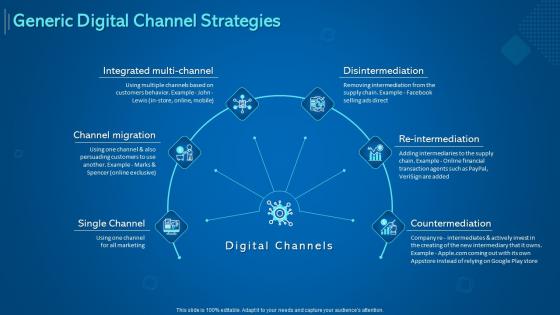
Introduction to digital marketing models generic digital channel strategies




Try Before you Buy Download Free Sample Product
 Impress Your
Audience
 100%
Editable
 Save Hours
of Time


Our Introduction To Digital Marketing Models Generic Digital Channel Strategies are topically designed to provide an attractive backdrop to any subject. Use them to look like a presentation pro.
People who downloaded this PowerPoint presentation also viewed the following :
Introduction to digital marketing models generic digital channel strategies with all 9 slides:
Use our Introduction To Digital Marketing Models Generic Digital Channel Strategies to effectively help you save your valuable time. They are readymade to fit into any presentation structure.









FAQs for Introduction to digital marketing models generic
Key components of a successful digital marketing model include targeted audience segmentation, multi-channel integration, content strategy, data analytics, and conversion optimization. These elements work together by streamlining customer acquisition, enhancing brand visibility, and maximizing ROI, with many organizations finding that strategic combination of these components ultimately delivers measurable growth and competitive advantage.
The funnel model follows a linear customer journey from awareness to purchase, while the flywheel model emphasizes continuous customer engagement and retention through circular momentum. The funnel treats customers as end points, whereas the flywheel leverages satisfied customers as advocates who drive referrals and repeat business, with many organizations finding that flywheel approaches ultimately deliver higher lifetime value and sustainable growth.
Buyer personas serve as foundational frameworks for digital marketing strategies by defining target audience demographics, behaviors, pain points, and preferences, enabling precise campaign targeting and content creation. These detailed profiles help marketers streamline messaging across channels, optimize ad spend allocation, and enhance customer experiences, with companies like retail brands and financial services finding significantly improved conversion rates and engagement through persona-driven approaches.
Businesses leverage data analytics to refine digital marketing models by tracking customer behavior patterns, measuring campaign performance metrics, and identifying high-converting audience segments across multiple touchpoints. Through predictive analytics and real-time monitoring, companies in retail, financial services, and healthcare optimize ad spending, personalize customer experiences, and increase ROI by 30-40%, ultimately delivering more targeted campaigns and competitive advantage.
Integrating omnichannel marketing delivers consistent customer experiences across all touchpoints, enhanced data collection, improved customer retention, and increased conversion rates. This strategic approach enables retailers, financial services, and healthcare organizations to streamline messaging, optimize resource allocation, and boost customer lifetime value, ultimately providing significant competitive advantage in increasingly fragmented markets.
AIDA excels in structured awareness-building through systematic attention, interest, desire, and action stages, while PAS creates urgency by highlighting problems, agitating consequences, and presenting solutions. In digital campaigns, AIDA works effectively for longer sales cycles and educational content, whereas PAS delivers stronger conversion rates for immediate-response campaigns, with many marketers finding that combining both models strategically enhances overall campaign performance.
Key performance indicators include conversion rates, customer acquisition cost, return on ad spend, click-through rates, and lifetime customer value. These metrics enable organizations to optimize campaign effectiveness, allocate budgets strategically, and measure ROI across channels, with many businesses finding that comprehensive tracking ultimately delivers improved targeting accuracy and significantly enhanced marketing efficiency.
Social media influences digital marketing strategy development by providing real-time consumer insights, enabling targeted audience segmentation, and offering direct engagement channels for brand building. Through social listening tools and analytics, businesses can identify trending topics, monitor competitor activities, and adjust their messaging strategies, ultimately delivering more personalized customer experiences and measurable ROI across campaigns.
Content marketing serves as the foundation of digital marketing models by building brand authority, engaging target audiences, and nurturing customer relationships through valuable, relevant information. This strategic approach drives organic traffic, enhances SEO performance, and generates qualified leads across multiple channels, with many businesses finding that consistent content creation ultimately delivers higher conversion rates and long-term customer loyalty than traditional advertising methods.
SEO best practices integrate into digital marketing frameworks through keyword optimization, content alignment, technical site improvements, and data-driven performance tracking. These elements enhance organic visibility by supporting content marketing campaigns, social media strategies, and paid advertising efforts, while delivering improved search rankings, increased qualified traffic, and ultimately stronger conversion rates across all marketing channels.
Emerging technologies reshaping digital marketing include artificial intelligence, machine learning, augmented reality, voice search optimization, and blockchain-based solutions. These innovations enhance customer targeting, automate campaign optimization, and create immersive brand experiences, with retail, automotive, and financial services sectors finding that personalized interactions and predictive analytics ultimately deliver higher conversion rates and competitive advantage.
Customer journeys significantly influence digital marketing model design by revealing touchpoint preferences, decision-making patterns, and conversion pathways across different customer segments. These insights enable marketers to create multi-channel approaches that align content, timing, and messaging with specific journey stages, with many retail and financial services companies finding that journey-mapped models deliver higher engagement rates and improved ROI.
Digital marketing ethical considerations include data privacy compliance, transparent advertising practices, honest customer communications, responsible targeting methods, and consent-based data collection. These principles help companies build sustainable customer relationships while navigating regulatory requirements, with many organizations finding that ethical marketing practices ultimately deliver stronger brand trust, reduced legal risks, and enhanced competitive advantage in increasingly privacy-conscious markets.
Small businesses can adapt enterprise digital marketing models by focusing on scalable, cost-effective strategies like automated email campaigns, social media scheduling tools, content marketing systems, and data-driven customer segmentation. While larger budgets enable broader reach, smaller companies often achieve higher engagement rates through personalized messaging and targeted local campaigns, ultimately delivering stronger ROI and more authentic customer relationships.
Automation streamlines digital marketing models by enhancing campaign management, personalizing customer experiences, optimizing ad spend allocation, and accelerating data-driven decision making across multiple channels simultaneously. Through AI-powered tools, businesses in retail, financial services, and healthcare achieve faster campaign adjustments, improved ROI tracking, and seamless customer journey optimization, ultimately delivering competitive advantage in increasingly dynamic markets.
-
Graphics are very appealing to eyes.
-
Awesomely designed templates, Easy to understand.