

Introduction To MIT Digital Transformation Framework Training Ppt




Try Before you Buy Download Free Sample Product
 Impress Your
 Audience
 100%
100% Editable
 Save Hours
 of Time


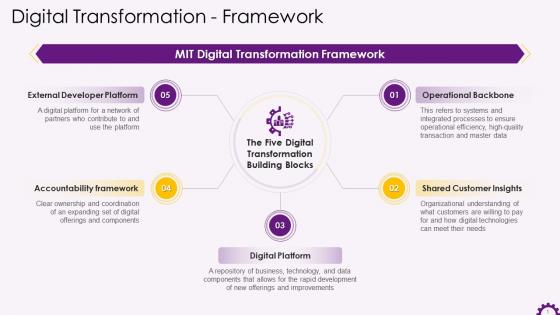
This slide depicts the MIT Digital Transformation Framework. It highlights the five building blocks of Digital Transformation such as operational backbone, shared customer insights, digital platform, accountability framework, and external developer platform.
People who downloaded this PowerPoint presentation also viewed the following :
Introduction To MIT Digital Transformation Framework Training Ppt with all 16 slides:
Use our Introduction To MIT Digital Transformation Framework Training Ppt to effectively help you save your valuable time. They are readymade to fit into any presentation structure.








FAQs for Introduction To MIT Digital Transformation
Honestly, it's mostly about keeping up with what customers want now - they expect everything to work like Amazon, you know? Competition's brutal too. If other companies are automating stuff and making decisions faster with data, you're screwed if you don't follow. COVID definitely pushed everyone into this way faster than normal. Oh, and cutting costs through automation is massive - that's probably the biggest motivator for most places. My advice? Don't try to transform everything at once. Just pick one process that's making everyone miserable and start there.
Track the obvious stuff first - cost savings, efficiency gains, revenue from new digital channels. Employee adoption rates matter more than most people think though. If your team isn't actually using the new systems, you're basically throwing money away. Customer satisfaction scores are crucial too. Set your baselines before starting anything, then check quarterly. Time-to-market improvements and how easily teams can access data - both solid indicators. Oh, and don't go crazy with metrics. Pick maybe 5-7 max or you'll drown in spreadsheets.
Oh man, culture will absolutely make or break your digital transformation - I've watched amazing tech projects completely tank because nobody was mentally ready for change. People need to feel safe experimenting and screwing up sometimes, you know? Otherwise they'll just dig in their heels no matter how cool the new tools are. My advice? Find those few people who actually get excited about digital stuff and let them be your unofficial evangelists. They'll do way more to shift attitudes than any top-down mandate ever could. Start there and let it spread naturally.
Honestly, don't make the mistake of adding security later - bake it in from day one. First thing? Figure out what data you actually have with a proper audit. Encrypt everything, both stored and moving around. MFA is absolutely mandatory at this point - like, come on, we're not living in 2010 anymore. Your team needs regular training because let's face it, people click on dumb stuff all the time. Oh, and get someone to try hacking you periodically with pen testing. Security isn't something you can just tack on when you remember it exists.
Oh man, where do I even start? People absolutely hate change - like, viscerally hate it. Your biggest headache will be getting everyone on board, especially when they're stuck in their old ways. Budget's always tight too, obviously. Then there's the tech nightmare - legacy systems that basically refuse to work with anything new, data scattered everywhere, and half your team doesn't know how to use the digital tools you need. Leadership can't agree on direction either, which makes everything worse. Honestly though? Don't try to boil the ocean. Pick one small pilot project, prove it works, then expand from there.
Honestly, small companies have a huge advantage here - you can move fast while big corporations are stuck dealing with ancient systems and endless approvals. I'd start by automating whatever's driving you crazy first. Maybe customer service chatbots or inventory tracking? Cloud tools are perfect since they're cheap and grow with you. The real win is that you can test stuff and pivot quickly when something isn't working. Big companies need three meetings just to change their email signature. Pick one process, get it working smoothly, then tackle the next thing.
Cloud computing and AI are absolutely crushing it right now - that's where most companies are seeing real wins. IoT is literally everywhere too (my coffee maker has wifi, which is honestly ridiculous). Automation tools are huge, plus those low-code platforms that let regular people build stuff without coding. Data analytics platforms are finally getting good at making sense of all the info you're drowning in. But here's the thing - figure out what problems you actually need to solve first. Don't just chase shiny new tech because everyone else is doing it.
Look, customer experience is basically your compass for the whole digital transformation thing. Whatever's frustrating your customers most - that's where you throw your tech budget first. Slow checkout? Fix payments. People want self-service? Build those portals. Honestly, it's way simpler than companies make it out to be. Don't get sucked into whatever flashy new tool everyone's talking about. Map out your customer journey instead and find the spots where people are getting stuck or annoyed. Those friction points? That's your roadmap right there.
Yeah, digital transformation usually helps with both engagement and productivity, but expect some growing pains at first. Better tools mean people spend less time on boring repetitive stuff and more time on work that actually matters. Productivity goes up from automation and smoother processes. Employees genuinely like using tech that makes their lives easier instead of harder - crazy concept, right? Just make sure you get your team involved from the start. Training is huge. Listen to what they're saying too, or you'll end up annoying everyone instead of helping them.
Honestly, just map your digital stuff directly to what actually makes money or saves time. Don't digitize random things because they seem cool - I've watched way too many companies blow budgets on flashy tech that does nothing. Your leadership needs to agree on what matters first. Then measure these digital projects the same way you'd measure any other big initiative. It's really just business strategy that happens to use technology, not some separate tech thing. The "why" has to come before the "what" or you're basically throwing money around.
Look at your current setup first and figure out what's driving everyone crazy day-to-day. I'd go for some quick wins alongside your bigger plans - honestly, nothing gets people on board faster than seeing immediate improvements. Focus on stuff that'll actually move the needle business-wise, not whatever's trending on LinkedIn. Get your end users involved early because they catch things you totally miss. Build in extra time and money for when things go sideways (they will). Oh, and decide upfront how you'll measure success - you can't fix what you can't track.
Start with something small - don't try to transform everything overnight. AI works great for automating boring stuff like customer service chatbots or analyzing your customer data for patterns you'd never catch manually. Predictive analytics can help with inventory (honestly saved my last company a ton of money), and machine learning personalizes user experiences really well. The trick is picking areas where you already have decent data and obvious problems. Run a pilot project first, see what actually works, then expand. There's so many possibilities it's almost overwhelming, but baby steps work best.
Honestly, cloud tech is what makes digital transformation actually work. You get flexibility and can scale up fast instead of being stuck with those crazy expensive on-premise systems that take forever to change. Everyone can access the same stuff from anywhere, so no more department silos - which is huge. The best part? You don't need massive upfront costs anymore. Just start with a small pilot project and see how it changes your workflow. Way less risky than the old "go big or go home" approach we used to do.
Ugh, regulatory stuff is such a nightmare for digital projects. It basically controls everything - what data you can touch, how systems work, the whole process. Healthcare and finance companies get hit the worst with all those privacy and security rules. Here's the thing though - loop in your compliance people right from the start. I know it sounds boring, but trust me on this. Otherwise you'll be rebuilding everything halfway through when they tell you it won't fly. Those compliance checks need to happen at every step, which yeah, slows things down when you want to move quickly. But better than starting over completely.
Honestly, this is huge - probably the biggest factor in whether digital transformations actually work. Technology moves so damn fast that your teams have to keep learning new stuff constantly. Otherwise everything just grinds to a halt. I've watched companies fail at this over and over. The trick is making learning part of people's regular routine, not some random training they squeeze in later. Figure out what skills are missing early on, then bake that learning right into their weekly schedule. You can't just hope people will find time for it - they won't.
-
Informative presentations that are easily editable.
-
Fantastic collection. Loved how we can personalize these templates as per the requirements.