

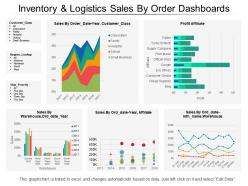
Inventory and logistics sales by order dashboards





Try Before you Buy Download Free Sample Product
 Impress Your
Audience
 100%
Editable
 Save Hours
of Time


Analyze expenses incurred with our Inventory And Logistics Sales By Order Dashboards. Be able to effectively indulge in cost cutting.
People who downloaded this PowerPoint presentation also viewed the following :
Inventory and logistics sales by order dashboards with all 6 slides:
Assure good equity with our Inventory And Logistics Sales By Order Dashboards. You will earn greater dividends.


FAQs for Inventory and logistics sales
Key components include demand forecasting, real-time tracking systems, automated reorder points, supplier management platforms, and inventory classification methods. These technologies streamline operations by reducing stockouts, minimizing carrying costs, and optimizing warehouse efficiency, with many retailers and manufacturers finding that strategic integration ultimately delivers improved cash flow and enhanced customer satisfaction.
Technology improves inventory accuracy through RFID tracking, barcode scanning, IoT sensors, automated data collection, and real-time analytics systems. These solutions streamline operations by eliminating manual errors, providing instant visibility into stock levels, and enabling predictive insights, with retailers and manufacturers finding significantly reduced discrepancies and enhanced operational efficiency.
Just-in-time inventory minimizes holding costs, reduces waste, and enhances cash flow by synchronizing production with actual demand rather than forecasts. This strategic approach enables manufacturers like Toyota and retailers like Zara to respond quickly to market changes, streamline operations, and maintain competitive advantage through reduced storage expenses and improved inventory turnover rates.
Businesses determine optimal stock levels through demand forecasting, economic order quantity calculations, ABC analysis for prioritizing items, and safety stock assessments based on lead times and variability. These methods enable companies to balance carrying costs with stockout risks, with many retail and manufacturing organizations finding that strategic inventory optimization reduces holding expenses by 15-25% while maintaining service levels.
Small businesses face limited budgets for advanced inventory systems, reduced supplier negotiating power, and fewer staff resources for manual tracking compared to larger enterprises. While enterprises leverage sophisticated forecasting technologies and dedicated teams, small businesses often struggle with cash flow constraints from overstocking, stockouts impacting customer satisfaction, and manual processes prone to errors, ultimately requiring more strategic, cost-effective inventory solutions.
Data analytics enhances inventory forecasting through predictive modeling, demand pattern analysis, seasonal trend identification, and real-time market intelligence integration. By leveraging machine learning algorithms and historical data, retailers and manufacturers can reduce stockouts by up to 30%, minimize carrying costs, and optimize procurement timing, ultimately delivering improved cash flow and customer satisfaction across supply chains.
Poor inventory management significantly impacts customer satisfaction through stockouts leading to lost sales, overstocking causing higher prices, delayed deliveries from supply chain disruptions, and inconsistent product availability. These challenges result in frustrated customers, damaged brand reputation, and reduced loyalty, with many retailers finding that inventory inefficiencies ultimately drive customers to competitors who deliver more reliable, cost-effective shopping experiences.
Inventory management software streamlines retail operations by automating stock tracking, optimizing reorder points, and providing real-time visibility across multiple locations. Through integrated systems, retailers reduce manual errors, prevent stockouts and overstock situations, and accelerate inventory turnover, with many finding that automated alerts and analytics ultimately deliver improved cash flow and enhanced customer satisfaction.
Companies should conduct inventory audits through cycle counting, ABC analysis prioritization, standardized procedures, real-time tracking systems, and cross-functional team involvement. These practices enable organizations to maintain accuracy while minimizing disruptions, with many retailers and manufacturers finding that systematic auditing reduces discrepancies, streamlines operations, and ultimately delivers better inventory control and cost management.
Inventory turnover ratio directly influences profitability by indicating how efficiently companies convert stock into sales, with higher ratios typically signaling better cash flow management and reduced carrying costs. Businesses with optimized turnover ratios, particularly in retail and manufacturing sectors, achieve improved working capital utilization, minimized storage expenses, and enhanced profit margins through strategic inventory optimization.
Inefficient inventory management creates significant environmental waste through overproduction, excess packaging, increased transportation emissions, and product disposal in landfills. These inefficiencies force companies to consume more raw materials and energy while generating unnecessary carbon footprints, with many organizations finding that streamlined inventory practices reduce environmental impact by 20-30% while delivering substantial cost savings.
Businesses leverage automation in inventory management through real-time tracking systems, automated reordering, demand forecasting algorithms, and barcode scanning technologies. These solutions streamline operations by reducing manual errors, optimizing stock levels, and accelerating fulfillment processes, with many retailers and manufacturers finding that automation ultimately delivers significant cost savings and enhanced customer satisfaction.
Perpetual inventory systems track stock levels in real-time through continuous updates, while periodic systems update inventory counts at specific intervals through physical counts. Perpetual systems enable immediate visibility into stock movements, automated reordering, and precise cost tracking, with many retailers and manufacturers finding that real-time data streamlines operations and reduces carrying costs significantly.
Businesses can prepare for seasonal fluctuations through historical data analysis, demand forecasting models, flexible supplier agreements, safety stock buffers, and cross-docking strategies. Retail companies increasingly leverage predictive analytics and automated reordering systems to anticipate peak periods like holidays or back-to-school seasons, ultimately minimizing stockouts while reducing excess inventory costs.
Companies can adopt strategies including automated tracking systems, regular cycle counts, supplier quality audits, theft prevention protocols, and structured disposal processes for obsolete stock. Through RFID technology and predictive analytics, organizations streamline inventory accuracy while minimizing shrinkage, with many retail and manufacturing companies finding that strategic combination of prevention and disposal planning ultimately delivers cost savings and operational efficiency.
No Reviews