

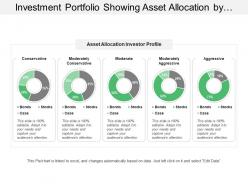
Investment portfolio showing asset allocation by investor profile





Try Before you Buy Download Free Sample Product
 Impress Your
Audience
 100%
Editable
 Save Hours
of Time


Our Investment Portfolio Showing Asset Allocation By Investor Profile act like a calling card. Give them a good account of your capability.
People who downloaded this PowerPoint presentation also viewed the following :
Investment portfolio showing asset allocation by investor profile with all 6 slides:
Allow our Investment Portfolio Showing Asset Allocation By Investor Profile to act as your eye's. Don't get blinded by all the data.


FAQs for Investment portfolio showing asset allocation
Asset allocation is crucial for diversified investment strategies because it spreads risk across different asset classes, reduces portfolio volatility, and optimizes potential returns based on individual risk tolerance and investment goals. Through strategic allocation across stocks, bonds, real estate, and commodities, investors can minimize losses during market downturns while capturing growth opportunities, with many financial advisors finding that proper allocation delivers more consistent long-term performance than concentrated investments.
Risk tolerance significantly influences asset allocation by determining the balance between growth-oriented and conservative investments, with higher risk tolerance enabling greater equity exposure and lower tolerance favoring bonds and stable assets. Through careful assessment of individual comfort levels, financial advisors help clients optimize portfolios that align with their risk capacity, ultimately delivering sustainable returns while minimizing emotional decision-making during market volatility.
Traditional asset classes include equities, fixed income securities, cash equivalents, real estate, commodities, and alternative investments like private equity and hedge funds. These asset categories enable portfolio diversification by spreading risk across different market sectors, economic cycles, and geographic regions, with many institutional investors finding that strategic allocation across multiple classes enhances long-term returns while minimizing volatility.
Investors can determine their optimal asset allocation by assessing their risk tolerance, investment timeline, financial goals, and current market conditions through comprehensive portfolio analysis. Financial advisors increasingly recommend diversified approaches combining stocks, bonds, and alternative investments, with many finding that regular rebalancing and periodic reassessment ultimately delivers enhanced long-term returns and risk management.
Time horizon significantly influences asset allocation by determining risk tolerance, liquidity needs, and growth objectives, with longer horizons typically allowing for higher equity exposure and shorter horizons favoring conservative bonds and cash. Investment managers increasingly recognize that strategic allocation shifts based on timeline enable younger investors to weather market volatility while pursuing growth, and pre-retirees to preserve capital, ultimately delivering more targeted financial outcomes.
Investors should reassess their asset allocation annually, after major life events, during significant market shifts, or when financial goals change substantially. This strategic rebalancing enables portfolio optimization through risk adjustment, performance evaluation, and goal realignment, with many financial advisors finding that regular reviews ultimately deliver improved long-term returns and enhanced financial security.
Common asset allocation pitfalls include over-concentration in single sectors, ignoring risk tolerance changes, failing to rebalance regularly, emotional decision-making during market volatility, and neglecting diversification across asset classes. These mistakes often result from inadequate planning, poor timing decisions, and insufficient monitoring, with many financial advisors finding that systematic approaches and regular portfolio reviews ultimately deliver more consistent returns and reduced risk exposure.
Market volatility significantly influences asset allocation decisions by prompting investors to reassess risk tolerance, rebalance portfolios more frequently, and adjust diversification strategies across asset classes. During volatile periods, many investors shift toward defensive assets like bonds or cash, while others capitalize on opportunities by increasing equity positions, ultimately seeking to optimize returns while managing downside risk effectively.
When reallocating assets during market changes, consider risk tolerance, investment timeline, market volatility, correlation between asset classes, and liquidity needs. Portfolio managers typically evaluate economic indicators, sector performance, and diversification requirements, with many financial institutions finding that strategic rebalancing during volatile periods enhances long-term returns while minimizing downside risk.
Asset allocation strategies should differ significantly between retirement and taxable accounts due to varying tax implications, liquidity needs, and time horizons. Retirement accounts benefit from tax-deferred growth, making them ideal for high-turnover strategies and tax-inefficient investments like REITs and bonds, while taxable accounts work better for tax-efficient index funds and long-term holdings, ultimately enabling investors to maximize after-tax returns across their entire portfolio.
Asset allocation tools include robo-advisors like Betterment and Wealthfront, portfolio analysis software such as Morningstar Direct, Monte Carlo simulation platforms, and risk assessment questionnaires from major brokerages. These technologies streamline portfolio construction by automating rebalancing, analyzing risk-return profiles, and providing data-driven insights, ultimately enabling investors to make informed decisions while minimizing emotional biases.
Investors can effectively integrate alternatives like real estate, commodities, precious metals, and REITs by allocating 5-15% of portfolios for diversification and inflation hedging. These assets typically exhibit low correlation with traditional stocks and bonds, enabling enhanced risk-adjusted returns while reducing overall portfolio volatility, with many institutional investors finding that strategic alternative exposure delivers superior long-term performance.
Global economic trends significantly influence asset allocation strategies through inflation pressures, interest rate fluctuations, currency volatility, geopolitical shifts, and emerging market dynamics. These factors require portfolio rebalancing across equities, bonds, commodities, and alternative investments, with many institutional investors finding that diversified geographic exposure and tactical adjustments ultimately deliver enhanced risk management and competitive returns.
Behavioral finance significantly impacts asset allocation through cognitive biases like loss aversion, overconfidence, and herding mentality, which often lead investors to make suboptimal portfolio decisions. These psychological factors cause individuals to overweight familiar investments, chase recent performance, and deviate from strategic diversification principles, ultimately reducing long-term returns and increasing portfolio risk.
Rebalancing maintains optimal asset allocation by systematically adjusting portfolio weights back to target percentages, ensuring risk levels align with investment objectives and preventing portfolio drift. Through periodic rebalancing, investors capture gains from outperforming assets while adding to underperforming ones, ultimately delivering enhanced long-term returns and consistent risk management across market cycles.
-
Colors used are bright and distinctive.
-
Presentation Design is very nice, good work with the content as well.