

Investment Proposal Deck For Sustainable Agriculture Ppt Template




Try Before you Buy Download Free Sample Product
 Impress Your
 Audience
 100%
100% Editable
 Save Hours
 of Time


Here is a competently designed Investment Proposal Deck for Sustainable Agriculture PowerPoint Presentation. Sustainable Agriculture is bridging farmers and investors through a pioneering platform, fostering income generation and sustainable agriculture. Our pitch deck delves into agricultures pressing challenges limited farming skills, fallow land and outdated tech. Additionally, the Startup Pitch Deck illuminates our tech driven solution an online nexus connecting farmers, landowners and investors. Furthermore, the investor deck unveils iGrows essence introduction, key facets, product array, unique selling proposition, pivotal milestones, business model, competition insights, market potential and financial prowess. Lastly, the Fundraising Elevator Pitch Deck presents an investment appeal, fund allocation, funding trajectory, core team expertise, exit strategy and equity distribution. Download this 100 percentage editable presentation and get access to our highly researched and skillfully designed pitch deck.
People who downloaded this PowerPoint presentation also viewed the following :
Content of this Powerpoint Presentation
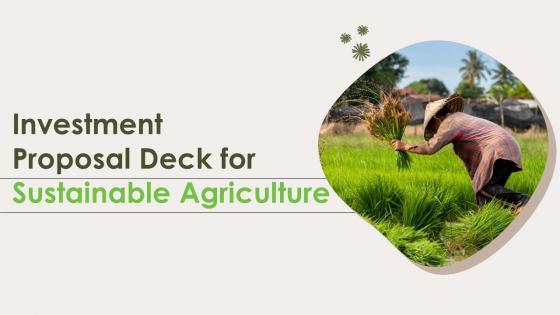
Slide 1: This slide introduces Investment Proposal Deck for Sustainable Agriculture. State your company name and begin.
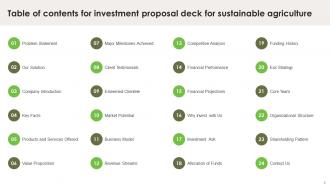
Slide 2: This slide shows Table of Content for the presentation.
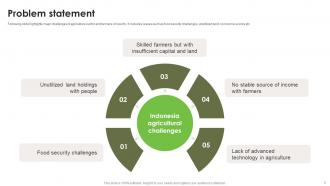
Slide 3: This slide highlights major challenges of agriculture sector and farmers of country.
Slide 4: This slide showcases solutions provided by company to solve major challenges associated with agriculture sector in country.
Slide 5: This slide provides comprehensive overview of company. It includes elements such as founders, legal name, website, business model, industries etc.
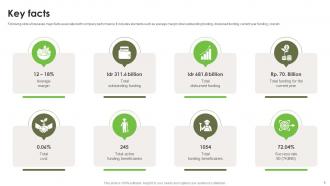
Slide 6: This slide showcases major facts associated with company performance. It includes elements such as average margin, total outstanding funding, disbursed funding etc.
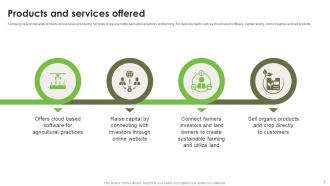
Slide 7: This slide presents products and services provided by company to assure better agriculture practices and farming.
Slide 8: This slide showcases company value preposition that helps company to gain competitive edge and sustainability in market.
Slide 9: This slide displays key milestones achieved by company. It includes information about number of disbursement, agricultural land empowered, lenders associations etc.
Slide 10: This slide exhibits customer reviews and testimonials about company services. It includes viewpoints of happy clients.
Slide 11: This slide showcases major customers that require company services. It includes clients such as skilled farmers, land owners and investors.
Slide 12: This slide displays market potential that helps company to grow and expand.
Slide 13: This slide showcases business and operational model of company. It includes elements such as key partners, resources, channels etc.
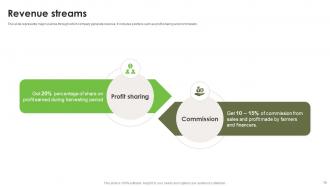
Slide 14: This slide represents major sources through which company generate revenue. It includes pointers such as profit sharing and commission.
Slide 15: This slide presents competitive analysis of company. It includes information about company names, founded year, growth score, location, total funding etc.
Slide 16: This slide showcases company financial statements to understand performance. It provides insights about gross profit, ROI, gross merchandise value, profit and loss report.
Slide 17: This slide displays forecasted financial performance of company. It includes elements such as operating revenue, total expenses, profits, cash from operations etc.
Slide 18: This slide highlights major reasons that helps to attract investors for fund raising. It includes pointers such as impact funding, farmer empowerment etc.
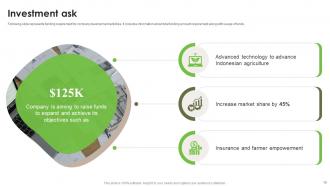
Slide 19: This slide represents funding requirement for company development activities. It includes information about total funding amount requirement along with usage of funds.
Slide 20: This slide showcases company funds usage for various agriculture and farming development. It includes funds allocated for technology, marketing, food security etc.
Slide 21: This slide exhibits company funding history. It includes elements such as announced date, funding round, amount raised, number of investors, total funding amount etc.
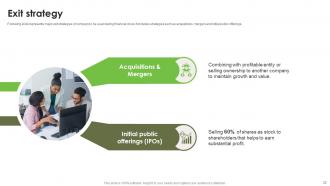
Slide 22: This slide represents major exit strategies of company to be used during financial crisis. It includes strategies such as acquisitions, mergers and initial public offerings.
Slide 23: This slide exhibits key members associated with company. It includes members such as CEO, COO and Community based development organization (CBDO) with experience and designation details.
Slide 24: This slide showcases company organizational structure that helps to understand roles and responsibilities. It includes members such as chairman, director, operations manager etc.
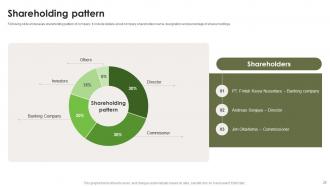
Slide 25: This slide showcases shareholding pattern of company. It include details about company shareholders name, designation and percentage of shares holdings.
Slide 26: This is a Thank You slide with address, contact numbers and email address.
Slide 27: This slide shows all the icons included in the presentation.
Slide 28: This slide is titled as Additional Slides for moving forward.
Slide 29: This is a Sand Clock Timeline slide. Show data related to time intervals here.
Slide 30: This slide contains Puzzle with related icons and text.
Slide 31: This slide shows Post It Notes for reminders and deadlines. Post your important notes here.
Slide 32: This slide presents Roadmap with additional textboxes.
Slide 33: This is an Idea Generation slide to state a new idea or highlight information, specifications etc.
Investment Proposal Deck For Sustainable Agriculture Ppt Template with all 39 slides:
Use our Investment Proposal Deck For Sustainable Agriculture Ppt Template to effectively help you save your valuable time. They are readymade to fit into any presentation structure.























FAQs for Investment Proposal Deck For Sustainable
Hit the basics first - market size, your solution, financials. For sustainable ag though, lead hard with environmental impact data and any certifications you've got. That's your real differentiator. Show actual crop yields or pilot results if you have them - way better than theoretical stuff. Investors eat that up. Don't skip the regulatory headaches (trust me, they matter in ag) and nail down your supply chain partnerships early. Your team's farming background is huge too. Keep it visual with real farm data, not just charts. Oh, and unit economics better be rock solid.
Dude, ditch those boring spreadsheets - nobody wants to stare at rows of numbers. Charts showing yield improvements and water savings tell way better stories. I'm obsessed with using maps to show where your farms are and their impact zones - visuals like that just hit different. Interactive dashboards are clutch because investors love poking around data themselves, builds trust. Make those complex ag metrics super digestible at first glance. Oh and definitely lead with your best performance numbers, then organize everything else around those wins. It's honestly night and day compared to traditional pitch decks.
So the big three are ROI, payback period, and cash flow projections - investors eat that stuff up. Cost per unit over time is super critical for sustainable ag since efficiency gains are what really get people excited. NPV and IRR matter too, obviously. But honestly? A clear revenue growth trajectory is what makes investors lean forward in their chairs. Break-even analysis is a must, plus don't sleep on government incentives or carbon credits - that's basically free money boosting your numbers. Oh, and whatever your strongest metric is, lead with that in your exec summary.
Look, you need hard numbers first - carbon sequestration rates, how much water you're saving, actual soil health data. Before/after photos are money too, especially those gnarly soil comparison shots. People eat that stuff up. But here's the key part - tie every environmental win straight to profit. Lower input costs, premium pricing, staying ahead of regulations. Honestly, half these investors don't care about saving the planet until you show them the ROI. Don't just wave around feel-good statements. Give them data they can actually crunch and get excited about.
Look, market research is what makes or breaks your pitch - investors need to see you actually get the space you're jumping into. Get hard data on market size, growth trends, competitor stuff, and whether people actually want sustainable products. Honestly, without this you're just guessing and that's investor kryptonite. Your research drives everything from how you position yourself to those financial projections. Don't just say "huge market potential" - find your specific target segments and back it up with real numbers. That's what separates the serious founders from the dreamers.
Put a full slide on risk mitigation - shows you're not clueless about what could go wrong. Hit the major stuff: weather issues (crop insurance, diversifying), market prices going crazy, regulations changing, tech adoption problems. Climate change is the wild card that keeps everyone up at night, but honestly that's why sustainable farming isn't just trendy BS. Don't just dump a list of scary scenarios on them. For every risk, show your actual plan to handle it. Maybe throw in backup strategies too. Investors love founders who aren't winging it and can think ahead.
Show them the financial and environmental wins upfront - that combo is gold. Break your ROI into chunks: quick returns from crop yields, medium-term savings on pesticides and water costs, plus long-term soil improvements. The soil health benefits are honestly where the real money is, even though they're trickier to put numbers on. Throw in some market data from similar projects and be straight about payback timing - usually 3-5 years for ag stuff. Don't forget sensitivity analysis with different scenarios so they know what they're getting into risk-wise.
Don't dump all your case studies at the end - that's boring as hell. Spread them throughout your pitch instead. Lead with a killer success story right after you explain the problem. Then back up each major point with real examples and actual numbers. ROI data, yield boosts, cost savings - whatever concrete results you've got from farms you've worked with. Honestly, investors eat that stuff up. Just make sure you have permission first (learned that the hard way). Your strongest case study should come early to prove this isn't just theoretical BS. Use those stories to show you've got real traction.
Honestly, precision agriculture and vertical farming are where the money is right now - investors are seeing crazy growth rates like 20-30% annually. Carbon credits are also blowing up since every company's scrambling to hit those net-zero goals, so definitely play up any carbon benefits your idea has. Oh, and alternative proteins plus regenerative farming are super hot topics too. Climate stuff is really driving consumer behavior these days. The trick is showing you can make money AND help the planet at the same time. Whatever direction you go, just make sure you've got solid market data to back it up.
Get letters of intent from farmers and partner up with co-ops - that stuff carries real weight. Surveys with your target communities are gold too since investors want proof farmers actually need this. Government partnerships? Even better. Honestly, the whole "build it and they'll come" approach is dead on arrival with investors. Map out your stakeholders - who's committed vs just interested. Focus groups help a ton here. NGO collabs add credibility too, though sometimes they move slower than you'd like. Bottom line: show concrete demand, not just assumptions about potential impact.
Investors always grill you on regulatory stuff, so get your ducks in a row. Environmental compliance is big - water permits, soil regs, pesticide restrictions for your area. Food safety certs like GAP or organic are gold if you're doing that. Labor laws can bite you hard, especially with seasonal crews (I've seen deals fall apart over this). Also check zoning requirements and what subsidies you qualify for. Oh, and make a simple chart showing where you stand on everything and timelines for approvals. Makes you look way more prepared than most people.
Dude, you gotta show real numbers that'll make investors' eyes light up. Like, actual data - precision irrigation cutting water use by 30%, AI monitoring slashing pesticide costs in half. Before/after comparisons are gold. Screenshots of your dashboards work way better than just talking about it, trust me. Drone footage is pretty sick too if you have it. Oh, and definitely separate what's already working from the experimental stuff - investors hate surprises about risk. Cost projections across different farm sizes will seal the deal.
Show investors those dramatic before/after shots of soil health - they eat that stuff up. Water usage dashboards are solid too. Interactive infographics work really well for connecting the dots: less pesticides means better biodiversity, which improves soil, which boosts yields. You can't go wrong with drone footage comparing healthy farmland to depleted areas. Charts showing water conservation and carbon reduction over time are must-haves. Oh, and those circular diagrams for crop rotation cycles help explain the process without being boring. Skip the generic farm photos though - data tells the real story here.
Totally depends on your audience, honestly. VCs want the money talk - market size, revenue projections, how they'll get their exit. NGOs are all about impact metrics and environmental benefits (which makes sense). Government grants? Ugh, the paperwork is brutal, but they love hearing about job creation and food security stuff. Your financial model doesn't change, but you're basically telling three different stories. I'd make separate executive summaries for each type. Same data, just frame it completely different depending on who's reading it.
Yeah, investors are obsessed with community impact right now - honestly it's almost as important as your revenue projections. Show them specific numbers like "supporting 200 smallholder farmers" or "cutting pesticide use by 40%." Jobs created, food security improvements, helping rural economies bounce back - that stuff matters. I'd definitely put a whole slide on quantifiable benefits and connect them to how you'll actually make money. Without that community angle, your pitch is probably dead in the water these days.
-
You know what? I'm so glad I opted for this PPT design. It has been a total game-changer for me and my presentations. Thank you!
-
Topic best represented with attractive design.