

IoT Applications For Manufacturing Case Study Industrial IoT Platform Smart Manufacturing IoT SS V





Try Before you Buy Download Free Sample Product
 Impress Your
Audience
 100%
Editable
 Save Hours
of Time


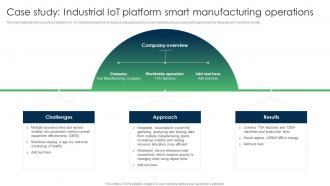
This side highlights the case study related to IoT in manufacturing which includes challenges faced by a tool manufacturing company with approaches for integrating IoT and their results.
People who downloaded this PowerPoint presentation also viewed the following :
IoT Applications For Manufacturing Case Study Industrial IoT Platform Smart Manufacturing IoT SS V with all 6 slides:
Use our IoT Applications For Manufacturing Case Study Industrial IoT Platform Smart Manufacturing IoT SS V to effectively help you save your valuable time. They are readymade to fit into any presentation structure.





FAQs for IoT Applications For Manufacturing Case Study Industrial IoT Platform Smart Manufacturing
IoT implementation in manufacturing delivers enhanced operational efficiency, predictive maintenance capabilities, real-time quality control, reduced downtime, and improved resource allocation across production lines. Through connected sensors and analytics, manufacturers streamline workflows, minimize equipment failures, and optimize energy consumption, with automotive and electronics companies finding that IoT integration ultimately reduces costs while accelerating production cycles.
IoT enhances supply chain visibility by providing real-time tracking of materials, automated inventory management, and predictive maintenance alerts across manufacturing operations. Through connected sensors and smart devices, manufacturers streamline logistics coordination, reduce stockouts and overstock situations, and accelerate production cycles, with automotive and electronics companies finding that IoT-enabled supply chains deliver significantly faster response times and lower operational costs.
Sensors monitor critical equipment parameters like temperature, vibration, pressure, and operational performance to detect anomalies before failures occur. Through real-time data collection, manufacturers can schedule maintenance proactively, reduce unexpected downtime, and extend equipment lifespan, with many industrial facilities finding that sensor-driven insights ultimately deliver significant cost savings and operational efficiency.
Real-time data collection through IoT devices revolutionizes quality control by enabling continuous monitoring, predictive maintenance, and immediate defect detection throughout manufacturing processes. These systems streamline operations by identifying issues before they escalate, reducing waste, and maintaining consistent product standards, with automotive and pharmaceutical manufacturers finding that IoT-driven quality control delivers significantly improved efficiency and customer satisfaction.
Manufacturers face security challenges including vulnerable device endpoints, data transmission risks, network intrusion threats, legacy system integration issues, and inadequate authentication protocols when deploying IoT solutions. These concerns can be addressed through encrypted communications, regular firmware updates, and network segmentation, with many manufacturing organizations finding that strategic cybersecurity investments ultimately deliver enhanced operational protection and competitive advantage.
IoT contributes to sustainable manufacturing through energy monitoring systems, predictive maintenance algorithms, waste reduction technologies, supply chain optimization platforms, and resource management solutions. These technologies streamline operations by minimizing energy consumption, reducing equipment downtime, and optimizing material usage, with many manufacturers finding that IoT-driven sustainability initiatives deliver both environmental benefits and significant cost savings.
Manufacturers leverage IoT analytics by collecting real-time data from connected machinery, sensors, and production lines to predict equipment failures, monitor performance patterns, and automatically adjust schedules based on demand fluctuations. Through predictive maintenance algorithms and continuous monitoring, companies like automotive and electronics manufacturers reduce unplanned downtime by up to 30%, while optimizing resource allocation and delivery timelines, ultimately delivering faster production cycles and significant cost savings.
Successful IoT smart factory implementations include Siemens' digital twin manufacturing, GE's predictive maintenance systems, BMW's connected assembly lines, Bosch's automated quality control, and Rolls-Royce's remote engine monitoring. These applications streamline production workflows, minimize equipment downtime, and enhance operational efficiency, with manufacturers achieving up to 25% cost reductions and significantly faster production cycles.
IoT-enabled machines communicate through industrial networks using protocols like Modbus, OPC-UA, and MQTT, enabling real-time data exchange between equipment, sensors, and control systems. Through wireless connectivity and edge computing, manufacturing facilities streamline production workflows, automate quality control, and optimize resource allocation, with many organizations finding that this interconnected approach ultimately delivers enhanced operational efficiency and reduced downtime.
Common IoT devices in manufacturing include sensors for temperature and vibration monitoring, RFID tags for inventory tracking, smart cameras for quality control, programmable logic controllers for automation, and wearable devices for worker safety. These technologies streamline operations by enabling predictive maintenance, reducing equipment downtime, and enhancing production efficiency, with many manufacturers finding that real-time monitoring ultimately delivers significant cost savings and competitive advantage.
IoT technology enhances workforce management through real-time location tracking, wearable safety monitors, skill-based task assignment systems, and automated attendance logging. These connected solutions streamline operations by optimizing labor allocation, reducing workplace accidents, and improving productivity metrics, with many manufacturing facilities finding that IoT-driven workforce analytics ultimately deliver enhanced operational efficiency and employee safety.
Edge computing processes IoT data locally within manufacturing facilities, reducing latency, enhancing real-time decision-making, and minimizing bandwidth requirements for cloud connectivity. This approach enables manufacturers to achieve faster response times for critical operations, improve operational efficiency through immediate data analysis, and maintain production continuity even during network disruptions, ultimately delivering enhanced automation and competitive advantage.
Manufacturers ensure IoT interoperability through standardized communication protocols like MQTT and OPC-UA, cloud-based integration platforms, edge computing solutions, and vendor-agnostic middleware architectures. These approaches streamline device connectivity, data exchange, and system coordination across production lines, with automotive and pharmaceutical companies finding that strategic protocol standardization ultimately delivers enhanced operational efficiency and reduced integration costs.
Emerging IoT innovations include autonomous production networks, predictive maintenance ecosystems, digital twin integration, real-time supply chain orchestration, and AI-driven quality control systems. These technologies streamline manufacturing by enabling self-optimizing processes, minimizing downtime, and enhancing operational transparency, with many manufacturers finding that interconnected smart factories ultimately deliver significant cost reductions and competitive advantages.
Regulatory requirements significantly influence IoT adoption in manufacturing by mandating data security protocols, equipment safety standards, and environmental compliance tracking. These regulations drive manufacturers to implement robust cybersecurity frameworks, real-time monitoring systems, and comprehensive audit trails, ultimately enhancing operational transparency and competitive advantage while ensuring regulatory adherence across production processes.
-
Exclusive and extensive collection of templates. Really helped me create a professional presentation in just no time.
-
It is my first time working with them and that too on a friend's recommendation. I would say, I am not expecting such a worldly service at this low price.