


IoT Communication Protocol Security Concerns IoT Security And Privacy Safeguarding IoT SS





Try Before you Buy Download Free Sample Product
 Impress Your
Audience
 100%
Editable
 Save Hours
of Time


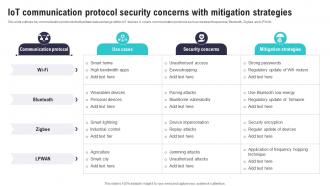
This slide outlines key communication protocols that facilitate data exchange within IoT devices. It covers communication protocols such as wireless frequencies, Bluetooth, Zigbee, and LPWAN.
People who downloaded this PowerPoint presentation also viewed the following :
IoT Communication Protocol Security Concerns IoT Security And Privacy Safeguarding IoT SS with all 9 slides:
Use our IoT Communication Protocol Security Concerns IoT Security And Privacy Safeguarding IoT SS to effectively help you save your valuable time. They are readymade to fit into any presentation structure.








FAQs for IoT Communication Protocol Security Concerns IoT Security And Privacy
Common IoT vulnerabilities include weak authentication protocols, unencrypted data transmission, insufficient update mechanisms, default password configurations, and inadequate network segmentation. These security gaps expose organizations to data breaches, unauthorized access, and operational disruptions, with many enterprises finding that comprehensive IoT security frameworks significantly reduce risks while enabling confident digital transformation.
Organizations can effectively implement IoT security frameworks through comprehensive device inventory management, network segmentation, regular firmware updates, access control protocols, and continuous monitoring systems. These strategies work together by establishing visibility across all connected devices, isolating potential threats, and maintaining real-time threat detection, with many enterprises finding that layered security approaches significantly reduce vulnerabilities while enabling scalable IoT deployment.
Encryption serves as the primary defense mechanism for IoT data protection by converting sensitive information into unreadable code during transmission and storage, preventing unauthorized access even if data is intercepted. Through advanced algorithms like AES-256, organizations in healthcare, manufacturing, and smart cities can secure patient records, production data, and infrastructure communications, ultimately delivering enhanced privacy compliance and operational confidence in increasingly connected environments.
Privacy regulations like GDPR, CCPA, and HIPAA significantly strengthen IoT security measures by mandating data encryption, access controls, consent mechanisms, and breach notification protocols. These compliance requirements drive organizations across healthcare, manufacturing, and smart cities to implement robust authentication systems, data minimization practices, and transparent governance frameworks, ultimately delivering enhanced consumer trust and competitive advantage.
IoT security best practices include network segmentation, regular firmware updates, strong authentication protocols, encrypted communications, and continuous monitoring systems. These approaches streamline security management by isolating device traffic, minimizing vulnerabilities, and enabling real-time threat detection, with many enterprises finding that strategic implementation ultimately delivers enhanced operational security and reduced breach risks.
Manufacturers can ensure IoT device security through secure-by-design principles, rigorous vulnerability testing, encrypted communications, regular firmware updates, and comprehensive security audits throughout development cycles. These practices enable companies to deliver robust products while minimizing post-deployment risks, with many technology firms finding that proactive security measures ultimately reduce support costs and enhance customer trust in increasingly connected markets.
Users can minimize IoT security risks by regularly updating device firmware, changing default passwords to strong unique credentials, enabling two-factor authentication, creating separate network segments for IoT devices, and regularly auditing connected devices. These strategies work together to create layered protection, with many households finding that network isolation and consistent password management significantly reduce vulnerability to cyber threats while maintaining device functionality.
Edge computing enhances IoT security by processing data locally rather than transmitting it to distant cloud servers, reducing exposure to network-based attacks and minimizing data breach risks. This approach enables real-time threat detection, faster response times, and improved data privacy, with manufacturing plants and smart cities finding that localized processing significantly strengthens their overall security posture.
AI and machine learning advancements in IoT security include behavioral analytics, anomaly detection, predictive threat modeling, automated response systems, and adaptive authentication protocols. These technologies enhance security by identifying unusual device patterns, predicting vulnerabilities before exploitation, and automating threat responses, with manufacturing and healthcare organizations finding that intelligent security systems significantly reduce breach risks while maintaining operational efficiency.
Securing legacy IoT devices presents challenges including outdated firmware, weak authentication protocols, unencrypted data transmission, limited update capabilities, and hardcoded passwords. These vulnerabilities expose organizations to cyber attacks, data breaches, and network compromises, with many enterprises finding that strategic network segmentation and third-party security overlays help mitigate risks while maintaining operational continuity.
Organizations can conduct regular IoT security assessments through automated vulnerability scanning, penetration testing, device inventory audits, network traffic analysis, and firmware update reviews. These comprehensive evaluations enable companies to identify weak points across manufacturing, healthcare, and retail environments, ultimately strengthening their security posture while ensuring continuous protection against evolving threats.
IoT security standards include ISO/IEC 27001, NIST Cybersecurity Framework, IEC 62443, ETSI EN 303 645, and IoT Security Foundation guidelines. These frameworks enable organizations to establish comprehensive security protocols by implementing risk assessment procedures, device authentication requirements, and data encryption standards, with many enterprises finding that systematic adoption across manufacturing, healthcare, and smart city initiatives ultimately delivers enhanced operational resilience and regulatory compliance.
Blockchain integration enhances IoT security practices by creating immutable transaction records, enabling decentralized device authentication, and eliminating single points of failure in network architectures. Through distributed ledger systems, organizations streamline identity verification, automate secure data exchanges, and maintain comprehensive audit trails, with many financial services and healthcare institutions finding that blockchain-based IoT networks deliver significantly improved transparency and threat resistance.
**INPUT**: What incident response measures should be in place following a breach in an IoT system? **OUTPUT**: IoT breach response measures include immediate device isolation, comprehensive network segmentation, forensic data collection, affected system assessment, and stakeholder communication protocols. These coordinated actions enable organizations to contain threats, preserve evidence, and restore operations efficiently, with many enterprises finding that pre-established response frameworks significantly minimize downtime and regulatory compliance risks. [Word count: 53 words]
**INPUT**: What training and awareness initiatives can help users and organizations strengthen IoT security? **OUTPUT**: Training initiatives include device configuration workshops, password management courses, network security protocols, threat recognition programs, and incident response training. These educational approaches enhance IoT security by building user competency, establishing security-first cultures, and streamlining threat mitigation, with many organizations finding that comprehensive training ultimately reduces vulnerabilities and strengthens operational resilience. **Word count: 54 words**
-
Great product with effective design. Helped a lot in our corporate presentations. Easy to edit and stunning visuals.
-
Time saving slide with creative ideas. Help a lot in quick presentations..