

IoT Implementation Project Summary Report





Try Before you Buy Download Free Sample Product
 Impress Your
Audience
 100%
Editable
 Save Hours
of Time


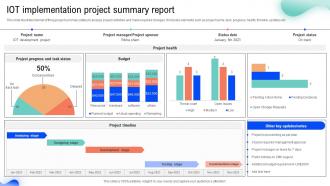
This slide illustrate internet of thing project summary status to analyze project activities and make required changes. It includes elements such as project name, task, progress, health, timeline, updates etc.
People who downloaded this PowerPoint presentation also viewed the following :
IoT Implementation Project Summary Report with all 7 slides:
Use our IoT Implementation Project Summary Report to effectively help you save your valuable time. They are readymade to fit into any presentation structure.






FAQs for IoT Implementation
So you're gonna need four main things for IoT. Sensors and devices to grab your data - that's the obvious one. Connectivity comes next, could be WiFi or cellular depending on what you're doing. Then some kind of cloud setup to handle all the data processing (seriously, it always ends up being way more data than you think). Analytics tools are the last piece so people can actually understand what's happening. Oh, and definitely figure out your specific use case first before picking any tech - saves you from buying stuff you don't need.
Start with open standards like MQTT or HTTP/REST - seriously, this saves so much headache later. I've watched teams buy random shiny devices without checking if they'll even talk to each other (big oops). Get some middleware or IoT platform set up first to translate between different device languages. JSON's pretty solid for data formats. Oh and honestly? Map out your whole device ecosystem before buying anything. Otherwise you'll have a bunch of expensive bricks sitting around that can't communicate. Trust me on this one.
Device authentication is your starting point - ditch those default passwords and give each device unique credentials. Segment your network so IoT stuff can't touch critical systems. The breach stories from unsecured devices are honestly terrifying. Regular firmware updates are clutch, even though they're annoying to manage. Also encrypt your data transmission and set up monitoring for weird device behavior. I know it sounds like a lot but these fundamentals will put you miles ahead of most setups. Start here and build out from there.
Think of data analytics as what makes your IoT setup actually useful. All those sensors are spitting out numbers constantly, but without analytics you're just hoarding data that doesn't mean anything. Pretty pointless, right? Analytics spots the patterns you'd miss - like when equipment's about to die or where you're wasting energy. Real-time monitoring catches bottlenecks before they screw you over. The trick is building dashboards around metrics that actually move the needle for your business, not just flashy numbers that look cool but won't help you make better decisions.
Track both the obvious stuff and the harder-to-measure benefits. Cost savings are easy - less downtime, better energy efficiency, automation cutting labor costs. But don't ignore things like happier customers and faster decisions. Those soft benefits can actually be huge (way bigger than most people think). Set your baselines before you start so you can prove what changed. New revenue from data insights is another big one. Most companies I've seen hit ROI around 12-18 months, assuming they're tracking the right metrics from day one.
Ugh, connectivity issues will drive you insane - your network can't handle tons of devices chatting simultaneously. Security's another massive pain point that'll bite you if you ignore it early on. Managing device updates across your whole fleet? Way harder than anyone tells you upfront. Data integration gets messy fast when sensors speak different languages. Honestly, I'd start with just a few devices first. Get your security sorted from day one, not later. Budget like 2x the time you think integration will take. Oh, and don't let anyone convince you it's plug-and-play. It's not.
So edge computing moves the actual processing right next to your IoT devices rather than everything going to the cloud first. You'll get way faster responses and cut down on bandwidth costs. Your devices won't crash every time the internet hiccups either, which honestly is a lifesaver. Privacy stuff stays local too - no need to send sensitive data halfway across the world. The cool part is real-time decisions happen right at the device level. Think industrial machines that can't wait 200ms for a cloud response. I'd start by figuring out which processes actually need that split-second timing.
Honestly, it depends what you're building, but here's what I'd focus on. WiFi (802.11) and Zigbee (802.15.4) are solid for most projects. Cellular like LTE-M if you need longer range. Don't sleep on security though - ISO 27001 and NIST frameworks will save your butt later. MQTT's probably your best bet for data exchange, maybe CoAP depending on your setup. Oh, and if you're doing anything with power grids, there's IEC 61850 too. I'd start by figuring out your range requirements first, then pick your connectivity standard from there.
Go modular and cloud-based from the start - trust me on this one. Microservices let you scale pieces independently instead of wrestling with one giant system that breaks everything when it goes down. Edge computing will save your sanity by cutting latency and keeping traffic off your main servers. Your message queuing (MQTT works great) needs to handle millions without falling over. Here's the thing though - design for failure right away. Devices will drop offline, data gets weird, it's just reality. Build the data pipeline first, then add the fancy analytics stuff later when you're not drowning.
Honestly, IoT privacy stuff freaks me out - these devices are basically little data vacuum cleaners in your house. Nobody reads those crazy long terms of service agreements, so we don't even know what we're agreeing to. Plus there's algorithmic bias, data ownership questions, and yeah... governments could totally use this for surveillance. The whole thing also creates this weird divide where rich people get all the cool smart home benefits while everyone else gets left out. My take? Build privacy protections right into whatever you're working on from day one. Also, just because you *can* collect someone's data doesn't mean you should, you know?
Honestly, personalization is where IoT gets good. Smart thermostats that actually learn when you're home, fitness trackers that get your habits - that stuff works because it anticipates what you need instead of waiting for you to tell it. Voice, apps, physical buttons, whatever - just make sure they all feel natural to use. I'd start by figuring out your users' daily routines first. Where would automation actually help vs just being another gadget to fidget with? Those moments are pure gold for UX.
Honestly, you're gonna want to nail three things here. First, get automated updates working - pushing firmware remotely instead of touching every single device (learned that one the hard way). Also set up some kind of centralized dashboard so you can actually see what's happening across all your devices. Health stats, connectivity issues, all that stuff. Oh and here's something most people forget - plan your hardware refresh cycles now. These things don't last forever and getting budget approval takes forever. I'd start by just making a list of what you currently have, then figure out update schedules from there.
So regulatory stuff is a total mess depending on where you're deploying. Europe's super strict with GDPR - they don't mess around with data privacy. The US? It's like a patchwork quilt of different state laws. Asia's completely all over the place - some countries barely care, others are obsessed with keeping data local. China's cybersecurity laws are honestly a nightmare to navigate. Cross-border deployments are where things get really fun (and by fun I mean expensive). You'll be dealing with multiple legal systems at once. Definitely map out your regions first and get legal help early - learned that one the hard way on a project last year.
Dude, IoT is seriously changing everything. Manufacturing plants now have sensors that predict when machines will break - saves them crazy money. Farmers are basically tech nerds now, using soil monitors and drones to boost crop yields. Healthcare can track patients remotely instead of constant hospital visits (which honestly makes so much sense). Smart shelves in stores automatically handle inventory, and shipping companies watch their trucks in real-time. Agriculture might be the coolest example though. The whole thing basically flips industries from always playing catch-up to actually preventing problems before they happen.
Your team needs training across a bunch of different areas since IoT is everywhere now. Hardware basics, networking, cloud stuff, data analytics - it's overwhelming but not everyone has to master everything. Get your devs to understand sensor limits while hardware people learn software constraints. Security training though? That's non-negotiable because these devices get attacked constantly. Start with AWS, Azure, or Google certifications depending on what platform you're using. Oh and aim for T-shaped skills - one deep specialty but understanding how the whole system works together. Cross-training is key here.
-
Exclusive and extensive collection of templates. Really helped me create a professional presentation in just no time.
-
Nice and innovative design.