

IoT Monitoring Dashboard In Smart Smart Agriculture Using IoT System IoT SS V





Try Before you Buy Download Free Sample Product
 Impress Your
 Audience
 100%
100% Editable
 Save Hours
 of Time


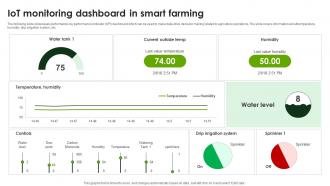
The following slide showcases performance key performance indicator KPI dashboard which can be used to make data-drive decision making related to agriculture operations. The slide covers information about temperature, humidity, drip irrigation system, etc.
People who downloaded this PowerPoint presentation also viewed the following :
IoT Monitoring Dashboard In Smart Smart Agriculture Using IoT System IoT SS V with all 10 slides:
Use our IoT Monitoring Dashboard In Smart Smart Agriculture Using IoT System IoT SS V to effectively help you save your valuable time. They are readymade to fit into any presentation structure.









FAQs for IoT Monitoring Dashboard In Smart Smart Agriculture Using IoT System
IoT monitoring in agriculture delivers enhanced crop yields, reduced water consumption, optimized fertilizer usage, early pest detection, and improved resource allocation. These technologies streamline farm operations by providing real-time soil conditions, weather patterns, and crop health data, with many agricultural enterprises finding that precision farming ultimately reduces operational costs while increasing productivity and sustainability.
IoT sensors improve soil health and crop yields by monitoring moisture levels, nutrient content, pH balance, and temperature in real-time, enabling precision irrigation and targeted fertilization. Through automated data collection, farmers can optimize water usage, reduce chemical inputs, and detect issues early, with agricultural operations finding that this technology delivers up to 30% higher yields while significantly reducing resource costs and environmental impact.
Farmers face challenges including high initial investment costs, limited rural internet connectivity, technical complexity requiring new skills, data security concerns, and integration difficulties with existing equipment. However, many agricultural operations find that strategic implementation, starting with pilot programs and partnering with technology providers, helps overcome these barriers while delivering improved crop yields and operational efficiency.
Data analytics from IoT devices influences farming decisions by transforming sensor data into actionable insights for crop management, resource optimization, and yield prediction. Through predictive algorithms and real-time monitoring, farmers can adjust irrigation schedules, optimize fertilizer applications, and detect pest infestations early, ultimately reducing costs while maximizing productivity and sustainability.
Connectivity serves as the foundation for IoT agriculture monitoring, enabling real-time data transmission from sensors measuring soil moisture, temperature, crop health, and weather conditions to centralized management systems. Reliable network infrastructure, whether through cellular, WiFi, or satellite connections, allows farmers to make immediate irrigation adjustments, detect pest threats, and optimize resource allocation, ultimately delivering enhanced crop yields and operational efficiency.
IoT devices enhance water resource management by enabling precision irrigation through soil moisture sensors, weather monitoring systems, and automated valve controls that deliver water exactly when and where needed. Through real-time data analytics, farms can reduce water consumption by up to 30% while maintaining crop yields, with many agricultural operations finding that smart irrigation systems significantly lower costs and improve sustainability.
IoT pest management solutions include smart traps with sensors, pheromone-based monitoring devices, computer vision cameras, soil moisture sensors, and predictive analytics platforms. These technologies streamline detection by providing real-time alerts, automated identification, and targeted treatment recommendations, with many farms finding that integrated systems reduce pesticide usage while enhancing crop yields and operational efficiency.
IoT-based systems enhance supply chain traceability by providing real-time tracking of agricultural products, automated data collection at every stage, and blockchain integration for immutable records. Through sensor networks and RFID technology, food manufacturers and retailers can monitor temperature, location, and quality parameters continuously, enabling rapid response to contamination issues while delivering enhanced consumer confidence and regulatory compliance.
IoT technologies in agriculture deliver significant environmental benefits including reduced water consumption, minimized chemical usage, decreased soil degradation, lower carbon emissions, and enhanced biodiversity protection. Through precision monitoring and automated resource management, farms achieve up to 30% water savings and 25% reduction in pesticides, while optimizing crop yields, ultimately enabling sustainable farming practices that support both profitability and environmental stewardship.
Farmers can ensure IoT data security through encrypted communications, regular firmware updates, strong authentication protocols, network segmentation, and secure cloud storage solutions. These security measures protect sensitive agricultural data from cyber threats while enabling farmers to maintain operational transparency, comply with privacy regulations, and build consumer trust, ultimately delivering competitive advantage in an increasingly connected agricultural landscape.
IoT's future in sustainable farming includes predictive analytics for crop optimization, autonomous irrigation systems, soil health monitoring, carbon footprint tracking, and precision resource management. These technologies enable farmers to reduce water usage by up to 30%, minimize chemical inputs through targeted applications, and increase yields while preserving environmental resources, ultimately delivering both profitability and sustainability in an increasingly climate-conscious agricultural landscape.
IoT technology enhances precision agriculture by enabling real-time monitoring of soil moisture, temperature, nutrient levels, and crop health through connected sensors and automated systems. Through GPS-guided tractors and drone surveillance, farmers optimize irrigation schedules, reduce fertilizer waste, and increase crop yields by up to 30%, ultimately delivering significant cost savings and sustainable farming practices.
IoT agriculture monitoring implementation costs include sensors and devices, connectivity infrastructure, data analytics platforms, installation services, and ongoing maintenance subscriptions. While initial investments can range significantly depending on farm size and complexity, many agricultural operations find that these systems ultimately deliver reduced labor costs, optimized resource usage, and improved crop yields that provide strong returns on investment.
Different crops benefit from tailored IoT monitoring through customized sensors for soil moisture, temperature, pH levels, and nutrient tracking specific to each plant's requirements. Precision agriculture enables tomatoes to receive optimal water scheduling, corn to benefit from real-time pest detection, and vineyards to monitor microclimates, ultimately delivering higher yields and reduced resource waste.
Resources for farmers integrating IoT include government agricultural extension programs, university research centers, technology vendor training platforms, industry associations, and specialized agricultural consultants. These resources deliver guidance through hands-on workshops, demonstration farms, and technical support services, with many farming operations finding that structured implementation programs significantly reduce adoption barriers while maximizing operational efficiency and crop yield improvements.
-
Kudos to SlideTeam for achieving the high success rate in delivering the top-notch slides.
-
Definitely a time saver! Predesigned and easy-to-use templates just helped me put together an amazing presentation.