

IOT Smart Grid Energy Management And Optimization




Try Before you Buy Download Free Sample Product
 Impress Your
 Audience
 100%
100% Editable
 Save Hours
 of Time


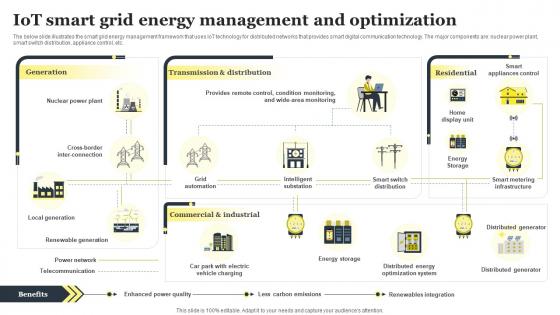
The below slide illustrates the smart grid energy management framework that uses IoT technology for distributed networks that provides smart digital communication technology. The major components are nuclear power plant, smart switch distribution, appliance control, etc.
People who downloaded this PowerPoint presentation also viewed the following :
IOT Smart Grid Energy Management And Optimization with all 9 slides:
Use our IOT Smart Grid Energy Management And Optimization to effectively help you save your valuable time. They are readymade to fit into any presentation structure.








FAQs for IOT Smart Grid Energy
IoT Smart Grid components include smart meters, sensors, communication networks, data analytics platforms, and automated control systems that monitor energy consumption, grid performance, and demand patterns. These technologies integrate seamlessly through real-time data exchange, enabling utilities to optimize energy distribution, predict maintenance needs, and reduce operational costs, while delivering enhanced reliability and efficiency across power networks.
IoT technology enhances grid reliability and efficiency by enabling real-time monitoring, predictive maintenance, automated fault detection, and dynamic load balancing across electrical networks. Through smart sensors and connected devices, utilities can identify potential failures before they occur, optimize energy distribution during peak demand periods, and restore power faster during outages, ultimately delivering more stable service and reduced operational costs.
Smart meters serve as critical data collection points in IoT Smart Grid ecosystems, enabling real-time energy monitoring, two-way communication between utilities and consumers, automated billing, and demand response management. These connected devices streamline grid operations by providing granular consumption data, facilitating dynamic pricing models, and supporting predictive maintenance, ultimately delivering enhanced operational efficiency and improved customer experiences for utility providers.
IoT Smart Grids facilitate demand response by enabling real-time communication between utilities and consumers, automated load management, dynamic pricing signals, and predictive analytics for consumption patterns. Through smart meters and connected devices, utilities can incentivize peak-hour reductions while consumers optimize energy usage, ultimately delivering lower costs, grid stability, and enhanced operational efficiency across residential and commercial sectors.
IoT smart grids face cybersecurity challenges including vulnerable device endpoints, insecure communication protocols, inadequate authentication systems, distributed attack surfaces, and legacy infrastructure integration complexities. These vulnerabilities enable cyber threats ranging from data breaches to grid manipulation, with utilities increasingly finding that comprehensive security frameworks, real-time monitoring, and multi-layered defense strategies are essential for protecting critical energy infrastructure.
Data analytics enables predictive maintenance in IoT Smart Grids by analyzing sensor data patterns, identifying equipment anomalies, and forecasting potential failures before they occur. Through machine learning algorithms, utility companies can optimize maintenance schedules, reduce unexpected outages, and extend asset lifecycles, with many finding that predictive approaches deliver significant cost savings and enhanced grid reliability.
IoT technology in Smart Grids delivers significant environmental benefits including reduced energy consumption, optimized renewable energy integration, minimized carbon emissions, decreased transmission losses, and enhanced demand response capabilities. These systems enable utilities to automatically balance supply and demand, seamlessly incorporate solar and wind power, and reduce overall grid inefficiency by up to thirty percent, ultimately supporting sustainability goals while delivering cost-effective energy management.
IoT Smart Grids facilitate renewable energy integration by providing real-time monitoring, predictive analytics, and automated load balancing to manage variable power generation from solar and wind sources. These intelligent systems enable utilities to optimize energy storage, coordinate distributed generation across multiple sites, and maintain grid stability, ultimately delivering enhanced efficiency and reduced carbon footprint for power companies.
IoT significantly transforms residential energy consumption by enabling real-time monitoring, automated demand response, and predictive usage optimization through smart meters, connected appliances, and intelligent thermostats. These technologies streamline energy management by reducing peak-hour demand, minimizing waste through automated controls, and providing granular consumption insights, with many households finding that IoT integration delivers 15-20% energy savings and enhanced grid stability.
Regulatory frameworks significantly influence IoT Smart Grid deployment by establishing data privacy standards, interoperability requirements, cybersecurity protocols, and grid modernization mandates. These regulations enable utilities to invest confidently in smart infrastructure while ensuring consumer protection, with many energy providers finding that clear regulatory guidance accelerates adoption and streamlines integration across existing power systems.
Critical communication protocols for IoT Smart Grids include 5G networks, LoRaWAN, Zigbee, cellular LTE, and fiber optic systems. These technologies streamline grid operations by enabling real-time monitoring, automated fault detection, and predictive maintenance capabilities, with many utilities finding that enhanced communication protocols ultimately deliver reduced operational costs and significantly improved grid reliability.
IoT Smart Grids enhance energy equity by providing real-time monitoring, automated demand response, and predictive maintenance that reduces outages and costs in underserved areas. Through smart meters and distributed sensors, utility companies can identify infrastructure gaps, optimize energy distribution, and implement targeted efficiency programs, ultimately delivering more reliable, affordable electricity access while enabling community-based renewable energy integration.
Notable IoT Smart Grid implementations include Amsterdam's smart energy network, Singapore's intelligent grid infrastructure, Barcelona's connected utility systems, South Korea's nationwide smart grid project, and California's advanced metering initiatives. These deployments revolutionize energy management by enabling real-time monitoring, automated demand response, and predictive maintenance, with utilities finding significantly reduced operational costs and enhanced grid reliability.
IoT Smart Grid contributes to sustainable urban development by optimizing energy distribution, reducing carbon emissions, and enabling real-time resource management across city infrastructure. Through predictive analytics and automated controls, municipalities streamline power consumption, integrate renewable sources more effectively, and minimize waste, ultimately delivering cleaner energy systems and enhanced operational efficiency for growing urban populations.
Transitioning to IoT-enabled Smart Grid infrastructure involves costs including advanced metering infrastructure, communication networks, data analytics platforms, cybersecurity systems, and grid modernization equipment. While initial investments are significant, utilities increasingly find that these systems deliver substantial returns through reduced operational costs, improved energy efficiency, enhanced grid reliability, and streamlined maintenance operations.
-
“Love it! I was able to grab an exciting proposal because of SlideTeam.”
-
Awesome presentation, really professional and easy to edit.