

Islamic Insurance Principles Of Takaful In Depth Analysis Of Islamic Finance Fin SS V




Try Before you Buy Download Free Sample Product
 Impress Your
Audience
 100%
Editable
 Save Hours
of Time


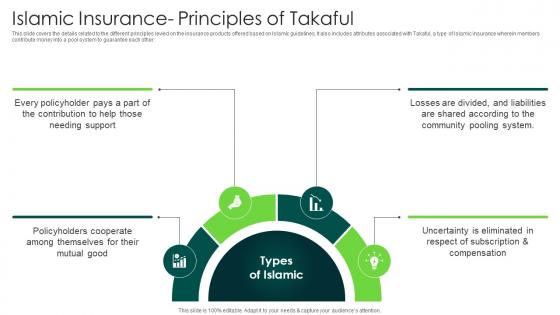
This slide covers the details related to the different principles levied on the insurance products offered based on Islamic guidelines. It also includes attributes associated with Takaful, a type of Islamic insurance wherein members contribute money into a pool system to guarantee each other.
People who downloaded this PowerPoint presentation also viewed the following :
Islamic Insurance Principles Of Takaful In Depth Analysis Of Islamic Finance Fin SS V with all 9 slides:
Use our Islamic Insurance Principles Of Takaful In Depth Analysis Of Islamic Finance Fin SS V to effectively help you save your valuable time. They are readymade to fit into any presentation structure.








FAQs for Islamic Insurance Principles Of Takaful In Depth Analysis Of Islamic Finance
Takaful is a Shariah-compliant insurance model based on mutual cooperation, shared responsibility, and collective risk-sharing among participants, rather than transferring risk to an insurer for profit. Unlike conventional insurance, Takaful operates through pooled contributions managed transparently, with surplus funds returned to participants, enabling financial institutions and organizations to offer ethical insurance solutions while maintaining religious compliance and fostering community-based risk management.
Takaful ensures risk sharing through mutual cooperation where participants contribute to a common fund, with surplus profits shared equitably and deficits covered collectively, adhering to Shariah principles of avoiding interest, gambling, and uncertainty. This cooperative model enables transparent risk distribution across healthcare, life insurance, and property protection sectors, while maintaining Islamic compliance through Shariah board oversight, ultimately delivering ethical financial protection and community-based security.
Takaful's core principles include mutual cooperation (ta'awun), shared responsibility (takaful), transparency (gharar avoidance), prohibition of interest (riba), and risk-sharing among participants. These principles create a communal insurance framework where members contribute to a common fund, share profits and losses equitably, and operate under Sharia-compliant guidelines, ultimately delivering ethical financial protection and fostering community solidarity.
Takaful contributions are structured as donations to a mutual fund shared among participants, rather than traditional insurance premiums paid to profit-driven insurers for coverage. This cooperative model enables risk-sharing through collective responsibility, transparent fee structures, and profit-sharing arrangements, with many Islamic financial institutions finding that participants benefit from lower costs and shared surplus returns.
Takaful operators manage participant funds through separate accounts, ensuring Shariah compliance, transparent financial reporting, and equitable surplus distribution among members. They act as trustees rather than insurers, maintaining clear segregation between participant funds and company assets, with many Islamic financial institutions finding that this fiduciary approach enhances trust and regulatory compliance.
Takaful products can be customized through flexible contribution structures, industry-specific risk assessments, demographic-based coverage options, and Sharia-compliant investment portfolios tailored to participant needs. Healthcare sectors benefit from medical takaful plans, while manufacturing industries utilize equipment protection schemes, with many Islamic financial institutions finding that personalized takaful solutions enhance customer retention and deliver competitive advantages in diverse markets.
Common misconceptions about Takaful include believing it's only for Muslims, that it offers inferior coverage compared to conventional insurance, that it's more expensive, and that it lacks regulatory oversight or global acceptance. Many businesses and individuals mistakenly assume Takaful products have limited investment options or slower claim processing, when in reality, modern Takaful operations deliver competitive returns, efficient services, and comprehensive coverage across diverse markets, with many multinational corporations finding that Takaful enhances their risk management strategies while meeting ethical investment criteria.
Takaful promotes social solidarity through mutual cooperation, shared risk pooling, collective responsibility for members' welfare, and community-based decision making. By operating on Islamic principles of mutual assistance, participants contribute to a common fund that supports fellow members during hardships, creating stronger community bonds while delivering ethical insurance solutions that align with religious values and foster collective prosperity.
Takaful investment funds strictly adhere to Shariah principles by avoiding riba (interest), gharar (excessive uncertainty), and haram industries like alcohol, gambling, or pork production. These investments focus on asset-backed securities, Islamic bonds (sukuk), real estate, and equity in Shariah-compliant businesses, with dedicated Shariah boards ensuring ongoing compliance and ethical alignment throughout the investment process.
**INPUT**: What risk management strategies are unique to Takaful as compared to traditional insurance? **OUTPUT**: Takaful employs cooperative risk-sharing, Shariah-compliant investments, participatory fund management, transparent surplus distribution, and ethical underwriting principles that exclude prohibited activities. These Islamic finance strategies enhance community solidarity and financial transparency while delivering sustainable risk protection, with many Islamic financial institutions finding that this cooperative approach ultimately strengthens policyholder trust and long-term organizational resilience. **Word count: 56 words**
Fintech has revolutionized the Takaful industry by enhancing operational efficiency, streamlining claims processing, and improving customer accessibility through digital platforms and mobile applications. These technological advances enable Islamic insurers to deliver faster policy issuance, automated Sharia-compliant assessments, and personalized customer experiences, with many institutions finding that digital transformation significantly reduces costs while expanding market reach.
The Takaful industry faces regulatory fragmentation across jurisdictions, inconsistent Shariah compliance standards, and limited harmonization of operational frameworks between different markets. These challenges create complexity for multinational insurers and cross-border operations, though increasing collaboration between Islamic finance regulators and standardization bodies is gradually establishing unified guidelines, ultimately enhancing market confidence and enabling broader global expansion.
Takaful caters to businesses and entrepreneurs by offering Sharia-compliant insurance alternatives that align with Islamic ethical principles, covering property, liability, trade credit, and key person risks. This cooperative model enables companies in banking, manufacturing, and retail to access comprehensive protection while maintaining religious compliance, ultimately delivering transparent risk-sharing mechanisms and ethical investment practices that support sustainable business growth.
Emerging trends in Takaful include digital transformation through mobile platforms, artificial intelligence for risk assessment, blockchain for transparency, parametric insurance products, and ESG-focused investment strategies. These innovations streamline operations by enhancing customer accessibility, automating claims processing, and improving regulatory compliance, with many Islamic financial institutions finding that technology-driven Takaful solutions deliver competitive advantages in increasingly diverse global markets.
Education and awareness initiatives can enhance Takaful adoption in non-Muslim communities by highlighting its ethical investment principles, transparent fee structures, and community-based risk sharing benefits. Through targeted outreach programs, financial literacy workshops, and partnerships with mainstream financial advisors, institutions can demonstrate how Takaful's participatory model delivers competitive returns while supporting socially responsible investing, with many diverse communities finding these values-driven approaches increasingly attractive.
-
It’s really cool, and you can find pretty much everything you could need for your work or school.
-
Mesmerized with the fantastic collection! Super sleek, relevant infographics.