

It infrastructure playbook infrastructure as code for overall process automation





Try Before you Buy Download Free Sample Product
 Impress Your
Audience
 100%
Editable
 Save Hours
of Time


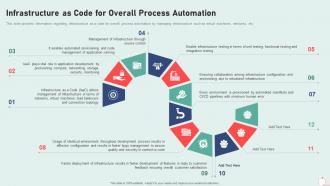
This slide provides information regarding infrastructure as a code for overall process automation by managing infrastructure such as virtual machines, networks, etc.
People who downloaded this PowerPoint presentation also viewed the following :
It infrastructure playbook infrastructure as code for overall process automation with all 6 slides:
Use our It Infrastructure Playbook Infrastructure As Code For Overall Process Automation to effectively help you save your valuable time. They are readymade to fit into any presentation structure.





FAQs for It infrastructure playbook infrastructure as code for
Infrastructure as Code delivers enhanced consistency, faster deployment cycles, improved version control, reduced human error, and significant cost optimization across cloud environments. These capabilities enable organizations to automate infrastructure provisioning, enhance scalability, and maintain standardized configurations, with many enterprises finding that IaC ultimately streamlines operations while delivering competitive advantage.
IaC improves collaboration by providing shared, version-controlled infrastructure definitions that both development and operations teams can understand, modify, and deploy consistently. Through standardized templates and automated provisioning, teams eliminate miscommunication around environment configurations, reduce deployment conflicts, and accelerate release cycles, with many organizations finding that collaborative infrastructure management ultimately delivers faster time-to-market and improved system reliability.
Common Infrastructure as Code tools include Terraform, AWS CloudFormation, Azure Resource Manager, Ansible, and Puppet, each offering distinct automation capabilities for cloud and on-premises environments. These platforms streamline infrastructure deployment by enabling version control, automated provisioning, and consistent configuration management, with many organizations finding that strategic tool selection significantly reduces deployment times while enhancing operational reliability and scalability.
IaC enhances security posture by enabling consistent security configurations, automated compliance checks, and version-controlled infrastructure changes across all cloud environments. Through standardized templates and automated scanning, organizations minimize human errors, ensure policy adherence, and maintain audit trails, with many financial services and healthcare institutions finding significantly reduced security vulnerabilities and faster incident response.
Infrastructure as Code version control best practices include using Git workflows with feature branches, implementing automated testing pipelines, maintaining clear commit messages, establishing code review processes, and separating environments through branching strategies. These practices streamline infrastructure management by ensuring rollback capabilities, tracking configuration changes, and enabling collaborative development, with many DevOps teams finding that structured version control ultimately delivers faster deployments and enhanced operational reliability.
Organizations integrate IaC into CI/CD pipelines by implementing version-controlled infrastructure templates, automated testing stages, and deployment orchestration tools like Terraform, Ansible, or CloudFormation. This strategic combination enables consistent environment provisioning, reduces manual configuration errors, and accelerates deployment cycles, with many enterprises finding that automated infrastructure delivery significantly enhances operational efficiency and developer productivity.
Teams transitioning to Infrastructure as Code face challenges including steep learning curves for new tools, resistance to change from traditional operations staff, complex legacy system integration, and initial time investment for automation setup. While these hurdles require significant upfront effort, organizations increasingly find that systematic training, gradual migration strategies, and cross-functional collaboration ultimately deliver enhanced operational efficiency and reduced manual errors.
Infrastructure as Code enables robust disaster recovery through automated backup configurations, version-controlled infrastructure definitions, rapid environment replication, and consistent deployment processes across multiple regions. These capabilities streamline recovery by minimizing manual errors, accelerating restoration timelines, and ensuring identical infrastructure rebuilds, with many financial services and healthcare organizations finding significantly reduced downtime and enhanced business continuity.
IaC enforces compliance and governance through automated policy validation, standardized templates, version-controlled configurations, and predefined security rules that prevent non-compliant deployments. Through tools like Terraform Sentinel or AWS Config, organizations streamline regulatory adherence, minimize configuration drift, and ensure consistent security baselines, with many financial services and healthcare institutions finding that automated governance significantly reduces audit times and compliance risks.
Configuration management tools like Ansible, Puppet, Chef, and SaltStack serve as crucial components in IaC ecosystems by automating software installation, system configuration, and ongoing maintenance across infrastructure environments. These tools complement infrastructure provisioning platforms by ensuring consistent application deployments, security compliance, and operational efficiency, with many organizations finding that this strategic combination ultimately delivers faster deployment cycles and reduced operational overhead.
IaC significantly enhances cost management by enabling automated resource provisioning, real-time monitoring, and precise scaling based on actual demand. Through template-based deployments, organizations can eliminate over-provisioning, implement consistent tagging strategies, and automatically shut down non-production environments, with many enterprises finding 20-40% cost reductions while maintaining optimal performance.
IaC module reusability strategies include creating parameterized templates, establishing standardized naming conventions, implementing modular architecture patterns, maintaining comprehensive documentation, and utilizing version control systems. These approaches streamline deployment processes by enabling consistent infrastructure provisioning, reducing development time, and minimizing configuration errors, with many organizations finding that standardized modules accelerate project delivery while ensuring compliance across environments.
Cloud providers support Infrastructure as Code through native tools like AWS CloudFormation, Azure Resource Manager, and Google Cloud Deployment Manager, alongside multi-cloud platforms like Terraform and Pulumi. These solutions enable organizations to automate infrastructure deployment, ensure consistency across environments, and reduce manual errors, with many enterprises finding that standardized IaC approaches ultimately deliver faster scaling and improved operational efficiency.
Infrastructure as Code automation presents risks including configuration drift, security vulnerabilities, cascading failures, inadequate testing, and dependency management challenges. These risks can be mitigated through comprehensive version control, automated security scanning, staged deployments, robust testing frameworks, and regular audits, with many organizations finding that proper governance and monitoring ultimately deliver greater reliability and operational efficiency.
IaC ensures environment consistency by using version-controlled templates that deploy identical infrastructure configurations across development, testing, and production environments. This approach eliminates configuration drift and manual setup variations, with many organizations finding that automated provisioning reduces deployment errors by up to 90%, ultimately delivering faster releases and more reliable software delivery pipelines.
-
Unique design & color.
-
Great product with highly impressive and engaging designs.