

IT Project Risk Management Dashboard





Try Before you Buy Download Free Sample Product
 Impress Your
Audience
 100%
Editable
 Save Hours
of Time


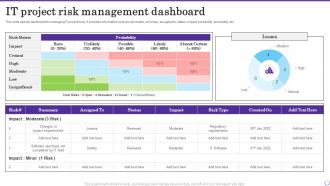
This slide depicts dashboard for managing IT project risks. It provides information such as risk matrix, summary, assigned to, status, impact, probability, probability, etc.
People who downloaded this PowerPoint presentation also viewed the following :
IT Project Risk Management Dashboard with all 7 slides:
Use our IT Project Risk Management Dashboard to effectively help you save your valuable time. They are readymade to fit into any presentation structure.






FAQs for IT Project
Key components of an effective risk management plan include risk identification, assessment and analysis, mitigation strategies, monitoring systems, and contingency planning. These elements work together by establishing clear protocols, enabling proactive decision-making, and creating systematic responses to potential threats, with many organizations finding that comprehensive planning ultimately delivers operational resilience and competitive advantage.
Organizations identify project risks through systematic risk assessment methodologies, stakeholder consultations, historical data analysis, environmental scanning, and regular project reviews. These approaches enable teams to uncover financial, operational, technical, and regulatory threats early, with many companies finding that proactive identification reduces project delays by 30% and enhances overall success rates.
Effective risk assessment tools include risk matrices, Monte Carlo simulations, scenario analysis, SWOT analysis, and fault tree analysis. These techniques enable organizations to quantify potential threats, model probability outcomes, and prioritize mitigation strategies, with many financial institutions and manufacturing companies finding that systematic assessment approaches significantly reduce operational losses while enhancing strategic decision-making capabilities.
Risk tolerance varies significantly across industries based on regulatory requirements, operational complexity, and customer impact expectations. Financial services and healthcare maintain extremely low risk tolerance due to strict compliance demands, while technology and manufacturing sectors often embrace higher risk levels for innovation and competitive advantage, ultimately balancing growth opportunities with operational stability.
Communication serves as the foundation of successful risk management by enabling transparent information sharing, facilitating stakeholder alignment, ensuring timely escalation of threats, and coordinating response strategies across all organizational levels. Through effective communication protocols, organizations streamline risk assessment processes, enhance decision-making speed, and build comprehensive awareness, with many companies finding that clear communication channels ultimately deliver faster threat resolution and stronger organizational resilience.
Organizations prioritize risks by evaluating probability and potential impact, categorizing threats into high, medium, and low priority levels, and considering regulatory requirements and strategic objectives. Through risk matrices and quantitative assessments, companies like financial institutions and healthcare organizations allocate resources to critical vulnerabilities first, ultimately optimizing protection while maintaining operational efficiency.
Common pitfalls include inadequate risk identification, poor communication across departments, over-reliance on historical data, insufficient scenario planning, and lack of regular process updates. These challenges can significantly impact operational efficiency, with many organizations finding that streamlined communication protocols, comprehensive assessment frameworks, and proactive monitoring systems ultimately deliver better decision-making capabilities and enhanced competitive advantage.
Technology enhances risk management strategies by automating threat detection, providing real-time analytics, and enabling predictive modeling across operations. Through AI and machine learning, organizations streamline compliance monitoring, accelerate incident response, and minimize human error, with many financial institutions and healthcare providers finding that automated systems deliver faster risk assessment and significantly improved regulatory compliance.
Stakeholder involvement ensures comprehensive risk identification, diverse perspectives, and shared ownership of mitigation strategies, while enhancing decision-making quality and organizational buy-in. Through collaborative risk assessments, organizations streamline communication, improve resource allocation, and build stronger resilience frameworks, with many financial institutions and healthcare systems finding that inclusive approaches deliver faster threat responses and sustained competitive advantage.
Regulatory compliance shapes risk management practices by mandating specific frameworks, reporting standards, and monitoring protocols that organizations must integrate into their operations. These requirements drive banks, healthcare systems, and financial institutions to implement comprehensive audit trails, enhanced transparency measures, and systematic risk assessment processes, ultimately delivering stronger governance and competitive advantage in increasingly regulated markets.
Key metrics include risk-adjusted returns, Value at Risk (VaR), probability of default rates, incident frequency and severity, and cost-benefit ratios of mitigation efforts. These measurements enable organizations to assess portfolio performance, operational resilience, and strategic effectiveness, with many financial institutions and healthcare systems finding that comprehensive metric frameworks ultimately deliver enhanced decision-making and competitive advantage.
Scenarios and simulations enhance risk analysis by modeling potential outcomes, testing strategic responses, and quantifying impact probabilities across various business conditions. Through advanced modeling techniques, organizations can evaluate market volatility, operational disruptions, and financial exposures before they occur, while enabling proactive decision-making, ultimately delivering more robust risk mitigation strategies and competitive preparedness.
Best practices for developing a risk response strategy include conducting comprehensive risk assessments, establishing clear risk tolerance levels, creating detailed response plans for each identified risk, implementing continuous monitoring systems, and ensuring stakeholder communication protocols. These practices enable organizations to proactively address potential threats through mitigation, avoidance, or acceptance strategies, ultimately delivering operational resilience and competitive advantage.
Cultural factors influence risk perception in global projects by shaping communication styles, decision-making processes, hierarchy respect levels, and uncertainty tolerance across different regions. Western teams often emphasize individual accountability and direct communication, while Asian cultures may prioritize collective consensus and relationship preservation, ultimately requiring project managers to adapt risk assessment frameworks and mitigation strategies for cross-cultural effectiveness.
Failed risk management case studies reveal that inadequate risk assessment, poor communication across departments, and lack of senior leadership engagement are primary failure factors. These lessons emphasize the importance of comprehensive risk frameworks, regular monitoring systems, and cross-functional collaboration, with many organizations finding that proactive risk cultures and integrated planning ultimately deliver better crisis resilience and competitive advantage.
-
My search for complete decks ended with SlideTeam. Such a surplus collection of HD PowerPoints. Moreover, their standard and widescreen formats have helped me in delivering bullseye presentations.
-
Great experience, I would definitely use your services further.