

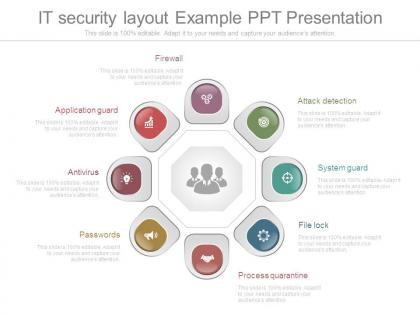
It security layout example ppt presentation




Try Before you Buy Download Free Sample Product
 Impress Your
 Audience
 100%
100% Editable
 Save Hours
 of Time


Convince folks you have an agile brain with our It Security Layout Example Ppt Presentation. Indulge in intelligent arguments.
People who downloaded this PowerPoint presentation also viewed the following :
It security layout example ppt presentation with all 7 slides:
Acquaint yourself with events gone by through our It Security Layout Example Ppt Presentation. It enables you to check back.
FAQs for It security layout
Key components of an effective IT security layout include firewalls, intrusion detection systems, endpoint protection, access controls, and network segmentation. These technologies work together by monitoring traffic patterns, restricting unauthorized access, and isolating critical systems, with many organizations finding that this layered approach significantly reduces vulnerability exposure while streamlining incident response capabilities.
Risk assessment fundamentally shapes IT security layout by identifying vulnerabilities, determining threat priorities, and establishing protection requirements across network segments, endpoints, and data flows. Through comprehensive risk analysis, organizations strategically position firewalls, access controls, and monitoring systems while implementing layered defenses, ultimately creating resilient architectures that balance security effectiveness with operational efficiency.
Network segmentation enhances IT security by isolating critical systems, containing potential breaches, and limiting lateral movement of cyber threats across infrastructure. Through strategic network division, organizations can control access permissions, monitor traffic more effectively, and minimize attack surfaces, with many financial institutions and healthcare providers finding that segmented architectures significantly reduce incident response times and compliance risks.
Organizations ensure compliance by implementing comprehensive security frameworks, conducting regular audits, maintaining detailed documentation, establishing access controls, and creating incident response protocols. These measures enable businesses to meet regulatory requirements like GDPR, HIPAA, and SOX while streamlining compliance processes, with many financial services and healthcare institutions finding that strategic security layouts ultimately deliver reduced risk exposure and operational efficiency.
Physical security best practices for IT security layouts include controlled access systems, environmental monitoring, surveillance cameras, secure equipment placement, and backup power solutions. These measures work by restricting unauthorized entry, protecting against environmental threats, and ensuring continuous operations, with many organizations finding that strategic physical barriers, biometric controls, and redundant systems significantly reduce security breaches while enhancing overall infrastructure resilience.
Balancing usability and security involves implementing layered authentication, intuitive security interfaces, role-based access controls, and user-friendly encryption methods that don't impede workflow. Through strategic design choices, organizations streamline security protocols while maintaining robust protection, with many finding that seamless integration ultimately enhances user adoption and reduces security vulnerabilities across their operations.
Modern IT security layouts should integrate firewalls, intrusion detection systems, endpoint protection, multi-factor authentication, and zero-trust network architectures. These technologies work together by creating layered defenses, monitoring suspicious activities, and verifying user identities, with many organizations finding that this comprehensive approach significantly reduces breach risks while maintaining operational efficiency.
Incident response plans integrate into IT security frameworks through defined escalation procedures, automated threat detection systems, communication protocols, and recovery workflows. These components streamline organizational responses by establishing clear roles, enabling rapid containment, and coordinating cross-functional teams, with many enterprises finding that integrated frameworks significantly reduce breach impact and restore operations faster.
Common vulnerabilities in IT security layouts include weak network segmentation, inadequate access controls, unpatched systems, insufficient endpoint protection, and poor data encryption practices. These weaknesses create entry points for cyber threats, with many organizations finding that addressing these vulnerabilities through layered security approaches significantly reduces breach risks while enhancing overall operational resilience.
User training significantly enhances IT security layout effectiveness by reducing human error vulnerabilities, improving threat recognition capabilities, and ensuring proper protocol adherence across all security layers. Well-trained employees become active security participants rather than weak links, with organizations finding that comprehensive training programs can reduce security incidents by up to 70%, ultimately strengthening the entire security infrastructure.
Cloud solutions fundamentally reshape traditional IT security by shifting from perimeter-based defense to zero-trust architectures, distributed monitoring, and identity-centric access controls. This transformation enables organizations across healthcare, finance, and retail to implement dynamic threat detection, automated compliance monitoring, and scalable security protocols, ultimately delivering enhanced protection while reducing infrastructure costs and complexity.
Organizations can adapt their IT security layout through continuous threat assessment, regular security audits, implementing zero-trust architecture, updating security protocols, and integrating AI-driven threat detection systems. These adaptive strategies enable businesses to proactively identify vulnerabilities, respond faster to emerging threats, and maintain robust defenses, with many financial institutions and healthcare organizations finding that dynamic security frameworks ultimately deliver enhanced protection and operational resilience.
Key metrics for evaluating IT security layout effectiveness include incident response times, threat detection rates, system vulnerability assessments, compliance audit scores, and user access management efficiency. These measurements enable organizations to streamline security operations, minimize breach risks, and enhance overall protective capabilities, with many enterprises finding that comprehensive metric tracking ultimately delivers improved operational resilience and competitive advantage.
Remote work IT security challenges include endpoint vulnerability management, unsecured network connections, device compliance monitoring, identity verification complexities, and data access control across distributed teams. These security gaps expose organizations to increased cyber threats, with many companies finding that traditional perimeter-based defenses require comprehensive restructuring to deliver effective protection and maintain operational security in decentralized work environments.
Automation tools enhance IT security layout reliability by continuously monitoring network traffic, automatically detecting threats, and implementing immediate response protocols without human intervention. These technologies streamline incident response, reduce false positives, and ensure consistent policy enforcement across complex infrastructures, with many organizations finding that automated systems deliver faster threat resolution and significantly improved operational efficiency.
-
Visually stunning presentation, love the content.
-
Easily Understandable slides.