

IT Service Management Process Model





Try Before you Buy Download Free Sample Product
 Impress Your
 Audience
 100%
100% Editable
 Save Hours
 of Time


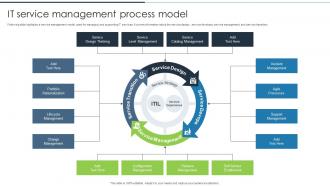
Following slide highlights a service management model used for managing and supporting IT services. It covers information about the service design , service develops, service management, and service transition.
People who downloaded this PowerPoint presentation also viewed the following :
IT Service Management Process Model with all 6 slides:
Use our IT Service Management Process Model to effectively help you save your valuable time. They are readymade to fit into any presentation structure.





FAQs for IT Service
Key components of an effective ITSM process model include incident management, problem management, change management, configuration management, and service level management, along with request fulfillment and knowledge management capabilities. These components work together by streamlining service delivery, minimizing downtime, and enhancing user experiences, with many organizations finding that integrated ITSM frameworks ultimately deliver improved operational efficiency and strategic competitive advantage.
ITIL framework significantly influences ITSM process model design by providing standardized best practices, structured service lifecycle approaches, and proven methodologies for incident management, change management, and service delivery. Organizations leverage ITIL's comprehensive guidelines to streamline operations, enhance service quality, and ensure consistent processes across departments, with many enterprises finding that ITIL-aligned models deliver improved efficiency and measurable business outcomes.
Automation enhances ITSM processes by streamlining incident resolution, accelerating service requests, and minimizing manual errors across IT operations. Through automated workflows and AI-powered tools, organizations achieve faster ticket routing, proactive system monitoring, and consistent service delivery, with many IT departments finding that automation reduces response times by up to 60% while improving overall operational efficiency.
Organizations measure ITSM implementation success through key performance indicators like incident resolution times, service availability percentages, customer satisfaction scores, and cost per ticket metrics. These measurements enable IT departments to track operational efficiency improvements, identify bottlenecks in service delivery, and demonstrate tangible value to stakeholders, ultimately delivering enhanced user experiences and strategic business alignment.
Common ITSM integration challenges include resistance to change, data silos, inconsistent processes, legacy system compatibility issues, and inadequate stakeholder training across departments. Organizations often find that addressing these hurdles through phased implementation, comprehensive change management, and cross-functional collaboration ultimately delivers streamlined operations, improved service delivery, and enhanced organizational efficiency.
ITSM process models facilitate improved incident management by providing structured workflows for detection, categorization, prioritization, and resolution of IT issues. These frameworks enable organizations to minimize downtime, automate escalation procedures, and maintain comprehensive incident tracking, with many financial services and healthcare institutions finding that standardized processes reduce resolution times by up to 40% while enhancing service reliability.
Essential ITSM lifecycle tools include service desk platforms, configuration management databases (CMDBs), monitoring and alerting systems, automation tools, and knowledge management systems. These technologies streamline incident resolution, asset tracking, and service delivery by centralizing information, automating routine tasks, and enabling proactive monitoring, with many organizations finding that integrated ITSM suites ultimately deliver faster service restoration and enhanced operational efficiency.
Continual service improvement can be embedded through regular performance monitoring, feedback loops, process reviews, and systematic data analysis integrated at each ITSM lifecycle stage. Organizations implement measurement frameworks, conduct periodic assessments, and establish improvement committees that evaluate service metrics, identify optimization opportunities, and drive iterative enhancements, ultimately delivering enhanced operational efficiency and superior customer experiences.
Adopting Agile methodology transforms ITSM processes by accelerating incident resolution, enhancing cross-functional collaboration, and enabling iterative service improvements through shorter development cycles. This approach streamlines traditional ITSM workflows, with many IT organizations finding that Agile practices reduce change management bottlenecks, improve customer feedback integration, and ultimately deliver more responsive, adaptive service delivery capabilities.
ITSM process models support change management by establishing structured workflows for evaluating, approving, and implementing IT changes while minimizing risks and disruptions. These frameworks enable organizations to assess change impacts, coordinate cross-functional teams, and maintain detailed audit trails, with many enterprises finding that standardized change processes reduce deployment failures and enhance operational stability.
Best practices for documenting ITSM process workflows include creating standardized templates, defining clear roles and responsibilities, mapping decision points and escalation paths, establishing version control systems, and incorporating visual flowcharts. These documentation approaches streamline operations by enhancing process transparency, reducing training time, and enabling consistent service delivery, with many IT organizations finding that comprehensive workflow documentation significantly improves incident resolution times and overall operational efficiency.
User feedback significantly influences ITSM process model evolution by identifying service gaps, highlighting inefficiencies, and revealing changing business requirements through surveys, incident reports, and satisfaction metrics. This continuous input enables organizations to refine workflows, automate repetitive tasks, and enhance service delivery mechanisms, with many IT departments finding that user-driven insights ultimately streamline operations and improve overall service quality.
Governance establishes clear accountability, standardized procedures, and performance metrics that ensure ITSM processes align with business objectives and deliver consistent service quality. Through structured oversight frameworks, organizations can monitor compliance, optimize resource allocation, and drive continuous improvement initiatives, with many enterprises finding that strong governance reduces operational risks while enhancing service delivery efficiency and stakeholder satisfaction.
Organizations align ITSM processes with business objectives by establishing clear service level agreements, implementing performance metrics that reflect business outcomes, and ensuring IT services directly support strategic goals. This alignment enables businesses to streamline operations, reduce costs, and enhance customer experiences, with many companies finding that integrated ITSM frameworks ultimately deliver competitive advantage and measurable ROI.
Future ITSM process model trends include AI-driven automation, cloud-native architectures, DevOps integration, self-service capabilities, and predictive analytics. These technologies streamline service delivery by reducing manual interventions, accelerating incident resolution, and enhancing user experiences, with many organizations finding that strategic automation ultimately delivers significant cost reductions and competitive advantage.
-
The designs by SlideTeam are honestly the best I have seen so far. Will be definitely coming back for more.
-
Amazing product with appealing content and design.