


ITIL 4 Implementation Plan Powerpoint Presentation Slides




Try Before you Buy Download Free Sample Product
 Impress Your
 Audience
 100%
100% Editable
 Save Hours
 of Time


Explore our ITIL 4 Implementation Plan PowerPoint presentation, which explains how to implement the ITIL 4 process in an organization. In this ITIL 4 Implementation Guideline Plan, we have covered the key challenges that organizations experienced, various performance tracking metrics, and performance gap analysis. This ITIL 4 Management Practice PPT also demonstrates the ITIL 4 adoption strategy and existing ITIL 3 model framework. It also discusses the project implementation process, which involved implementing the ITIL 4 dimension, service value system, and service value chain. Furthermore, this ITIL 4 Framework template caters to scenarios after integrating ITIL 4 implementation in the organizational networks based on several parameters. Moreover, this ITIL 4 Service Value Chain Deck comprises a budget overview, including estimated costs for ITIL 4 implementation and employee training. Lastly, our Service Design PowerPoint Presentation contains a performance tracking dashboard and the impact of ITIL 4 deployment on the organization. Download our 100 percent editable and customizable template, also compatible with Google Slides.
People who downloaded this PowerPoint presentation also viewed the following :
Content of this Powerpoint Presentation
Slide 1: This slide introduces ITIL 4 Implementation Plan. State Your Company Name and begin.
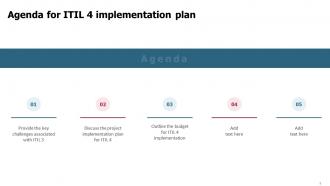
Slide 2: This slide is an Agenda slide. State your agendas here.
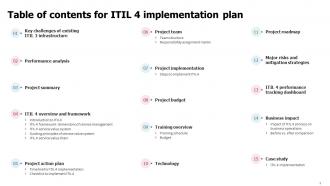
Slide 3: This slide shows a Table of Contents for the presentation.
Slide 4: This slide is an introductory slide.
Slide 5: This slide discusses the issues faced by the organization in ITIL 3.
Slide 6: This slide is an introductory slide.
Slide 7: This slide indicates the performance analysis of the organization’s current ITIL 3 infrastructure process and further recommended solution.
Slide 8: This slide is an introductory slide.
Slide 9: This slide represents the summary of the ITIL 4 implementation project providing information of problems faced, recommended solution, etc.
Slide 10: This slide is an introductory slide.
Slide 11: This slide explains the ITIL 4 that helps navigate the fourth industrial revolution and incorporates modern IT approaches.
Slide 12: This slide explores four dimensions of service management in ITIL4 and its implementation process.
Slide 13: This slide includes the service value system of Information Technology Infrastructure Library 4.
Slide 14: This slide puts the guiding principles of the service value system of Information Technology Infrastructure Library 4.
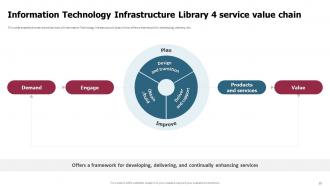
Slide 15: This slide entails the service value chain of Information Technology Infrastructure Library 4 that offers a framework for developing, delivery, etc.
Slide 16: This slide is an introductory slide.
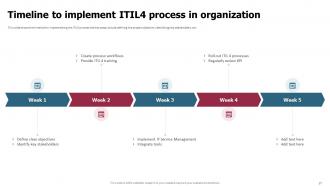
Slide 17: This slide shows the timeline for implementing the ITIL4 process the key steps include defining the project objective, identifying key stakeholders, etc.
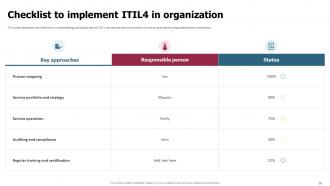
Slide 18: This slide represents the checklist for implementing and deploying the ITIL4 in an enterprise environment with its key approaches.
Slide 19: This slide is an introductory slide.
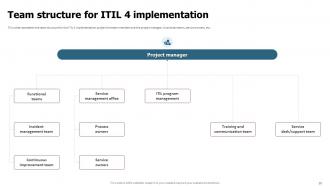
Slide 20: This slide presents the team structure for the ITIL 4 implementation project.
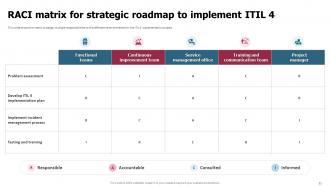
Slide 21: This slide shows the matrix to assign multiple responsibilities to the different team members for the ITIL 4 implementation project.
Slide 22: This slide is an introductory slide.
Slide 23: This slide discusses the key revolutionary steps of ITIL4 technology implementation.
Slide 24: This slide describes the key revolutionary steps of ITIL4 technology implementation; these are defining KPIs, assign roles, develop communication, etc.
Slide 25: This slide is an introductory slide.
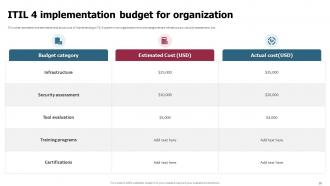
Slide 26: This slide represents the estimated and actual cost of implementing a ITIL 4 system in an organization.
Slide 27: This slide is an introductory slide.
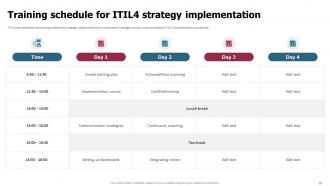
Slide 28: This slide presents the training schedule for strategy implementation for customers to manage, monitor, and troubleshoot ITIL 4 implementation procedures.
Slide 29: This slide showcases the breakdown cost for the ITIL 4 installation and management training for the customers.
Slide 30: This slide is an introductory slide.
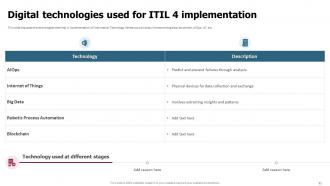
Slide 31: This slide discusses the technologies that help in implementation of Information Technology Infrastructure Library 4.
Slide 32: This slide is an introductory slide.
Slide 33: This slide highlights the project roadmap to implement the ITIL4 plan in an organization.
Slide 34: This slide is an introductory slide.
Slide 35: This slide describes the challenges faced while implementing ITIL 4 process the components are risk, probability of occurrence, impact, etc.
Slide 36: This slide is an introductory slide.
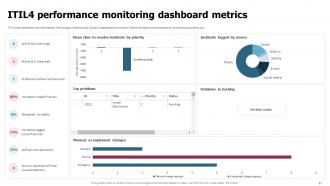
Slide 37: This slide represents the Information Technology Infrastructure Library 4 dashboard to monitor the performance the components include top problems, etc.
Slide 38: This slide is an introductory slide.
Slide 39: This slide explains the impact of ITIL 4 in terms of improved service quality, efficiency and cost reduction, customer experience, etc.
Slide 40: This slide puts the comparative analysis of the before versus after ITIL 4 implementation plan in organization with its various aspects.
Slide 41: This slide is an introductory slide.
Slide 42: This slide outlines an overview of Easy Pay company, which faces various challenges, it also proved different solutions and outcomes.
Slide 43: This slide shows all the icons included in the presentation.
Slide 44: This slide is titled Additional Slides for moving forward.
Slide 45: This slide is a Location slide with maps to show data related to different locations.
Slide 46: This slide shows Post-It Notes. Post your important notes here.
Slide 47: This slide is an Idea Generation slide to state a new idea or highlight information, specifications, etc.
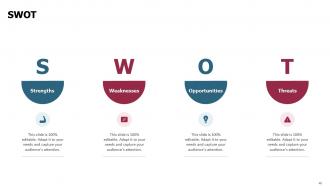
Slide 48: This slide shows SWOT describing- Strength, Weakness, Opportunity, and Threat.
Slide 49: This slide is Our Target slide. State your targets here.
Slide 50: This slide is a Timeline slide. Show data related to time intervals here.
Slide 51: This slide contains a Puzzle with related icons and text.
Slide 52: This slide is a financial slide. Show your finance-related stuff here.
Slide 53: This slide is a thank-you slide with address, contact numbers, and email address.
ITIL 4 Implementation Plan Powerpoint Presentation Slides with all 61 slides:
Use our ITIL 4 Implementation Plan Powerpoint Presentation Slides to effectively help you save your valuable time. They are readymade to fit into any presentation structure.






























FAQs for ITIL 4 Implementation Plan
ITIL 4's key components include the service value system, four dimensions of service management, guiding principles, governance, service value chain, and continual improvement practices. These elements work together by aligning IT services with business outcomes, streamlining operations through integrated workflows, and enabling scalable service delivery, with many organizations finding that strategic implementation enhances customer satisfaction while reducing operational costs.
ITIL 4's flexible, principle-based framework allows organizations to adapt its practices through selective implementation, custom workflows, and industry-specific modifications that align with existing processes, regulatory requirements, and business objectives. Many healthcare systems, financial institutions, and manufacturing companies successfully tailor ITIL 4 by integrating compliance standards, adjusting service value chains, and customizing governance structures, ultimately delivering enhanced operational efficiency while maintaining their unique organizational culture and strategic priorities.
Common ITIL 4 implementation challenges include resistance to cultural change, insufficient stakeholder buy-in, inadequate training resources, complex process integration, and unrealistic timeline expectations. Organizations address these by establishing cross-functional change management teams, investing in comprehensive staff education programs, adopting phased rollout approaches, and maintaining regular communication channels, with many finding that early wins and visible improvements help sustain momentum throughout transformation.
ITIL 4 facilitates digital transformation by integrating agile practices, emphasizing value streams, and promoting collaborative cross-functional teams that accelerate service delivery. Through its flexible framework, organizations streamline operations, enhance customer experiences, and adapt quickly to market changes, with many enterprises finding that ITIL 4's holistic approach ultimately delivers competitive advantage and operational resilience.
ITIL 4 promotes continuous improvement through its guiding principles of progress iteratively with feedback, collaborate and promote visibility, and focus on value, while embedding improvement practices across all service value chain activities. These approaches enable organizations to systematically identify inefficiencies, streamline processes, and enhance service delivery, with many enterprises finding that regular improvement cycles ultimately deliver greater operational efficiency and stronger competitive advantage.
Leadership plays a crucial role in ITIL 4 implementation by driving cultural transformation, securing necessary resources, and establishing clear governance frameworks that align IT services with business objectives. Through strategic commitment and change management expertise, leaders enable cross-functional collaboration, streamline service delivery processes, and ultimately deliver enhanced operational efficiency and customer experiences across the organization.
Organizations measure ITIL 4 implementation success through key performance indicators like incident resolution times, service availability percentages, customer satisfaction scores, mean time to recovery, and change success rates. These metrics enable businesses to track operational efficiency improvements, cost reductions, and enhanced service delivery, with many finding that regular assessment against baseline measurements demonstrates tangible ROI and competitive advantage.
Tools that complement ITIL 4 processes include service management platforms, automation software, AI-powered analytics, cloud infrastructure solutions, and integrated monitoring systems. These technologies streamline incident management, enhance service delivery, and automate routine tasks, with many organizations finding that strategic combinations ultimately deliver faster resolution times and improved customer experiences.
ITIL 4 integrates with Agile and DevOps through its flexible service value system, shared practices like continuous improvement and collaboration, and emphasis on iterative delivery cycles. This strategic combination enables organizations to streamline development processes, enhance operational efficiency, and accelerate service delivery, with many technology companies finding that unified frameworks ultimately deliver faster deployment and improved customer experiences.
Effective ITIL 4 training strategies include role-based learning paths, hands-on workshops, mentorship programs, gamified learning modules, and cross-functional team exercises. These approaches enhance understanding by combining theoretical knowledge with practical application, while many organizations find that blended learning formats with real-world case studies deliver faster competency development and improved service management adoption.
Stakeholder engagement throughout ITIL 4 implementation can be ensured through regular communication workshops, cross-functional steering committees, role-based training programs, feedback collection mechanisms, and milestone celebration events. These approaches streamline buy-in by involving stakeholders in decision-making, addressing concerns proactively, and demonstrating value early, with many organizations finding that sustained engagement ultimately delivers smoother transitions and higher adoption rates.
Organizations avoiding ITIL 4 practices face significant operational risks including inefficient service delivery, poor incident response, inadequate change management, limited scalability, and reduced customer satisfaction. Without these frameworks, companies struggle with siloed operations, reactive rather than proactive service management, and difficulty adapting to digital transformation demands, ultimately losing competitive advantage in increasingly complex technology environments.
The service value system provides the holistic framework for ITIL 4 implementation by integrating guiding principles, governance structures, service value chain activities, and continual improvement practices. Governance influences implementation through strategic oversight, risk management, and resource allocation decisions, with many organizations finding that strong governance accelerates transformation while ensuring alignment with business objectives and stakeholder expectations.
Major banks like JPMorgan Chase have streamlined incident management and change processes, while healthcare systems such as Kaiser Permanente enhanced service delivery through ITIL 4's value streams approach. These organizations achieved 30-40% faster resolution times, improved customer satisfaction scores, and better alignment between IT services and business outcomes, with many finding that the framework's flexibility enables continuous service improvement.
ITIL 4 practices enhance customer experience by aligning service delivery with business outcomes, streamlining incident response, and implementing continuous feedback loops for service improvement. Through service design thinking and customer journey mapping, organizations can proactively address pain points, reduce resolution times, and deliver more personalized services, ultimately building stronger customer relationships and competitive advantage.
-
Nice and innovative design.
-
The visual appeal of the templates is just unparalleled! I was so worried about the design of my presentation but SlideTeam made it all so easy.