

Kaizen Implementation Challenges Training Ppt




Try Before you Buy Download Free Sample Product
 Impress Your
 Audience
 100%
100% Editable
 Save Hours
 of Time


This set of slides in-depth covers the challenges faced while implementing Kaizen for continuous improvement. These are lack of adequate resources for its implementation, miscalculation in goal setting, insufficient management support, and lack of training on Kaizen.
People who downloaded this PowerPoint presentation also viewed the following :
Content of this Powerpoint Presentation
Slide 2
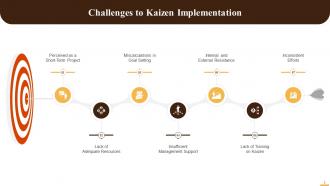
This slide showcases challenges faced while implementing Kaizen. These are that Kaizen is perceived as a short-term project; lack of adequate resources for its implementation; miscalculation in goal setting; insufficient management support; internal and external resistance; lack of training on Kaizen, and inconsistent efforts.
Challenges to Kaizen implementation are:
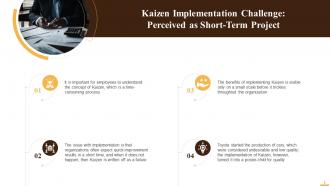
Kaizen is Perceived as Short Term Project:
- It is important for employees to understand the concept of Kaizen, which requires time
- The issue with implementation is that organizations often expects quick improvement results in a short time; when this does not happen, then Kaizen is written off as a failure
- The benefits of implementing Kaizen usually appear, first, on a small scale, on a small scale before it propagates throughout the organization
- Toyota started the production of cars which were considered undesirable and low quality, but with the implementation of Kaizen, it turned out to be the poster child for quality
Lack of Adequate Resources:
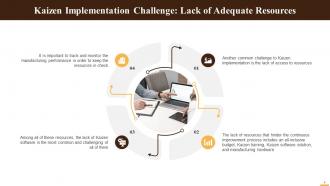
- Another common challenge to Kaizen implementation is the lack of access to resources
- Lack of resources that hinder the continuous improvement process is manifested in an all-inclusive budge . Then, organizations are also able to allocate special resources for Kaizen training, Kaizen software solution, and manufacturing hardware
- Among all of these resources, the lack of Kaizen software is the most common and challenging resources that plagues adoption of the technique
- It is important to track and monitor manufacturing performance to ensure organizations overcome this resistance to allocate resources
Miscalculations in Goal Setting:
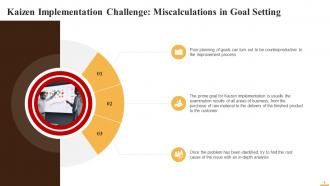
- Poor planning of goals can turn out to be counterproductive to the improvement process
- The prime goal for Kaizen implementation is to improve important metrics of all aspects of businesses, from the purchase of raw material to the delivery of finished products to the customer
- Once the problem has been identified, try to find the root cause of the issue with an in-depth analysis
Insufficient Management Support:
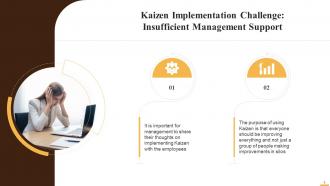
- It is important for the management to share their thoughts on implementing Kaizen with the employees
- The purpose of using Kaizen is that everyone should be improving everything and not just a group of people making improvements in silos
Internal and External Resistance:
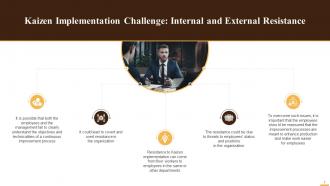
- It is possible that both the employees and the management fail to clearly understand the objectives and technicalities of the continuous improvement process
- It could lead to covert and overt resistance in the organization
- Resistance to Kaizen implementation can come from floor workers to employees in the same or other departments
- The resistance could be due to threats to employees' status and positions in the organization
- To overcome such issues, it is important that employees are reassured that the improvement processes are meant to improve production and make work easier for the employees
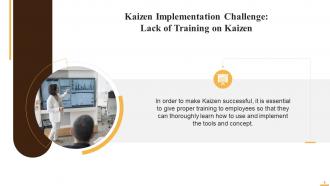
Lack of Training on Kaizen:
- In order to make Kaizen successful, it is essential to give proper training to employees so that they can thoroughly learn how to implement the tools and concept
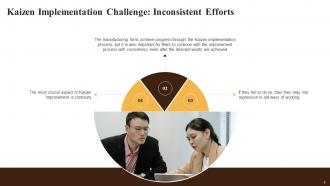
Inconsistent Efforts:
- The most crucial aspect of Kaizen improvement is continuity
- Manufacturing firms achieve progress through the Kaizen implementation process, but it is also important for them to continue with the process with consistency even after the desired results are achieved
- If they fail to do so, then they may risk regression to older, inefficient ways of working
Slide 3
This slide provides information on Kaizen implementation challenge, which is that it is perceived as a short-term project. It also explains that it is important for employees to understand the concept of Kaizen, which requires time.
Slide 4
This slide provides information on lack of adequate resources, as a major challenge to Kaizen implementation.
Slide 5
This slide provides information on miscalculations in goal-setting, a challenge for the Kaizen implementation process. It illustrates that poor planning of goals can turn out to be counterproductive to the improvement process.
Slide 6
This slide provides information on insufficient management support, a challenge for the Kaizen implementation. It also highlights that it is vital for the management to share their thoughts on implementing Kaizen with its employees.
Slide 7
This slide provides information on internal and external resistance, a challenge for the Kaizen implementation process. It also exemplifies that both the employees and regulatory bodies may fail to understand the objectives and technicalities of this continuous improvement process, another cause for resistance.
Slide 8
This slide provides information on the lack of training provided on Kaizen as a challenge for its implementation. It also explains that to make Kaizen successful, it is essential to give employees proper training so they can use and implement the tools and concepts.
Slide 9
This slide provides information on inconsistent efforts as a challenge for Kaizen implementation.
Kaizen Implementation Challenges Training Ppt with all 28 slides:
Use our Kaizen Implementation Challenges Training Ppt to effectively help you save your valuable time. They are readymade to fit into any presentation structure.












FAQs for Kaizen Implementation
Key obstacles include employee resistance to change, inadequate leadership commitment, insufficient training programs, cultural misalignment with continuous improvement principles, and lack of systematic measurement frameworks. These challenges often manifest in manufacturing, healthcare, and service sectors, where organizations struggle with sustaining momentum, securing cross-departmental participation, and translating initial enthusiasm into long-term behavioral shifts, ultimately requiring strategic change management approaches.
Company culture can hinder Kaizen implementation through resistance to change, hierarchical communication barriers, fear of job displacement, and lack of employee empowerment in decision-making processes. Organizations with rigid structures often struggle to embrace continuous improvement principles, with many finding that cultural transformation requires sustained leadership commitment, comprehensive training programs, and gradual mindset shifts to achieve meaningful operational enhancement.
Effective strategies for overcoming employee resistance include comprehensive training programs, transparent communication about benefits, involving employees in problem identification, creating recognition systems for participation, and demonstrating quick wins. Through collaborative workshops and leadership commitment, organizations streamline change adoption while building trust, with many manufacturing and service companies finding that employee-led improvement teams ultimately deliver sustained engagement and operational excellence.
Leadership can support Kaizen by providing clear vision, allocating necessary resources, actively participating in improvement activities, recognizing employee contributions, and maintaining consistent commitment to continuous improvement principles. Conversely, leadership undermines efforts through inconsistent messaging, failing to model improvement behaviors, or prioritizing short-term results over long-term cultural transformation, with many organizations finding that sustained executive engagement ultimately determines whether Kaizen delivers lasting operational excellence and competitive advantage.
Training and education serve as foundational pillars for successful Kaizen adoption, providing employees with continuous improvement methodologies, problem-solving techniques, waste identification skills, and collaborative approaches essential for sustainable transformation. Through comprehensive training programs, organizations enhance employee engagement, streamline operational processes, and build improvement-focused cultures, with many manufacturing and service companies finding that well-educated teams deliver significantly higher implementation success rates.
Organizations can measure Kaizen effectiveness through key performance indicators like productivity rates, defect reduction percentages, employee engagement scores, cost savings metrics, and cycle time improvements. These measurements enable continuous monitoring of operational efficiency, with many manufacturing and service organizations finding that combining quantitative data with employee feedback surveys ultimately delivers comprehensive insights into process optimization and competitive advantage.
Common Kaizen misinterpretations include viewing it as a one-time project rather than continuous improvement, expecting immediate dramatic results instead of gradual progress, implementing top-down mandates without employee engagement, and focusing solely on cost-cutting rather than holistic process enhancement. These misconceptions create resistance and unrealistic expectations, with many organizations finding that successful Kaizen requires cultural transformation, consistent leadership commitment, and employee empowerment to deliver sustainable operational improvements.
Communication barriers significantly undermine Kaizen outcomes by preventing effective idea sharing, reducing employee engagement in continuous improvement processes, and creating misalignment between team members and management objectives. These obstacles often result in slower problem identification, inconsistent implementation of improvement suggestions, and decreased participation in kaizen events, with many organizations finding that enhanced communication training and structured feedback systems ultimately deliver better collaborative outcomes and more sustainable operational improvements.
Hierarchical structures can significantly impact Kaizen execution by creating communication barriers, slowing decision-making processes, and limiting employee empowerment to suggest improvements. However, organizations with strong leadership commitment often overcome these challenges by establishing cross-functional teams, encouraging bottom-up feedback, and implementing structured continuous improvement programs, ultimately delivering enhanced operational efficiency and employee engagement across all organizational levels.
Lack of resources significantly constrains Kaizen initiatives by limiting employee participation in improvement activities, reducing training opportunities, and preventing proper implementation of identified solutions. Organizations with tight budgets often struggle to dedicate staff time for continuous improvement workshops, while insufficient funding hampers the purchase of necessary tools or technologies, ultimately slowing progress and diminishing long-term competitive advantages.
Long-term Kaizen momentum requires regular celebration of small wins, continuous employee training programs, leadership reinforcement through visible participation, and systematic progress tracking with visual management boards. These techniques work together by maintaining engagement, building capabilities, and demonstrating commitment, with many manufacturing and service organizations finding that consistent recognition and skill development ultimately delivers sustained improvement cultures and competitive operational advantages.
Varying employee engagement levels significantly impact Kaizen success, as disengaged workers resist continuous improvement initiatives, contribute fewer suggestions, and maintain status quo behaviors. While highly engaged employees drive innovation and embrace change, mixed engagement creates inconsistent implementation across departments, with organizations finding that comprehensive training, clear communication, and leadership support help bridge engagement gaps, ultimately delivering more sustainable improvements.
Manufacturing faces equipment downtime during process changes, while healthcare encounters patient safety concerns and regulatory compliance issues. Financial services struggle with risk management protocols and data security requirements, and retail operations must balance customer service continuity with staff training, ultimately requiring tailored approaches that address each sector's unique operational constraints and stakeholder expectations.
Organizations ensure sustainable Kaizen improvements by embedding continuous monitoring systems, establishing regular review cycles, training employees as improvement champions, and integrating changes into standard operating procedures. Through systematic documentation and measurement protocols, companies across manufacturing, healthcare, and financial services create accountability structures that prevent regression, while empowering teams to identify new optimization opportunities, ultimately delivering lasting operational efficiency and competitive advantage.
Feedback serves as the critical measurement and adjustment mechanism in Kaizen implementation, enabling teams to identify process gaps, validate improvement effectiveness, and guide iterative refinements. Through regular employee input, performance metrics, and stakeholder evaluations, organizations can continuously optimize their improvement initiatives, ensuring sustainable change and measurable results while building stronger engagement across all organizational levels.
-
Appreciate the research and its presentable format.
-
Stunning collection! With a wide variety of options available, I was able to find a perfect slide for my presentation. Thank you, SlideTeam!