

Key B2B Ecommerce Business Models Business To Business E Commerce Management




Try Before you Buy Download Free Sample Product
 Impress Your
 Audience
 100%
100% Editable
 Save Hours
 of Time


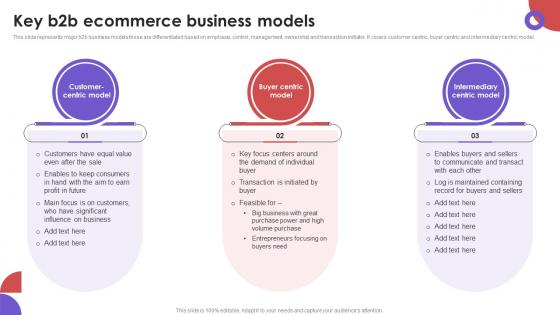
This slide represents major b2b business models those are differentiated based on emphasis, control, management, ownership and transaction initiator. It covers customer centric, buyer centric and intermediary centric model.
People who downloaded this PowerPoint presentation also viewed the following :
Key B2B Ecommerce Business Models Business To Business E Commerce Management with all 6 slides:
Use our Key B2B Ecommerce Business Models Business To Business E Commerce Management to effectively help you save your valuable time. They are readymade to fit into any presentation structure.





FAQs for Key B2B Ecommerce Business Models Business To Business
B2B eCommerce involves complex purchasing processes, bulk orders, longer sales cycles, and relationship-based transactions between businesses, while B2C focuses on individual consumers with simpler, emotion-driven purchases. B2B platforms typically feature custom pricing, credit terms, and integration capabilities, whereas B2C emphasizes user experience and instant gratification, with B2B ultimately delivering higher transaction values and strategic partnerships.
B2B marketplace models function as digital platforms connecting multiple suppliers with business buyers, facilitating transactions through centralized infrastructure, payment processing, and logistics coordination. While these platforms enable broader market reach, streamlined procurement processes, and reduced operational costs for participants, they also present challenges including increased competition among suppliers and platform dependency, with many businesses finding that strategic marketplace participation ultimately delivers enhanced visibility and access to new customer segments.
Subscription-based models in B2B eCommerce provide predictable revenue streams, enhanced customer retention, and streamlined procurement processes for recurring business needs like software licenses, industrial supplies, and maintenance services. Through automated billing, usage-based pricing tiers, and value-added services, companies in manufacturing, healthcare, and professional services deliver consistent value while reducing acquisition costs, ultimately building stronger client relationships and sustainable competitive advantages.
The direct sales model in B2B involves manufacturers selling products directly to business customers through dedicated sales teams, online platforms, and direct relationships, bypassing intermediaries like distributors or retailers. This approach enables companies to maintain greater control over pricing, customer relationships, and brand messaging, while delivering higher profit margins and faster customer service, with many organizations finding that direct engagement ultimately enhances customer loyalty and competitive positioning.
Leveraging dropshipping in B2B eCommerce presents both significant opportunities and operational considerations, including reduced inventory costs, faster market entry, expanded product catalogs, and streamlined fulfillment processes. While this model enables businesses to scale rapidly without substantial upfront investment, it also requires careful supplier management and quality control, with many B2B companies finding success through strategic partnerships that ultimately deliver enhanced flexibility and competitive advantage.
B2B companies ensure pricing transparency through automated quote systems, tiered pricing displays, real-time inventory updates, contract management platforms, and personalized customer portals that show negotiated rates. These digital tools streamline negotiations by enabling dynamic pricing adjustments, automated approval workflows, and transparent communication channels, with many organizations finding that integrated platforms reduce negotiation cycles while enhancing customer trust and operational efficiency.
Implementing a hybrid B2B/B2C model presents challenges including managing different customer expectations, maintaining separate pricing structures, balancing complex logistics requirements, and integrating distinct sales processes. While B2B customers expect bulk pricing and personalized service, B2C consumers prioritize convenience and speed, with many organizations finding that strategic technology investments and scalable platforms ultimately deliver operational efficiency and expanded market reach.
B2B companies can optimize supply chain processes through eCommerce platforms by automating procurement workflows, implementing real-time inventory tracking, integrating supplier networks, and enabling demand forecasting analytics. These digital solutions streamline operations by reducing manual processing times, enhancing supplier collaboration, and providing end-to-end visibility, with manufacturers and distributors finding significantly improved efficiency and cost reduction across their supply networks.
Essential technologies for B2B eCommerce include enterprise resource planning (ERP) systems, customer relationship management (CRM) platforms, API integration tools, automated inventory management, and secure payment gateways. These technologies streamline operations by enabling real-time data synchronization, personalizing buyer experiences, and automating order processing, with many organizations finding that strategic integration ultimately delivers enhanced operational efficiency and competitive advantage.
CRM systems integrate with B2B eCommerce platforms through API connections, real-time data synchronization, automated workflows, and unified customer databases that consolidate purchase history, preferences, and interactions. This strategic combination enables sales teams to deliver personalized experiences, streamline order processing, and enhance customer service, with many organizations finding that integrated systems significantly improve operational efficiency and drive higher customer retention rates.
Personalized experiences in B2B eCommerce significantly enhance customer engagement, streamline procurement processes, and drive higher conversion rates by delivering tailored product recommendations, customized pricing, and relevant content based on buyer behavior and preferences. Through advanced analytics and AI-driven platforms, businesses create more efficient purchasing journeys, reduce decision-making time, and ultimately strengthen client relationships while gaining competitive advantage in increasingly complex B2B markets.
B2B businesses measure eCommerce success through key performance indicators including conversion rates, average order value, customer acquisition costs, customer lifetime value, and sales cycle length. These metrics enable organizations to track revenue growth, operational efficiency, and customer satisfaction, with many companies finding that integrated analytics platforms streamline performance monitoring while ultimately delivering strategic insights for competitive advantage.
Globalization significantly transforms B2B eCommerce business models by expanding market reach, enabling cross-border transactions, streamlining international supply chains, and facilitating real-time global partnerships. These developments allow businesses to access diverse supplier networks, reduce procurement costs, and serve international clients seamlessly, ultimately delivering competitive advantages and operational efficiency in an increasingly interconnected marketplace.
B2B companies should focus on relationship-building through educational content, account-based marketing, and longer nurture sequences, while B2C firms prioritize immediate conversions and emotional appeals. Through LinkedIn campaigns, webinars, and industry-specific case studies, B2B organizations build trust and authority over extended sales cycles, ultimately delivering higher-value partnerships with decision-making committees rather than individual consumers.
Emerging trends in B2B eCommerce include AI-powered personalization, subscription-based models, marketplace integration, mobile-first experiences, and self-service portals. These technologies streamline procurement processes, enhance customer experiences, and automate routine transactions, with many organizations finding that strategic adoption delivers improved operational efficiency and competitive advantage in increasingly digital markets.
-
Incredibly beautiful designs that will help you get noticed! These eye-catching templates are perfect for corporate presentations that can be altered to fit any occasion or taste.
-
Illustrative design with editable content. Exceptional value for money. Highly pleased with the product.