

Key Challenges Of Augmented Analytics Accuracy Ppt Infographics




Try Before you Buy Download Free Sample Product
 Impress Your
Audience
 100%
Editable
 Save Hours
of Time


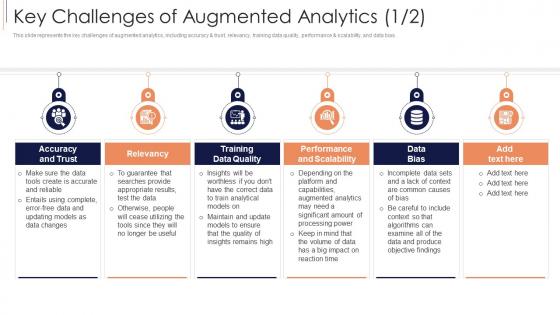
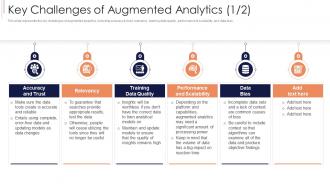
This slide represents the key challenges of augmented analytics, including accuracy and trust, relevancy, training data quality, performance and scalability, and data bias.
People who downloaded this PowerPoint presentation also viewed the following :
Key Challenges Of Augmented Analytics Accuracy Ppt Infographics with all 6 slides:
Use our Key Challenges Of Augmented Analytics Accuracy Ppt Infographics to effectively help you save your valuable time. They are readymade to fit into any presentation structure.





FAQs for Key Challenges Of Augmented Analytics
Augmented analytics accuracy depends on data quality, algorithm selection, feature engineering, training dataset size, and model validation processes. These factors work together to minimize bias and improve predictive performance, with organizations in healthcare, finance, and retail finding that comprehensive data preprocessing, continuous model retraining, and robust validation frameworks ultimately deliver more reliable insights and better decision-making outcomes.
Data quality and preprocessing significantly impact augmented analytics effectiveness by ensuring clean, consistent datasets that enable accurate pattern recognition, reliable predictions, and trustworthy insights. Poor data quality leads to flawed automated recommendations and misleading visualizations, while comprehensive preprocessing through data cleansing, normalization, and validation enhances algorithm performance, ultimately delivering more precise business intelligence and strategic decision-making capabilities.
Augmented analytics mitigates human bias through automated pattern recognition, statistical validation algorithms, diverse data sampling techniques, and machine learning models that identify interpretation inconsistencies. These systems enable organizations to uncover objective insights by standardizing analytical processes, flagging potential cognitive biases, and providing multiple analytical perspectives, ultimately delivering more accurate business intelligence and strategic decision-making capabilities.
Machine learning enhances augmented analytics accuracy by automatically detecting data patterns, identifying anomalies, and continuously refining predictive models through iterative learning processes. These algorithms minimize human error, adapt to changing data landscapes, and improve pattern recognition over time, with financial services and healthcare organizations finding that ML-driven analytics deliver significantly more precise insights and reliable forecasting capabilities.
Organizations can evaluate augmented analytics reliability through data quality audits, model validation testing, cross-referencing insights with historical trends, and implementing human oversight protocols. Through A/B testing and performance monitoring, companies in finance and retail track prediction accuracy rates, compare automated insights against known outcomes, and establish confidence thresholds, ultimately ensuring strategic decisions rest on trustworthy, validated intelligence.
Common pitfalls include poor data quality, insufficient data cleansing, biased training datasets, inadequate model validation, and lack of user context awareness. These issues can significantly impact decision-making accuracy, with many organizations finding that investing in robust data governance, regular model updates, and comprehensive user training ultimately delivers more reliable insights and competitive advantage.
Real-time data integration significantly enhances augmented analytics accuracy by providing current information for analysis, eliminating data lag, and enabling continuous model updates based on fresh inputs. This approach allows financial institutions to detect fraud patterns immediately, helps retailers adjust pricing strategies dynamically, and enables healthcare systems to monitor patient conditions continuously, ultimately delivering more precise insights and faster decision-making capabilities.
Validation techniques include cross-validation with historical data, A/B testing against traditional methods, statistical significance testing, domain expert reviews, and comparative analysis across multiple algorithms. These approaches enhance reliability by identifying potential biases, confirming pattern accuracy, and ensuring model robustness, with many organizations finding that multi-layered validation ultimately delivers greater confidence and strategic decision-making capabilities.
User behaviors and interactions significantly impact augmented analytics outcomes by influencing data quality, query formulation, and interpretation patterns. When users consistently engage with relevant data sources, provide feedback on insights, and ask strategic questions, these systems learn and adapt, delivering increasingly accurate predictions and recommendations, with many organizations finding that active user engagement enhances analytical precision by over forty percent.
Algorithm selection significantly impacts augmented analytics accuracy by determining data processing methods, pattern recognition capabilities, predictive modeling precision, and insight generation quality. Machine learning algorithms like neural networks, decision trees, and ensemble methods each excel in different scenarios, with financial institutions finding that strategic algorithm combinations enhance fraud detection accuracy while retail companies leverage clustering algorithms for customer segmentation, ultimately delivering more reliable business intelligence.
Augmented analytics platforms ensure compliance through automated data governance, encryption protocols, role-based access controls, anonymization techniques, and audit trails that track data usage. These systems enable organizations to maintain analytical accuracy while meeting GDPR, HIPAA, and other regulatory requirements, with many financial services and healthcare institutions finding that automated compliance features streamline reporting without compromising insights.
Visual representation significantly influences perceived accuracy through chart selection, color schemes, scale manipulation, and data aggregation levels, with misleading visuals potentially distorting interpretations. Well-designed dashboards in financial services and healthcare enhance trust by presenting clear trends and outliers, while poor visualization choices can undermine confidence in otherwise accurate analytics, ultimately affecting strategic decision-making across organizations.
User feedback significantly enhances augmented analytics accuracy by enabling continuous model refinement, identifying data quality issues, validating automated insights, and correcting algorithmic biases. Through iterative feedback loops, organizations can recalibrate their analytics engines, improve prediction reliability, and ensure insights align with business realities, with many companies finding that user-driven refinements ultimately deliver more actionable intelligence and competitive advantage.
Emerging technologies enhancing augmented analytics accuracy include advanced machine learning algorithms, natural language processing, automated data preparation, real-time streaming analytics, and explainable AI frameworks. These innovations work together by reducing human error, accelerating pattern recognition, and improving data quality, with financial services and healthcare organizations finding that automated insights deliver significantly faster decision-making and enhanced predictive capabilities.
Businesses maximize insight accuracy by implementing automated data processing with human oversight for complex interpretations, strategic context validation, and exception handling. This strategic combination enables faster analysis while maintaining analytical rigor, with many financial services and healthcare organizations finding that human experts focusing on high-value decision-making, rather than routine data tasks, ultimately delivers superior accuracy and competitive advantage.
-
I discovered this website through a google search, the services matched my needs perfectly and the pricing was very reasonable. I was thrilled with the product and the customer service. I will definitely use their slides again for my presentations and recommend them to other colleagues.
-
It makes easy work of my work presentations. I’ve never had to be nervous about my presentations for meetings.